

On this page
- The short answer, and the two things you are actually matching
- What 5W-30 tells you, and what it leaves out
- The ACEA class, and why it is the half that decides it
- Manufacturer approvals sit on top of the ACEA class
- Where your car writes it down
- Before you buy an unfamiliar brand, there is a UK register that tests these claims
- Can I use a different grade? The substitution questions, answered honestly
- How much your engine takes, and why people overfill it
- What can happen when the wrong oil goes in
- Booking it in: what to ask for, and what it should cost
- Frequently asked questions
The short answer, and the two things you are actually matching
You're at the shelf with a bottle in each hand. Both say 5W-30, one costs noticeably more, and it isn't obvious why. That's the question behind every search for what oil for my car, and the answer comes in two parts.
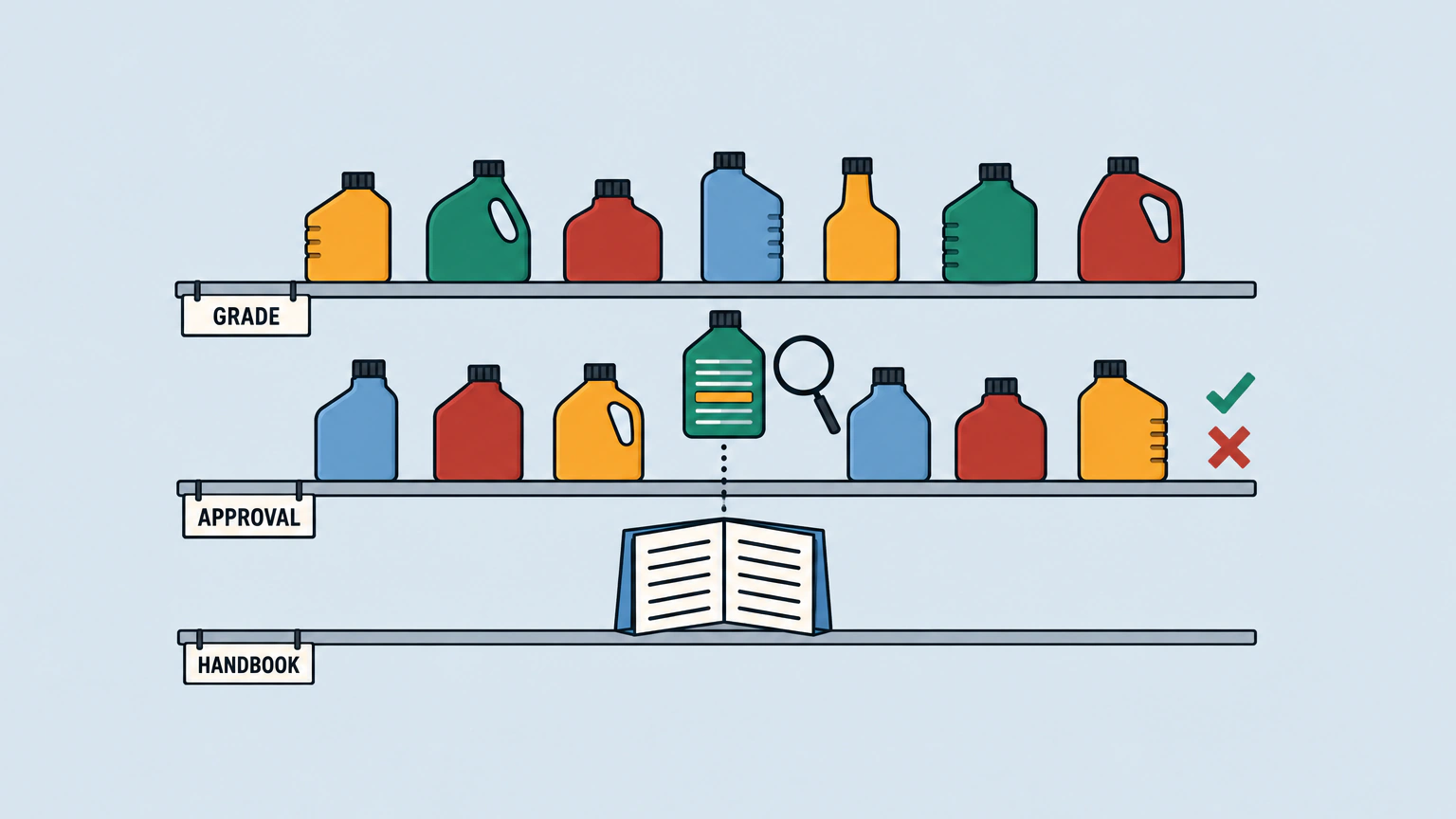
Your car asks for two things, not one: a viscosity grade like 5W-30, and a specification, which is either an ACEA class such as C3 or your manufacturer's own approval code. Both of them are printed in your handbook, and a bottle is only right for your engine if it lists both, which is why two bottles that both say 5W-30 can be entirely different oils.
The grade is the easy half, and it's the part you'll spot first. The specification is the half that decides it. On a bottle, look for an ACEA class, a carmaker's approval code, or both. For the car, look in the handbook, on a label near the oil filler cap on some cars, and on your last invoice if the garage wrote it down.
Here's a real pairing. Mazda's handbook for the diesel CX-5 asks for ACEA C3, in 0W-30 or 5W-30. Match both halves and the price gap between two bottles stops being a mystery.
What 5W-30 tells you, and what it leaves out
Start with the grade, because it's a genuine standard. ACEA's own sequences don't redefine it. They point to the SAE J300 viscosity scale, so every 5W-30 has to meet the same definition. What the grade leaves out is everything else: how kind the oil is to an exhaust filter, say, or how thick it stays under the hardest load.
The two numbers, and which one matters on a January morning
Castrol explains the pair plainly. "The first number precedes the letter 'W' which stands for winter. This measurement is related to how an oil flows when it is cold, such as at engine start-up." The second, it says, "is defined by how an oil flows at normal engine operating temperatures." Lower means thinner.
On a frosty January morning, after a night sitting in the sump, the first number tells you how readily the oil gets moving when you turn the key. A 5W-30 flows more easily at start-up than a 10W-30. That's why some handbooks offer more than one grade with a temperature chart, and Mazda's tells owners to "select the recommended viscosity from the chart."
Why two bottles of the same grade are not interchangeable
Here's what the grade can't tell you. Every ACEA class sets a floor for high-temperature high-shear viscosity, or HTHS. ACEA measures it at 150°C with the oil being sheared extremely hard, so think of it as how thick the oil stays when it's hot and working its hardest. ACEA's current categories set these floors:
| ACEA category | SAPS level, in ACEA's words | Minimum HTHS viscosity or range | Built for |
|---|---|---|---|
| A3/B4 | High SAPS | 3.5 mPa·s | Stay in grade, petrol and light duty diesel, extended drain where specified |
| A5/B5 | High SAPS | 2.9 to 3.5 mPa·s | Extended drain, engines designed for low viscosity oils |
| A7/B7 | High SAPS | 2.9 to 3.5 mPa·s | As A5/B5, plus pre-ignition, wear and turbo deposit protection |
| C2 | Mid SAPS | 2.9 mPa·s | Filter compatible, extended drain, low viscosity engines |
| C3 | Mid SAPS | 3.5 mPa·s | Filter compatible, extended drain, thicker oil engines |
| C4 | Low SAPS | 3.5 mPa·s | Filter compatible, extended drain, thicker oil engines |
| C5 | Mid SAPS | 2.6 mPa·s | Fuel economy, filter compatible, engines approved for this low-viscosity oil |
| C6 | Mid SAPS | 2.6 mPa·s | As C5, plus pre-ignition, wear and turbo deposit protection |
| C7 | Mid SAPS | 2.3 mPa·s | Fuel economy, based on C6, for the thinnest grades |
Source: ACEA Oil Sequences for Light-Duty Engines, 2023 edition, consumer language and requirements tables.
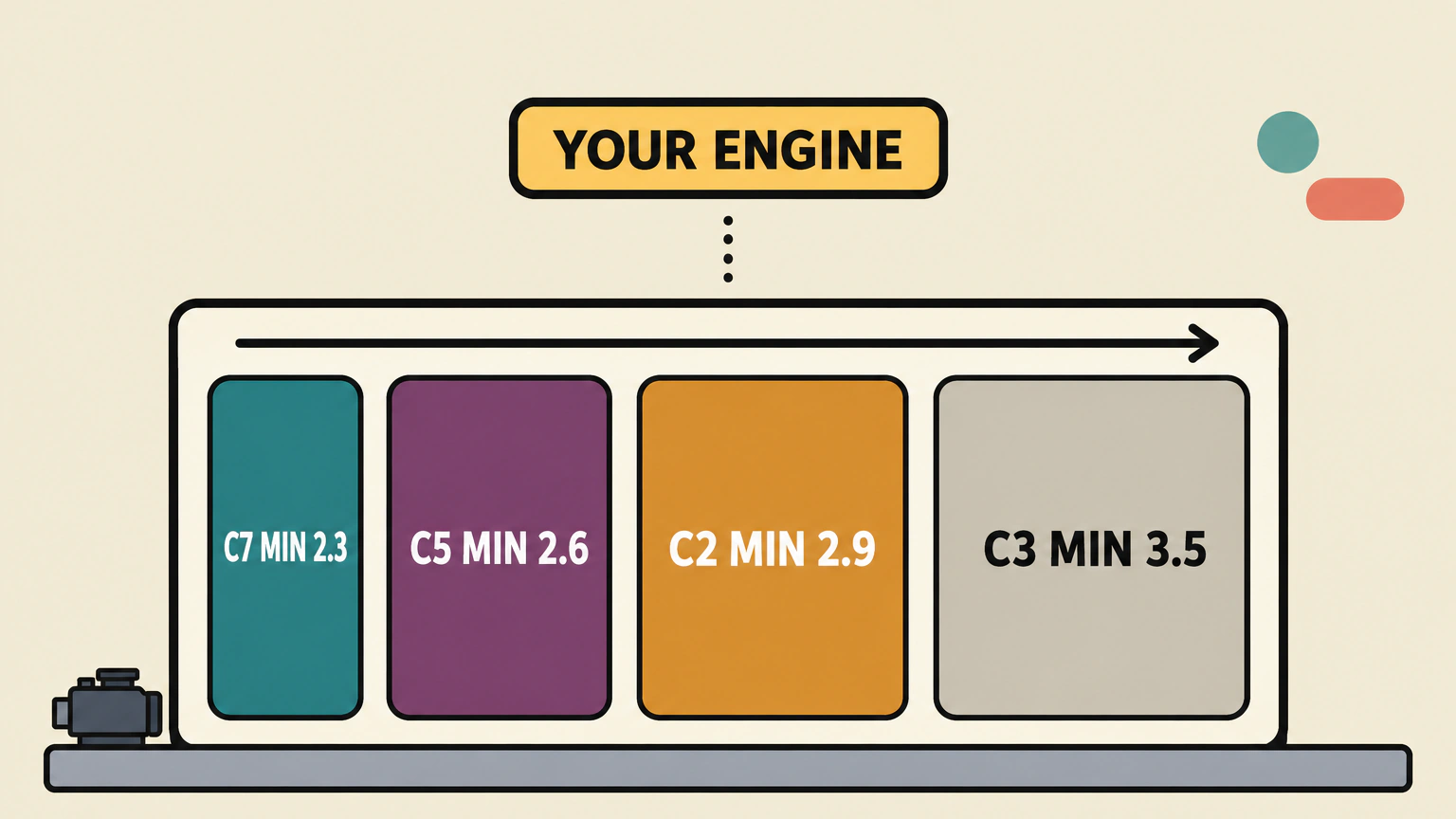
The floors differ by class. C3 has to reach at least 3.5 mPa·s and C5 only 2.6, a gap of 0.9. The grade won't tell you which floor an oil was built to. Only the class does.
And one grade really does come in several builds. Castrol's current UK Magnatec range alone lists six different 5W-30s: one each for A3/B4, A5/B5 and C2, one for C2 and C3 together, and two sold on carmaker approvals with no ACEA class listed. A C2 oil has to reach 2.9. A C3 oil has to reach 3.5.
The six C categories share just four floors between them. A3/B4 has its own 3.5 mPa·s minimum in ACEA's requirements table, even though the consumer summary leaves it out.
The ACEA class, and why it is the half that decides it
ACEA is the European Automobile Manufacturers' Association, the carmakers' own trade body, and its oil sequences are the European system. Pages written for American drivers talk about API ratings instead. ATIEL, the European lubricants industry body, runs the system oil companies sign up to when they claim an ACEA class.
The naming is simple. The letter is the class and the number is the category, so C3 is category 3 of class C. Our guide to the same question about coolant runs the other way, because there the colour on the bottle is a decoy. Here, the grade is real. It's just half the answer.
A and B, C, and what low SAPS is actually protecting
SAPS stands for sulphated ash, phosphorus and sulphur. ACEA heads its A/B oils "High SAPS" and says nothing about filters when it describes them. The C oils are the ones it calls "Catalyst and GPF/DPF compatible", built for cars with catalytic converters and particulate filters. "These oils will increase the DPF/GPF and TWC life and maintain the vehicle's fuel economy," it says.
The reason is ash. DieselNet, the engine-emissions reference, calls it "the incombustible material left behind following filter regeneration and soot oxidation", and names lubricant additives as generally its largest source. Regeneration burns soot. Ash stays.
There's a wrinkle in ACEA's own labelling. Its heading calls the whole C class "Low SAPS", yet its entries describe C2, C3, C5, C6 and C7 as mid SAPS. Only C4 is low SAPS.
What happens when an ACEA category is withdrawn
ACEA publishes in editions, and each one starts a clock on the last. Its rule reads: "When a new ACEA Oil Sequences is introduced, oils with claims against the previous issue can be marketed for another two years only." The last three editions for car engines:
| Sequence issue | Mandatory for new claims from | Oils with this claim could be marketed until |
|---|---|---|
| 2016 | 1 December 2017 | 1 May 2023 |
| 2021 | 1 May 2022 | 1 August 2025 |
| 2023 | 12 September 2024 | The current edition |
For categories that continue into the 2023 edition, new claims now have to meet the 2023 sequence. Categories drop out along the way. The 2021 edition withdrew A3/B3 and C1, and A1/B1 had already gone in 2016.
You won't usually see the edition on a bottle. ATIEL says the year number is for industry use, so a current continuing claim reads "C3", not "C3-23". Withdrawn categories work differently. ATIEL says a claim can remain valid when it comes from the last issue that carried that category, though only ACEA can give an authoritative interpretation. Match the category or approval in your handbook rather than rejecting an oil because its category is absent from the newest sequence.
The current edition carries nine categories, each with its own floor.
Manufacturer approvals sit on top of the ACEA class
This is the line the trade draws and consumer pages don't. An ACEA claim is the oil company's own declaration. ATIEL calls these claims "self-certifying", and says "ACEA 'approved', 'certified' or 'recommended' are not valid ways of making an ACEA claim."
A manufacturer approval is different. It is a claim against the carmaker's own requirements, and some carmakers publish lists of products carrying it. The approval code is the tighter match for that engine. ACEA itself says its members "may indicate performance parameters other than those covered by the tests shown or more stringent limits." Match only the class and you've matched the floor.
Approval codes have a recognisable shape. Three real ones, as examples only and not a recommendation for your car: VW 504 00, BMW Longlife-04, MB-Approval 229.51. One Castrol 5W-30 shows why the wording matters. After its list of specifications and approvals comes "Meets MB 229.31/ 229.52", then a line saying it's "Warranted by Castrol to be completely suitable" for two VW specifications. Approved, meets and warranted aren't the same promise. When your handbook gives a manufacturer code, match that code.
Where your car writes it down
The car and its paperwork usually settle it:
- Open the handbook at the maintenance or servicing section, not the introduction, and find the engine oil entry.
- Write down both parts: the grade, and every specification or approval code printed beside it, character for character.
- If the handbook gives a manufacturer code, that code is the one to match. An ACEA class on its own isn't a substitute for it.
- Open the bonnet and read the label on or near the oil filler cap, which on some cars repeats the same information.
- Check your last service invoice. It tells you what actually went in, which isn't always what should have.
- Run a registration lookup if you want a shortcut, then check its answer against what you wrote down in step two.
- If nothing in the car tells you and the handbook is gone, ring a garage or a main dealer parts desk with your registration.
The handbook, the filler cap and the service record
The handbook comes first because it's written for your engine. The oil entry sits with the maintenance pages or the specifications, usually as a short table of grade, class and code. What oil does my car take? That table is the answer.
The filler cap label is a useful check, but it doesn't replace the handbook. The service record answers a different question: what went in last time, not what should have. If the invoice names a brand but no specification, you've learned something about how that garage writes things down.
No handbook? Some carmakers put theirs online, and Mazda publishes its owner's manuals on a public site, specifications included. Failing that, ring a local garage with your registration.
Registration lookups: a good shortcut with a limit the tools state themselves
Plenty of people would rather type in a number plate, and a what oil for my car by reg search does exactly that. A car oil checker turns the registration into a make, model and engine, then matches it to the seller's own product list.
Castrol's own finder admits its limit. Asked what happens if your vehicle isn't listed, it answers: "We apologise we do not have specific product information for your vehicle at this time. Please consult your owner's manual for product recommendations." ACEA's current sequences say to consult the handbook in case of doubt three times over.
So use the lookup, then check it against what you wrote down. Never accept a result that contradicts a manufacturer code printed in the car.
If the car and the handbook both come up empty, a garage or a main dealer parts desk can look the specification up against your registration. That's a better answer than a guess.
Before you buy an unfamiliar brand, there is a UK register that tests these claims
Say the cheapest bottle is a brand you've never heard of, listing exactly the right code. Someone checks claims like that.
VLS, the Verification of Lubricant Specifications company, is a subsidiary of the UK Lubricants Association, so this is the oil trade checking its own claims. When a case is raised, it says it will respond "by independently investigating and checking compliance to industry standards and performance claims within the UK marketplace." The maker gets a right of reply. If nothing is put right, VLS passes what it found to the relevant authorities.
Its register holds 150 cases. Of those, 126 are archived, with the detail visible only to VLS's own committee, which leaves 24 on public view. Eighteen of those are 5W-30 engine oils. Seven of the 24 are marked not proven compliant and escalated to Trading Standards, and three of those seven are engine oils.
Read it fairly. Of the 20 visible cases with a verdict, 12 ended with the product found compliant. VLS also says it won't "Eradicate lower price value products which carry correct specification claims". Cheap isn't the complaint. Unproven is.
Before you pay, open the Case Outcomes page on the VLS site and search the brand or product name. Cases under investigation are anonymous, and so are some closed ones and every archived case, so a clean search isn't a certificate. It's one more check that costs nothing.
Can I use a different grade? The substitution questions, answered honestly
Swapping 5W-30 for 5W-40 is fine if your handbook lists 5W-40 for your engine. Mazda's gives grades by temperature range and warns that "Using oils of viscosity besides those recommended for specific temperature ranges could result in engine damage." If yours lists 5W-30 only, stay there.
Thicker isn't safer. Both oils carry the same 5W winter grade, but the 40 is thicker once the engine is warm. An engine built for a 30 was designed around the 30. That's a different oil, not an upgrade.
Topping up is where people get stuck. If the dipstick is at or below the minimum, don't keep driving on low. Castrol warns that low oil increases stress on the engine. Add only an oil your handbook allows. If the level is between the marks, add nothing and buy the right oil.
Once you've mixed in an oil the handbook doesn't list, you can't count on the sump meeting the required specification.
How much your engine takes, and why people overfill it
The handbook's specifications give a rough answer to how much oil your car needs. Mazda's gives two figures for the diesel CX-5, 5.1 litres with a new filter and 4.8 without, and heads the table "Approximate Quantities". The number gets you close, and the dipstick finishes the job.
After a drain, use the handbook's filling procedure. Castrol's top-up advice is to add a small amount, wait a minute or two for it to reach the sump, then re-read the dipstick. It's also blunt: "over-filling is as bad for your engine as under-filling; so don't treat the high level mark as a target."
The waiting is the step people skip. Oil still draining down makes the level look low, so in goes more. Makers also differ on when to read it. Mazda wants a warm engine switched off for at least five minutes on level ground, and Castrol's top-up guide wants a cool one after at least 20 minutes. Follow your handbook, and after a service, read your own dipstick. Garages can overfill too.
On some diesels a rising level is a warning in itself. Mazda's diesel dipsticks carry an extra "X" mark, and its handbook says oil above it should be replaced by a repairer. If your diesel's level climbs between services, get it looked at rather than draining a bit off.
What can happen when the wrong oil goes in
The effects of the wrong oil may not show themselves straight away.
The particulate filter is one risk. Mazda's handbook for its 2.2 diesel says that with oil other than the specified one, "the Diesel Particulate Filter effective period of use will be shortened or the Diesel Particulate Filter may be damaged." Ash from the oil's additives stays in the filter, and regeneration can't burn it out.
Then protection. An engine that calls for C3's 3.5 mPa·s floor won't get that minimum from an oil that only meets C5. Mazda also ties keeping its maintenance interval to oil of the correct specification, so a long interval on the wrong oil gives both problems longer to work.
Red flag: Stop topping up and get the car checked if a diesel's oil level keeps rising between services. Mazda treats oil at its X mark as a reason to replace it. If the invoice names a brand but no specification, ask the garage to identify exactly what it used.
A belt inside the oil can be damaged by contaminated oil, and belt debris can block the oil-pump strainer. Check whether your car has a belt running in oil. Where a diesel has a particulate filter, the MOT fails visible smoke of any colour, and what an emissions failure actually means covers that test.
If you know the wrong oil has just gone in, contact a garage before driving. It may need to be drained and refilled with the right specification.
Booking it in: what to ask for, and what it should cost
When you book, give the grade and the specification from the handbook, code included, and ask the garage to confirm the oil they'll use carries it. That gets you what your car asks for rather than whatever's on the shelf.
Then ask for the specification on the invoice. We'd put that ahead of any brand preference. It's your record, it tells the next garage what went in, and it's evidence if something goes wrong. If an invoice names no specification and the engine has suffered, start with putting a bad repair right.
Across 583 of our own cost profiles for oil and filter changes, the typical price is £55 to £113 and the average £83, with the full spread running from £41 to £216. It's our figure for the category, priced to a location, so read it as a guide and compare oil and filter servicing near you.
If a service is due anyway, a garage that does full servicing will do both in one visit. With room to work safely around the car, an oil change is a driveway job. Anything needing the car in the air wants a ramp, and for the rest, a mobile mechanic can come to you.
Frequently asked questions
Can I mix two different brands of engine oil?
Brand isn't what matters. Grade and specification are. Two brands are both suitable only if each matches the required grade and approval. Mix one that carries the approval with one that doesn't, and you can't count on the result meeting that approval. Top up with the same specification where you can.
Is 5W-40 thicker than 5W-30, and does that matter?
Yes at running temperature, and yes, it matters. Both oils carry the same 5W winter grade, while a 40 has the higher viscosity band once the engine is warm. An engine specified for a 30 was designed around that band, so thicker isn't a margin of safety. If your handbook lists 5W-40 for your engine, use it. If not, stick to the grade it gives.
What happens if I put the wrong oil in my car?
You may notice nothing on day one. Risks include ash collecting in a particulate filter, an oil that misses the engine's HTHS minimum, or a long service interval on an oil not specified for it. Contact a garage before driving if the oil does not meet the required specification.
Does the MOT check my engine oil?
Not its condition or its grade, no. GOV.UK is plain that "The test does not cover the condition of the engine, clutch or gearbox." But the inspection manual lets a tester refuse to test a car that "is not fit to be driven when necessary to complete the test because of a lack of fuel, or oil". So the MOT won't tell you whether your oil is right, and it can still turn you away for having too little.
How often should I change my engine oil in the UK?
On the schedule in your handbook. Where it gives both a mileage and a time, whichever comes first is the one that counts, and on a car that covers few miles it's usually the time. A long-life schedule only works if the oil carries the specification it assumes, and Mazda's handbook ties its maintenance interval directly to oil of the correct specification.
Is fully synthetic always better than semi synthetic?
No. The test is whether the bottle carries the grade and specification your car asks for. The marketing description on the front does not replace those requirements.