

On this page
- The short answer, and the one place your car writes it down
- Colour is a dye, not a specification
- Find the code your car actually asks for
- The four families behind the codes
- Test what is already in there, before the first frost
- Why more antifreeze is not more protection
- Topping up: water, concentrate and ready mixed
- What goes wrong when the wrong coolant goes in
- If a garage put the wrong coolant in your car
- Booking it in: what to ask for, and what it should cost
- Frequently asked questions
The short answer, and the one place your car writes it down
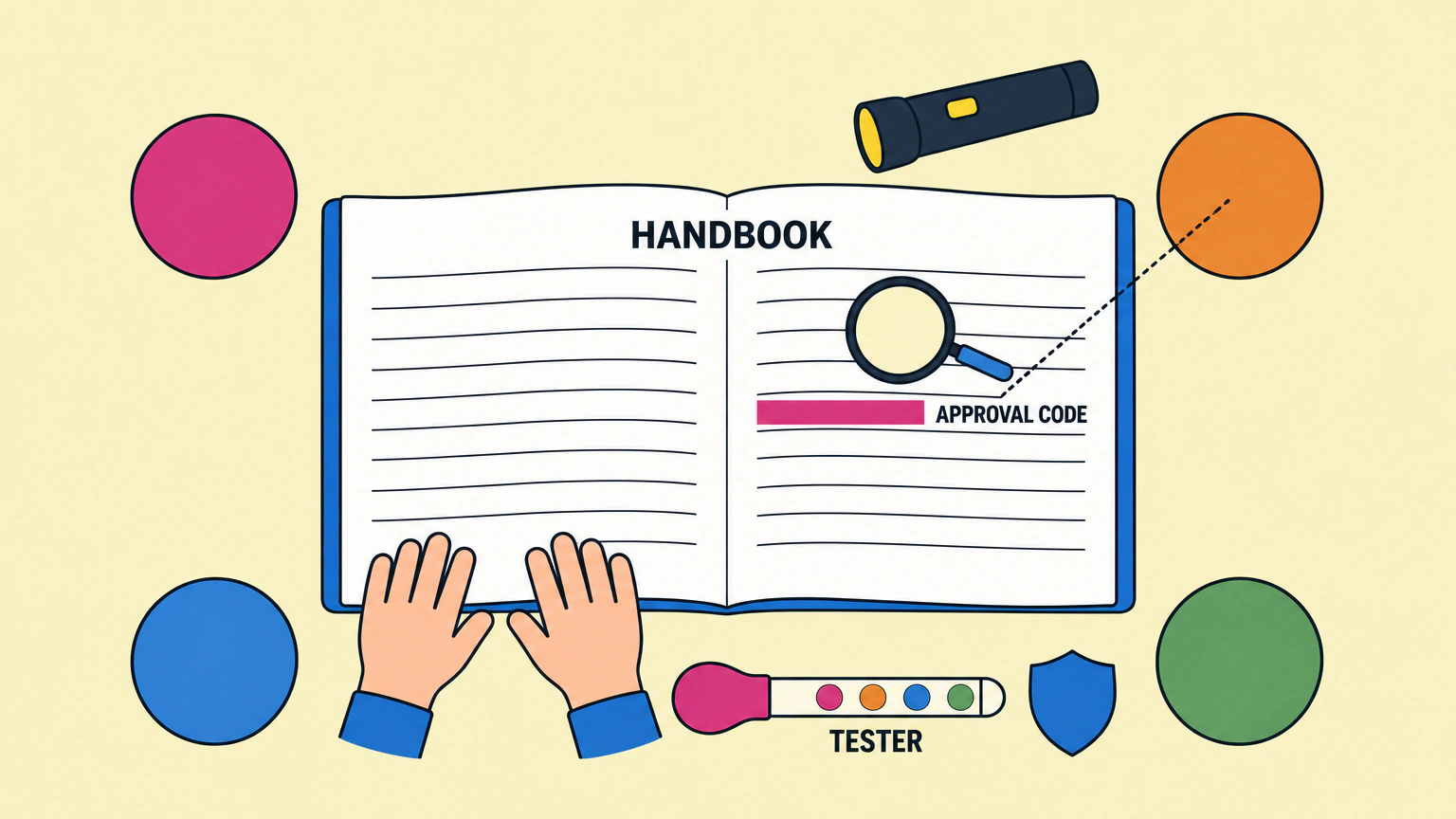
Stand at the antifreeze shelf in October and you'll meet four bottles in four colours and one question: what coolant does my car need? Your car doesn't ask for a colour. It asks for a specification, a short code printed in the handbook or on a label under the bonnet, and the only job of the bottle is to list that code among its approvals. Before you buy anything, though, spend two minutes finding out whether what's already in there is still strong enough for winter, because a £17 tester answers that and a colour never will.
The code lives in three places: the handbook's fluids table, a label on or near the expansion tank on some cars, and the carmaker's own service information, which a dealer can read against your registration. The colour of the fluid isn't one of them. The AA is plain: "The colour of the antifreeze isn't proof of the type or quality of product that was used."
Colour is a dye, not a specification
Colour is a starting point, and that's all. Enilive, the Eni group's lubricants business, says colours "generally" match the additives inside, then admits "this is not a strict rule". BASF, which makes Glysantin coolant, notes that carmakers write the dye into their specifications. It still says a coolant's colour "does not identify the chemical and technical properties" of the fluid.
Why two bottles of the same colour can be wrong for each other
The protection comes from corrosion inhibitors, not dye. Caltex, which sells Havoline coolant, puts that additive package at only about 2.5% of a ready-to-use coolant, with water and glycol making up the rest.
Those packages grew up around local water. Phosphates leave scale in hard water, so Caltex says phosphate hybrids aren't used in Europe but suit most of Asia, where the water is soft. Silicates went the other way. Silicated hybrids are mostly European, and in Japan, Caltex says, trouble with water pump seals and heat transfer led to a ban on silicate coolants.
None of that shows in the colour. The AA's own colour guide gives blue to both traditional inorganic coolant and silicated long-life coolant, and Enilive lists pink against three different long-life chemistries.
The British Standard on the bottle was withdrawn in 2015
BS 6580 is the British Standard you'll still see on antifreeze. BSI published the 2010 edition on 31 March 2010 and withdrew it on 31 August 2015. Its record names no successor.
When it was live, it set "minimum performance requirements and certain marking requirements" for concentrates used in "all types of liquid-cooled internal combustion engine". That's a floor for every engine. It was never a fit for yours.
It has not disappeared from current product literature. BASF's April 2022 data sheet for its G48 concentrate lists BS 6580:2010 among the standards met. A withdrawn standard on a label tells you nothing about your car.
Find the code your car actually asks for
The code your car needs is a dull string of letters and numbers. Volkswagen Group cars use a standard called TL 774 with a letter after it, and VW's own product names run G11, G12+, G12++, G13 and G12evo. Mercedes-Benz writes MB-Approval 325.0 or 325.6. Treat those as examples of the shape, not a shopping list.
Then turn the bottle round. A good approvals list names the carmaker, the code and often a date range, and a single letter matters. On BASF's lists, TL 774-C sits against Volkswagens built up to 1996 and TL 774-G against those built from September 2008. BASF says its coolant technologies "are not compatible" with each other. Carmakers don't "recommend" coolants, BASF adds. They grant approvals. So "approved" on a bottle beats "recommended".
It's the same lesson as your handbook's cambelt interval: the number your engine depends on sits in the paperwork, not on a part you can see.
Where the code is written down, and what to do if the handbook is gone
Start with the handbook, then any label near the expansion tank, then the service book and old invoices. Parts retailers' coolant-by-reg lookups make a sensible first filter, but treat the answer as a shortlist and check the approval on the bottle before you pay.
Without a handbook, the AA's advice is to check with a dealer. If nothing in the car tells you and the handbook's gone, a main dealer's parts desk or one of the local garages near you can look the specification up against your registration. That call is worth making before you pour anything in.
The four families behind the codes
Behind every code sits one of a few chemistries. Knowing them helps you read a label, but it doesn't replace the code.
- IAT, the traditional inorganic type, uses silicates and phosphates. Enilive says it's typical of cars from before the mid-1990s and has a shorter service life, and the AA gives it 2 to 3 years or 30,000 miles.
- OAT, organic acid technology, drops the silicates and phosphates. Enilive rates it for aluminium engines and modern cooling systems, and the AA says it can last up to 5 years or 150,000 miles.
- HOAT adds a little silicate or phosphate to an organic base for quicker protection. Enilive says it suits engines that mix iron and aluminium.
- Si-OAT is the silicated long-life version, which the AA calls common in European cars, particularly Volkswagen and Audi.
Lifespans vary by product. BASF recommends a complete coolant change every three to four years, so follow the interval in your handbook.
Hybrid and electric cars follow the same code rule, but they carry a high-voltage battery, so check whether a garage is trained for electric cars before you book a drain and refill.
Test what is already in there, before the first frost
Nothing on the dashboard tells you how strong your coolant is. The gauge and the heater can behave normally whether the mix is half and half or has had a summer of water top-ups. BASF adds a second reason to look: the antifreeze keeps working for a long time, but the corrosion inhibitors wear out. So test the strength every autumn, and change the coolant when the handbook says. Here's the cold-bonnet check.
- Engine stone cold. Not warm, not "it's been off an hour". Cold. The AA warns that a warm system can scald you with a sudden release of pressurised hot water.
- Find the expansion tank and read the level against its own min and max marks. It's the see-through bottle under the bonnet, and a level that keeps falling needs a garage.
- Unscrew the cap and look at its underside for sludge or grit before you look at anything else. A jelly-like film there is a red flag.
- Draw a sample into a clear glass or plastic container. You can't judge the colour or the debris through the tank wall. Pour it back slowly and check what's left in the bottom, with extra care for orange fluid, because rust is orange too.
- Squeeze the tester bulb, fill it, tap out the bubbles, and count the floating discs against the printed table.
- Write down the specification code from your handbook or the under-bonnet label before you go anywhere near a shop.
- Check whether the bottle you're about to buy is concentrate or ready mixed, because getting that wrong halves or doubles the strength of whatever you pour in.
Which tester to buy, and what it costs
A disc tester is the cheap option, and the one we'd start with. Sealey's AK4120 costs £17.34 including VAT and "checks condition of coolant antifreeze, hot or cold". You count how many of its six coloured discs float, then read the protection level off the table printed on its body.
The mistake that ruins a reading is the wrong glycol. The AK4120 is for ethylene glycol, the base of most car antifreeze, and Sealey sells a separate propylene glycol tester, the AK4122. They aren't interchangeable, so check which glycol your bottle names.
A refractometer is the upgrade. Sealey's VS005 costs £99.54, reads "the refractive index of light passing through the mixture", and is "suitable for synthetic antifreeze mixtures including long-life OAT (Organic Acid Technology) and G13".
Reading the result against a British winter
A proper half-and-half mix protects to about -37 °C. The coldest temperature ever recorded anywhere in the UK is -27.2 °C. That gap is useful margin, but it does not mean more concentrate is safer. Both a weak mix and an over-strong one can lose protection.
| Antifreeze in the mix, by volume | Freezes at about | What that means here |
|---|---|---|
| None, water only | 0 °C | Freezes and expands on the first hard frost |
| 20% | -7.9 °C | Fails on an ordinary cold snap |
| 30% | -13.7 °C | Short of every UK nation's record low, Northern Ireland's included |
| 40% | -23.5 °C | Close to the Welsh record, short of the Scottish one |
| 50% | -36.8 °C | Roughly ten degrees of margin on the UK record |
| 60% | -52.8 °C | The lowest point on the curve |
| 100%, neat concentrate | -12.8 °C | Worse than a 30% mix |
| Nation | Lowest recorded | Where | When |
|---|---|---|---|
| Scotland | -27.2 °C | Braemar, Aberdeenshire | 10 January 1982 |
| England | -26.1 °C | Newport, Shropshire | 10 January 1982 |
| Wales | -23.3 °C | Rhayader, Powys | 21 January 1940 |
| Northern Ireland | -18.7 °C | Castlederg, County Tyrone | 24 December 2010 |
Freezing points for ethylene glycol and water from Engineering Toolbox. Record lows from the Met Office.
Those are all-time records, not a normal winter, though Scotland has hit -27.2 °C three times. If your tester reads no better than about -14 °C, the 30% row, your coolant would freeze on a night every UK nation has already seen. We'd book a drain and refill before December rather than guess at a splash of concentrate.
Why more antifreeze is not more protection
This is the part that catches careful people out. On the standard ethylene glycol curve, protection improves up to about 60% antifreeze and then gets worse again. Neat concentrate freezes at -12.8 °C. That's warmer than a 30% mix. Go from half and half to neat and you give away 24 °C of protection.
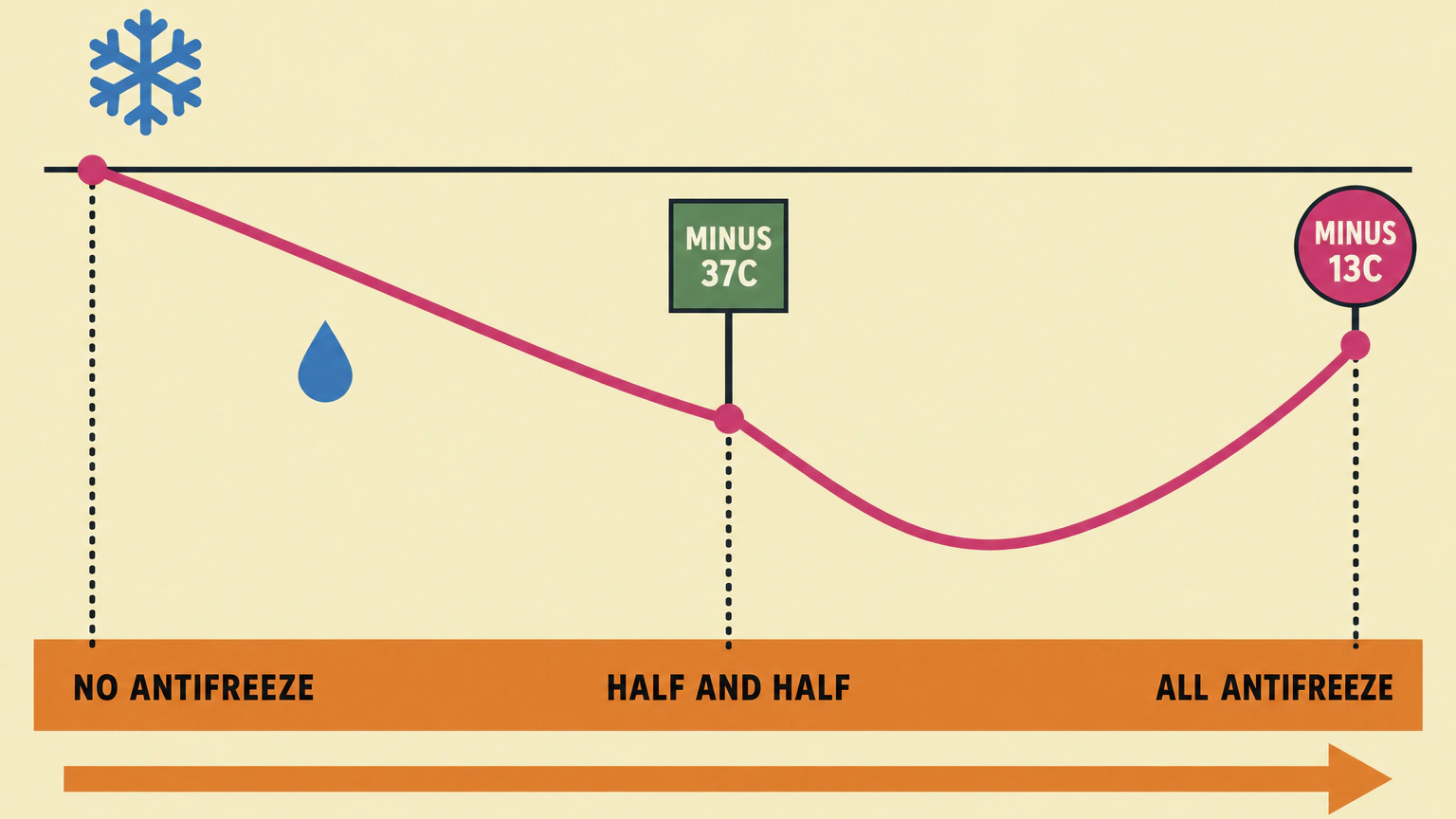
BASF's limits follow the curve. It recommends 50:50 and says its concentrate should make up "no less than 33% and no more than 60%" of the mix.
The tester has a blind spot here. Its discs float on density, and the mixture keeps getting denser all the way to neat concentrate, so a mix that's gone too strong can look superb. If you've been topping up with concentrate and the tester says you're maxed out, drain and refill to a known ratio.
A five-minute side-by-side test on a ball tester shows it happening. A quarter-strength mix still floats a ball, and neat antifreeze floats every ball, the very reading the curve says is wrong. The scale on screen is Fahrenheit, while a UK tester reads Celsius.
Topping up: water, concentrate and ready mixed
Antifreeze and coolant aren't quite the same thing. The AA calls antifreeze the concentrated product, which becomes coolant once it's diluted with water, usually 50/50. Ready-mixed bottles have done that for you, and BASF says its Ready Mix products "do not have to be diluted any further". Check the front label for "concentrate" or "ready mix" before anything goes in.
Mix concentrate with deionised or distilled water. BASF recommends either, and allows tap water only below hardness and chloride limits that few of us have ever looked up.
Plain water has one job: getting you home. The AA says it can be used in an emergency but "could also cause damage if left for too long". We'd still take water over a guessed bottle, because it won't add another inhibitor package that could react with what's already in there. Treat it as a lift home, and put the mix right before the first frost.
Never open a hot system. Keep old coolant out of the drain, too: the Environment Agency classes antifreeze containing hazardous substances as hazardous waste, so ask your council tip whether it takes it.
What goes wrong when the wrong coolant goes in
The damage builds gradually, which makes it easy to miss. Mix incompatible packages and Enilive warns that silicates can react with organic acids, "forming gel/sludge". BASF says the wrong coolant can corrode and damage the water pump, radiator, hoses and gaskets, and in the worst case the engine. Without protection, it says, the cooling water can "etch deep holes into the metal". Sludge can also reach the heater matrix, the mini radiator behind the dashboard that hot coolant flows through to warm the cabin, and a blocked matrix shows up as cold air in January.
Red flag: Stop topping up and get it looked at if you see any of these. The fluid is brown or muddy, whatever colour it started. There's a jelly-like film on the cap or in the tank. The level keeps dropping with no puddle on the drive. The heater blows cold once the engine is warm. The expansion tank is over-full and cloudy. Each one is a job for radiator and cooling system specialists, not another bottle.
At the far end, the sums get serious. Our 796 cost profiles for engine repair specialists average £2,363, from £788 to £5,908. Our category pages price to a location, so treat that as one snapshot rather than a fixed national line.
If a garage put the wrong coolant in your car
This one's on the garage. Section 49 of the Consumer Rights Act 2015 treats every service contract as including a term that "the trader must perform the service with reasonable care and skill". A coolant your car isn't approved for is hard to square with that. Section 54 gives you the right to ask for the work to be done again. A price reduction follows if that is impossible or the garage does not do it within a reasonable time and without significant inconvenience.
Gather your evidence in this order: the invoice showing what went in, a photo of the bottle, your handbook page with the code, and any report of damage. Then complain to the garage in writing.
If the garage is accredited to The Motor Ombudsman, it gets eight weeks to give its final answer, and after that you can take the dispute to the ombudsman. If the garage isn't signed up, the ombudsman says it can't help. Our guide to putting a bad repair right covers the rest.
Booking it in: what to ask for, and what it should cost
Ring with the code your car needs written down. Ask for a drain and refill to that specification at your handbook's ratio, with the product name on the invoice, because a top-up of an unknown mix isn't the same job. If the wrong fluid may already be in there, BASF's advice is to drain completely, flush the system thoroughly with water, then refill.
Our 798 radiator repair cost profiles average £355, from £131 to £1,159, on the same location-priced basis. The top of that range is radiator work, not a simple refill.
A drain and refill is routine for a garage that does full servicing. Ask a mobile mechanic whether they can do it on your drive, catch the old coolant and take it away. The AA calls antifreeze a hazardous substance and says a drain and flush isn't a job to attempt yourself. If any of those red flags are showing, book a garage that will find the cause.
Book through us and our guarantee comes with it: if you're not happy, we'll work with you and the garage in good faith to put it right.
Frequently asked questions
How do I know what coolant is already in my car?
Often you can't tell by looking, unless a service record spells it out. The AA admits it's "not easy to identify it without sophisticated tests", and a rusty system can pass for a healthy orange one. A disc tester can check the freeze protection, but it cannot identify the coolant. If the records do not tell you what went in, book a drain and refill to the handbook specification.
Does coolant colour matter?
Not as a specification. The dye is part of a carmaker's approval, but BASF says colour alone can't identify a coolant, and the same shade turns up across different chemistries. Two pink bottles can carry packages that shouldn't meet. Ignore the colour on the shelf, and match the approval code in your handbook to the list on the back of the bottle.
Can I mix pink and blue coolant?
Not on the strength of the colours, because colour doesn't tell you whether the two packages are compatible. Some mixes cause real trouble: Enilive warns that silicates can react with organic acids and form gel. BASF advises against mixing different Glysantin coolants with each other. If you don't know what's already in there, a drain and refill is cheaper than the damage.
Can I put water in my coolant in an emergency?
Yes, to get you home. The AA says water can be used in an emergency but could cause damage if it's left too long. Adding it changes the mixture, so correct the concentration as soon as you can. We'd still choose water over a guessed bottle of the wrong antifreeze. Just treat it as a lift home, not a top-up.
What happens if antifreeze is too strong?
Your freeze protection gets worse, not better. On the standard ethylene glycol curve the best protection sits around 60%, and neat concentrate freezes at -12.8 °C, which is warmer than a 30% mix. BASF caps its own concentrate at 60%. A disc tester can flatter a mix that's too strong, so if you've been topping up with concentrate, drain and refill to your handbook's ratio.
Is coolant checked in the MOT?
No. GOV.UK says "the test does not cover the condition of the engine, clutch or gearbox", and nothing in it looks at coolant strength. DVSA says the fluid type alone is not a reason for failure, but an excessive leak can still fail the test. So a fresh MOT pass tells you nothing about your antifreeze. The autumn tester check is yours to do.