

On this page
- Start here: check your cambelt's mileage and time limits
- How to tell whether you've got a belt, a chain or a wet belt
- Wet belts: the third answer, and the one that catches owners out
- So when is yours actually due?
- Why an MOT pass tells you nothing about your cambelt
- What the job should cost, and how to read the quote
- Buying used: low mileage doesn't mean the belt is fine
- Common questions
Start here: check your cambelt's mileage and time limits
Your car has one of three things driving its valves: a cambelt, a timing chain, or a wet belt that runs inside the oil. If you want to know whether your car has a cambelt or a chain, your handbook settles it faster than anything else. And if it's a belt, check the mileage limit and any time limit in the service schedule. At England's average mileage, the months run out first in Haynes' Citroën example, with the odometer still well short of the limit.
The time limit is the one that catches people out. Ask most drivers when their cambelt is due and they'll give you a mileage. Hardly anyone quotes the months, because nothing on the dashboard counts them and no warning light exists for a belt that's quietly going hard. Rubber ages on a driveway too. That's why a time limit still matters when a car hasn't covered many miles.
That makes "how long does a cambelt last" the wrong question. The right one is when your service schedule says it's due, and how far away that is. None of it matters, though, until you know what your engine has under the cover. Start there.
The three timing systems you'll meet on UK roads
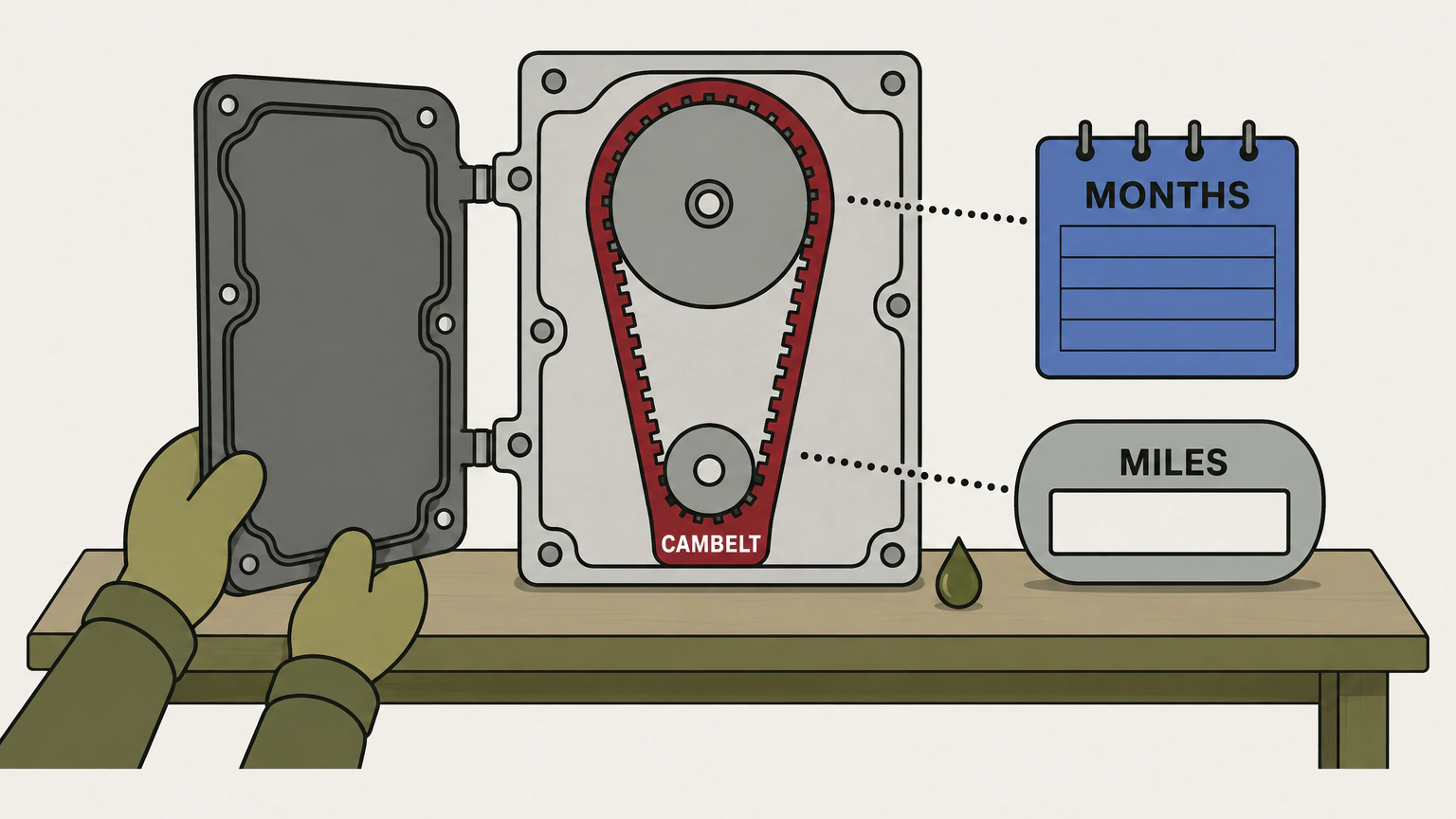
A cambelt and a timing belt are the same thing. Haynes says so plainly, and British drivers just use the shorter word. It's a toothed rubber belt on the outside of the engine, hidden behind a light cover, and it has a replacement interval. A timing chain does the same job in metal, runs inside the engine on the oil, and carries no set replacement interval at all. A wet belt is the newest of the three: a rubber belt that also runs inside the engine, bathed in oil.
One more distinction decides what a failure costs you. In an interference engine, valves and pistons occupy the same space at different moments in the cycle. Lose the belt and they meet. Haynes is blunt about the result: valves bend, connecting rods distort, and what's left is scrap. Almost every engine built in recent years is the interference type.
| Timing system | How to spot it | When it needs work | What a failure usually means |
|---|---|---|---|
| Cambelt (dry belt) | Light plastic cover on one end of the engine, with a timing belt interval in the service schedule | At the mileage or time limit given in your schedule | On an interference engine, bent valves and a scrapped engine |
| Timing chain | Metal cover flush with the block, with the timing system confirmed for your engine | No set interval. Chains can stretch and need work on symptoms | Usually rattles first. A snapped chain does the same damage a belt does |
| Wet belt | No external belt cover, because the belt runs inside the engine in the oil | At the interval, and oil changes on time matter just as much | Belt debris can block the oil pick-up and kill the engine without snapping |
How to tell whether you've got a belt, a chain or a wet belt
Three checks, in the order that settles the question quickest. Before you start, one warning that saves people a lot of money: the answer follows the engine, not the badge on the boot. Two cars with the same name in the same showroom year can have different timing systems, because the buyer chose a different engine.
The service schedule settles it fastest
Open the handbook or the service schedule and look for the maintenance intervals. If a timing belt or cambelt interval is listed, your car has a belt. Check whether the schedule gives a mileage, a time limit, or both. If nothing is listed, confirm the timing system for your engine before treating it as a chain. Haynes points owners to the handbook too. If yours has gone missing, a franchised dealer's parts desk can look up the schedule from the VIN, and so can garages that work to the manufacturer's schedule.
Intervals are set per engine, not per badge. The only interval that governs your car is the one in your own service schedule, and that goes for any list you read, ours included.
What the engine bay tells you
Open the bonnet and look at the end of the engine, usually to one side. A light plastic cover with clips or small bolts, sitting proud of the block, generally means a dry belt: a belt that runs in fresh air doesn't need sealing in, it just needs keeping clean. A metal cover bolted flush to the block, with a gasket, generally means the drive runs in oil, so you're looking at a chain or a wet belt.
This check narrows the answer without settling it. Covers get changed, engine bays are crowded, and some layouts hide the timing end against the bulkhead where you can't see it at all.
Registration lookups, and the check to run afterwards
Type your registration into a lookup tool and plenty of sites will tell you whether the car has a belt or a chain. That's a reasonable place to start, and it's plainly what people want: "by reg" is one of the first things the search box offers on this question. It isn't the last word, though.
Manufacturers have switched between belt and chain partway through a model's life, and they've run different timing systems in different engines under one nameplate in the same year. A lookup keyed to the model can be right about the car and wrong about the engine. So take the lookup's answer, then confirm it against the service schedule for your engine code. If the two disagree, the handbook wins.
Wet belts: the third answer, and the one that catches owners out
There's a third answer that most pages skip, and it's the one currently costing British owners real money. The wet belt is the newest of the three systems. Some PureTech owners can claim compensation for repairs. If your car has one, the rules you've read about cambelts only half apply.
Which engines use one
Work by engine family, because that's how the answer lands. Earlier Ford 1.0 EcoBoost engines use an oil-immersed timing belt, including versions in the Fiesta and Focus. Newer versions use a timing chain, including engines in the Puma. Earlier Stellantis 1.2 PureTech engines, the EB2, use a wet belt in models including the Peugeot 208, 2008 and 3008. They're also found in the Citroën C3 and C4, and the Vauxhall Corsa and Mokka. Those two families are the ones FixMyCar names, and the PureTech comes with a documented belt delamination problem attached.
Plenty of neighbouring engines from the same makers run ordinary dry belts, and some run chains. Stellantis's 1.5 BlueHDi diesel is a dry belt. But Ford's 2.0 EcoBlue diesel in the Transit uses a wet belt. Same forecourt, same badge, different job list.
Why running a belt in oil changes everything
Wet belts need oil that meets the manufacturer's specification. Unsuitable or contaminated oil can damage the belt and make it shed material. Those particles can circulate through the engine. If they block the oil pick-up, the engine starves, and that's how a wet belt can kill it without ever snapping.
So oil changes on these engines aren't a nice-to-have. They're the belt's maintenance. Intervals originally sold as long have been revised down since, and Stellantis's newer hybrid versions use a chain.
Stellantis is also paying out. Parkers reports a compensation portal, opened to UK owners in 2025, covering costs from excessive oil consumption or premature timing belt failure on the 1.0 and 1.2 PureTech petrol engines, incurred between 1 January 2022 and 31 December 2024. Stellantis's current UK terms require servicing, diagnosis and repair through its authorised network, with the maintenance plan followed. At the repair date, the car had to be under 112,000 miles and less than ten years from its warranty start date. Other eligibility conditions apply. Parkers also reports an earlier extended warranty on previous generations of the engine, covering parts and labour to ten years or 112,000 miles, subject to conditions. If that sounds like your car, ask your dealer about it, run the registration through the vehicle recalls and faults service on GOV.UK, and get whatever you're told in writing.
So when is yours actually due?
If your schedule gives two limits, either one can make the belt due. Here's the rule, then a worked example from one real engine, then a tool that does the sums on your own numbers.
Miles or months, whichever comes first
Reaching either number counts. Not passing it, reaching it. Haynes says to change the belt as soon as you get to either figure, and works the example both ways round: six years at 40,000 miles means change it now, and 62,500 miles in four years means change it now as well.
A time limit accounts for ageing even when a car isn't being driven, so a car that sits does its belt no favours at all. That's also why a low-mileage car isn't automatically the safe buy it looks like.
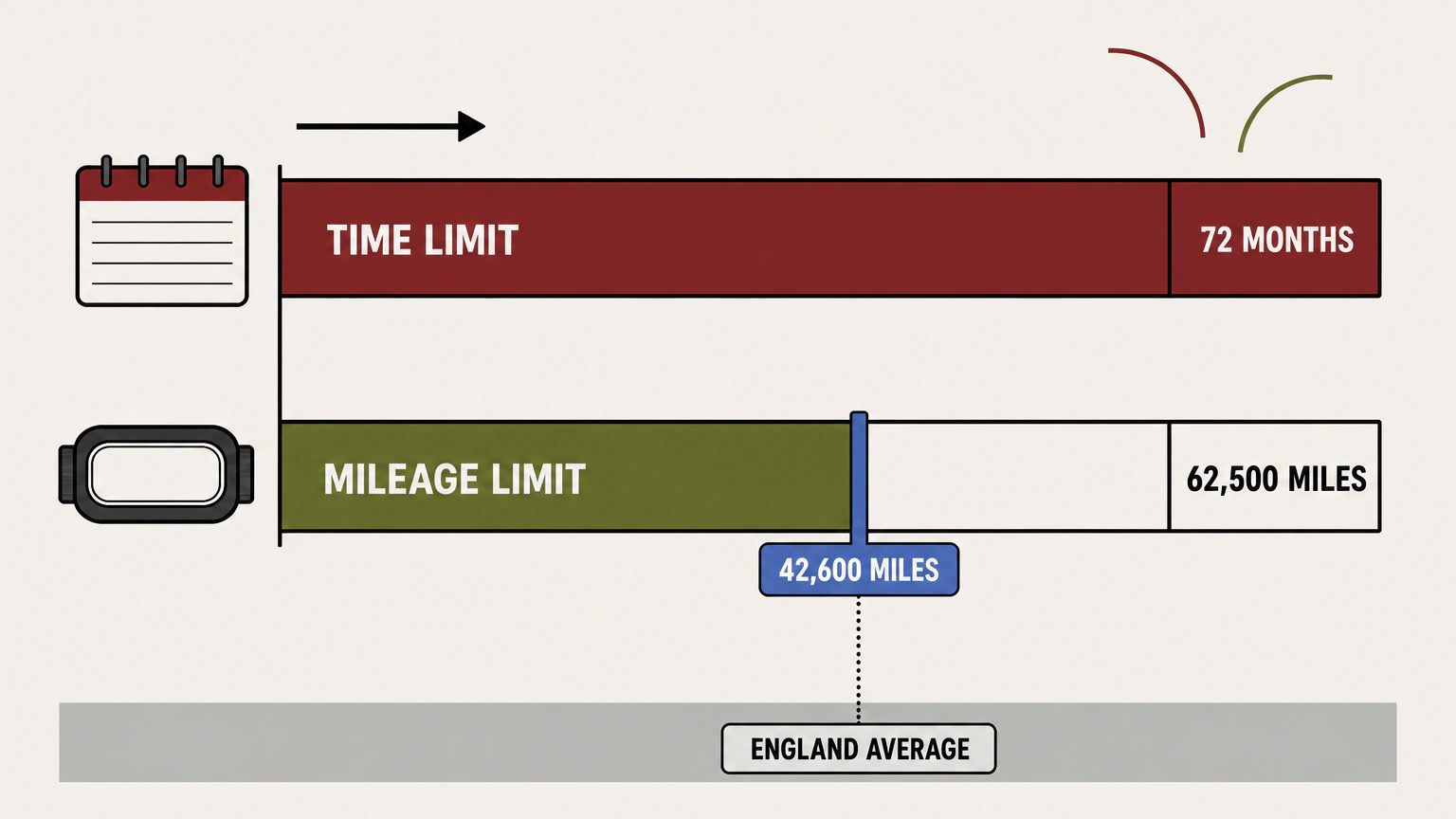
Worked example: Haynes gives the Citroën C4 Spacetourer 1.2 PureTech an interval of 62,500 miles or 72 months. Cars in England averaged 7,100 miles in 2024, in the Department for Transport's National Travel Survey. Six years at that rate is 42,600 miles, about two thirds of the mileage limit. The clock got there first.
Why the months can win
Look at that gap again: on the England average, a car takes roughly eight years and ten months to cover 62,500 miles. The six-year clock beats it by nearly three years. At the six-year mark the odometer reads about 42,600 and looks perfectly healthy, but the belt is due anyway.
The exception is the high-mileage driver, and it's a real one. Company car, long commute, 20,000 miles a year: you'll hit 62,500 miles in a little over three years, and the mileage limit is the number to watch. Diesel drivers sit closer to that end too, at 8,300 miles a year in England against 6,200 for petrol. Check both limits in your own schedule, and diary the date if it gives one.
Work out where your own car stands
Your limits come from your handbook. Your two readings come from the last belt invoice, which should show the date and the mileage on the day, and from the odometer this morning. Fill those in and you'll see which limit lands first and how far off it is. If nobody can produce that invoice, leave the date empty and read the answer anyway: it's still a useful one.
Is your cambelt due?
Two numbers decide it, and most people only ever watch one of them. Fill in what your handbook and your last invoice say.
The two limits below start on an ordinary example. They aren't your car's figures, so change them to what your handbook says.
It's in the service schedule, usually under cambelt or timing belt. Leave it empty if yours only gives a time.
Some handbooks put this in months instead. Seventy two months is six years.
It should be printed on that same invoice.
Today's reading, near enough.
Where your belt stands
The time limit gets there first
About 24 months to go
You've covered 29,000 miles since the belt was done, so you've around 31,000 left on the mileage limit. At about 600 miles a month you'd reach that in roughly 51 months. The clock beats it by more than two years.
The belt is due as soon as you reach either number, not once you've gone past it.
Intervals differ by engine, not just by badge, so take yours from your own service schedule.
What that looks like on a real car
Haynes gives the Citroën C4 Spacetourer 1.2 PureTech an interval of 62,500 miles or 72 months, and says to change the belt as soon as you reach either of those numbers. That is one engine's published figure, not a number that applies to every car.
- Time limit72 months
- Mileage limit62,500 miles
- Six years at the England average42,600 miles
Cars in England averaged 7,100 miles in 2024, in the Department for Transport's National Travel Survey. Six years of that is 42,600 miles, about two thirds of the way to the mileage limit, and by then the time limit is already up.
Once you know the belt is close, the next move is quotes. Get two or three from local mechanics, and compare what's in each price rather than the total on the bottom line.
Why an MOT pass tells you nothing about your cambelt
Here's the false comfort that lets a belt run years past its date. GOV.UK says it in one sentence: the MOT "does not cover the condition of the engine, clutch or gearbox". Nobody removes a timing cover during an MOT, and no tester is asked to.
Look at what the test does cover and the gap is obvious. The DVSA inspection manual runs to eleven numbered sections, and they go: identifying the vehicle, brakes, steering, visibility, lamps and electrics, axles and wheels and tyres and suspension, body and structure, other equipment, nuisance, supplementary checks for buses and coaches, and seat belt installation. Not one of them reaches the timing drive.
So a fresh certificate is good evidence about lights, brakes and tyres, and it's evidence about nothing at all under that cover. A car can pass its MOT on Monday morning and lose its engine on Tuesday, and neither the tester nor the certificate did anything wrong. Worth knowing too: in England, Scotland and Wales, a car MOT costs no more than £54.85, with no VAT on the fee. If your car has gone the other way and failed, we've written separately on what happens when a car does fail its MOT.
What the job should cost, and how to read the quote
Cambelt quotes vary wildly, and most of the variation is legitimate: it's access, not rubber. Here's what the published figures look like, and then the four things that move your number.
| Published figure | What it covers | Whose figure it is |
|---|---|---|
| £560.55 | average timing belt replacement | FixMyCar platform data |
| £1,088.76 | average timing chain replacement | FixMyCar platform data |
| £300 to £650 | timing belt with water pump and pulleys | ClickMechanic |
| at least £400 | belt and tensioners fitted by a garage | Haynes |
| £2,363 | average engine repair or rebuild | our own cost profiles, 796 of them |
Pro tip: Haynes reckons the belt itself can cost as little as £20, while the garage bill starts at £400. You're not paying for rubber. You're paying for the hours it takes to reach it, which is exactly why anything else sitting behind the same cover should come out on the same day.
Belt on its own, or belt with the water pump and tensioner
When the water pump is driven by the same belt, it's buried behind the same cover. Almost all of the cost of replacing it is the labour you've just paid for once. Do it later and you pay that access twice. Haynes puts the rule in a sentence worth stealing: change the pump because you're doing the belt, not the belt in three months because you forgot the pump. Tensioners aren't optional at all, and a decent garage will insist on a full kit.
A garage can be right to say no, mind you. On some engines the pump isn't belt-driven and comes out separately, and a pump replaced last year doesn't need doing again. What you want is the reason, not a refusal.
Four questions that move the price
Ask these four and most of the spread between quotes explains itself. First, engine layout and access: a transverse engine jammed against the wing takes longer than one you can walk around. Second, is the water pump in or out, and are the tensioner and idlers included. Third, main dealer or independent, because labour rates vary. Fourth, is the price for a full belt kit or a bare belt, because a bare belt on old pulleys is a false economy.
Red flag: Four things should stop you signing. A price with no line for the tensioner. A refusal to say whether the water pump is in or out. Anyone telling you the belt is "lifetime" and never needs changing. And a verbal quote that never becomes a written one. Ask for all four in writing before the car goes anywhere near a ramp.
If a few hundred pounds has made you wonder about a cheaper route, it's worth reading what a mobile mechanic can and can't do on your driveway before you ring round.
What it costs if you leave it
Set the job against the alternative. Our own cost profiles for engine repair and rebuild work, 796 of them, average £2,363 and run from £788 to £5,908. Hold that beside a belt job Haynes prices from £400 and the arithmetic makes itself. Those profiles are a snapshot of what people pay across our engine repair and rebuild specialists listings, not a fixed line for the country. If you want to know how we put our figures together, it's set out in plain English.
The honest qualifier: not every snapped belt ends in a rebuild. On a non-interference engine you get a tow, a new belt and a bruised ego. Those engines are now rare, and you don't get to choose which sort you own.
Buying used: low mileage doesn't mean the belt is fine
A ten-year-old car showing 38,000 miles will be sold to you as barely run in. On the timing belt it's the opposite story. That car is well past half way through a 62,500-mile limit. If it's still on its original belt, it's four years past a six-year clock. The low reading is exactly what should make you ask for the belt paperwork, and a seller who offers the mileage as reassurance is either not thinking about it or hoping you won't.
Proof is documentary, and it's easy to check. Cross-read the invoice mileage against the vehicle's MOT history on GOV.UK, which records the reading at every test back to 2005 for cars in England, Scotland and Wales. If there's no proof at all, treat the belt as due: price the job, and take it off the asking price rather than the seller's word. While you're checking paperwork, the other thing to check before you buy is whether the car has been written off and repaired.
What good proof looks like:
- An invoice naming the belt and the tensioner, not just the word "service".
- The mileage printed on that same invoice.
- A dated entry in the car's paper or digital service record.
- The water pump listed as changed, or listed as deliberately left alone.
- An under-bonnet sticker giving the date and mileage of the change.
- The car's MOT history on GOV.UK, to cross-check the invoice mileage.
- Failing all of that, a written quote for doing the job now, before you agree a price.
Common questions
How do I know if my cambelt has been changed?
Ask for the invoice. It should name the belt and the tensioner, carry a date, and show the mileage on the day, and it should match the car's paper or digital service record. An under-bonnet sticker is a good sign but isn't proof on its own. Then check that invoice mileage against the car's MOT history on GOV.UK, which records the reading at every test. No paperwork, treat the belt as due.
How long does a cambelt last?
As long as your handbook says, and not a month longer. Intervals are set per engine, so check the mileage limit and any time limit. Haynes quotes 62,500 miles or 72 months for one Citroën 1.2 PureTech, and says to change the belt as soon as you reach either figure. Your engine's interval may be nothing like that, so look it up rather than borrowing someone else's.
What happens if you don't change the cambelt?
On most modern cars, it destroys the engine. They're interference engines: valves and pistons share the same space at different moments, so when the belt lets go they collide. Haynes describes bent valves, distorted connecting rods and scrap. A non-interference engine gets away with a tow and a new belt, but very few cars built in recent years are made that way.
Do timing chains need replacing too?
Not on a schedule. Chains carry no set replacement interval, which is the main reason owners like them. They do stretch with age and mileage, and a stretched chain usually announces itself with a rattle on a cold start. When one does need doing, it costs more than a belt: FixMyCar puts the average timing chain replacement at £1,088.76 against £560.55 for a belt.
Should I buy a car with a wet belt engine?
You can, but price the belt in before you offer. A wet belt depends on oil that meets the manufacturer's specification. Ask for a full oil-change history on the correct grade, and for belt paperwork if the car is anywhere near its interval. A wet-belt car with vague servicing is one to walk away from.
Should the water pump be changed at the same time?
Usually yes, when the belt drives it. Most of the bill is the labour to reach the belt, and the pump sits behind the same cover, so doing it separately means paying for that access twice. ClickMechanic prices a belt with pump and pulleys at £300 to £650. If your garage says no, ask why: sometimes the pump isn't belt-driven and the answer is a good one.
Does the MOT check the cambelt?
No. GOV.UK says the test "does not cover the condition of the engine, clutch or gearbox", and the DVSA inspection manual's eleven numbered sections run from identifying the vehicle to seat belt checks without one of them reaching the timing drive. A fresh certificate tells you about lights, brakes and tyres. It tells you nothing whatsoever about your belt.