

On this page
- What your coil light is telling you
- Can you keep driving with it on?
- Why it flashes, and why it's often not the glow plugs
- Will a flashing glow plug light fail an MOT?
- What glow plugs do after the engine starts
- How a good garage tests glow plugs
- What glow plug replacement costs in the UK
- When an old glow plug snaps
- What to agree before the work starts
- Frequently asked questions
What your coil light is telling you
It's a cold morning, you turn the key, and a little amber coil lights up on the dash. That's the glow plug light. Most days it's gone in seconds. Today it stayed on, or started flashing halfway to work.
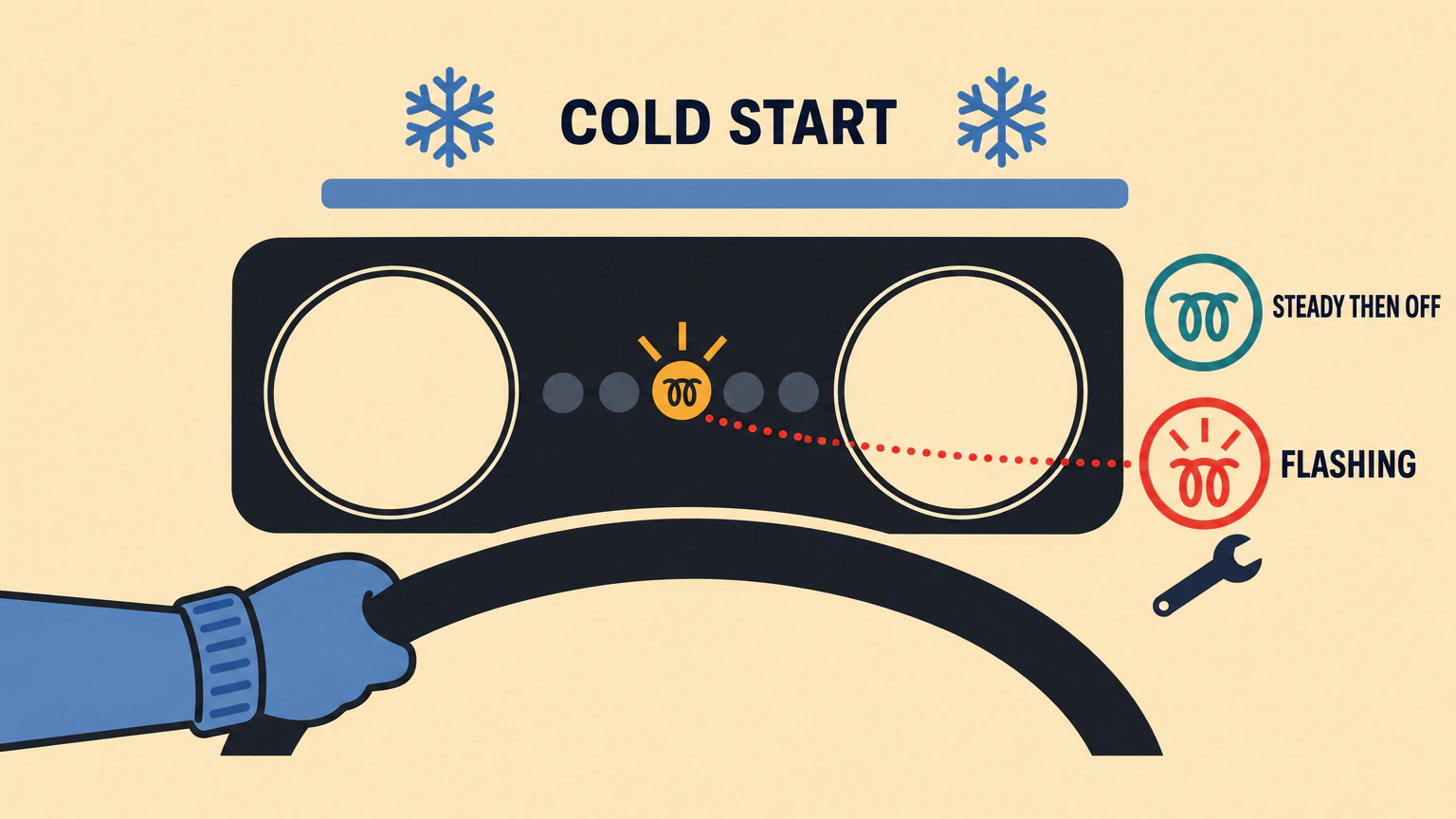
If the coil-shaped light comes on when you turn the key and goes out a few seconds later, your glow plugs are warming up and all is well. If it stays on or flashes with the engine running, the car has logged a fault: drive gently and get the codes read before anyone sells you parts. In Great Britain that light can also fail the MOT on a diesel first used from 1 July 2008, because on some diesels, Volkswagen's among them, the coil doubles as the engine management light.
A diesel has no spark plugs. It lights its fuel by squeezing air until the air is hot enough to ignite it, and on a cold engine that heat isn't there yet. So each cylinder usually gets a glow plug, a small electric heater. NGK, which makes them, says they pass 800°C. The glow plug warning light can do four things, and only the first is good news.
| What you see | What it usually means | What to do | At the MOT in Great Britain |
|---|---|---|---|
| It lights when you turn the key, then goes out after a few seconds | The glow plugs are preheating. That's normal. | Wait for it to go out, then start the engine. | Nothing to fix. |
| It stays on, or comes back on, with the engine running | The engine computer has logged a fault. | Drive gently and get the fault codes read soon. | Can fail a diesel first used from 1 July 2008 where this lamp is the engine management light. |
| It flashes while you're driving | A logged fault, and on some cars a clogged particulate filter or reduced power as well. | Drive slowly and carefully to a garage without delay. | Can fail a diesel first used from 1 July 2008 where this lamp is the engine management light. |
| It never lights, even on a cold start | The lamp or its circuit may not be working. | Get it checked before the MOT. | A lamp that doesn't work fails on a diesel first used from 1 July 2008 where it's the engine management light. |
The MOT column follows the DVSA manual used in Great Britain. It checks the engine management light, not the coil by name. A coil that only indicates preheating is outside this MIL check. Other defects can still fail the car.
That's what the light means. Whether you can keep going is the next question.
Can you keep driving with it on?
Usually, yes. Gently, and not for long.
Volkswagen's advice for a coil that stays on or flashes with the engine running is short: "Drive slowly and carefully to an authorised repairer without delay". Škoda's Roomster handbook says what the car does next. Once the coil flashes on the move, the engine computer "allows the vehicle to run in emergency mode". If the car suddenly feels flat, that may be why.
Don't sit on it either. NGK says faulty plugs bring hard starting, "especially during winter when the vehicle may not start at all".
Stop instead if the engine, in GSF Car Parts' words, "runs badly enough to feel unsafe, or the warning comes with clear loss of power". We'd add heavy smoke and any red warning light.
The next step is a code read. FixMyCar's average diagnostic booking is £51.66. RAC Mobile Mechanics charges £99 for up to 30 minutes, then £20 for every extra 15.
Why it flashes, and why it's often not the glow plugs
The coil reports what the engine computer sees, so the cause can sit well away from the plugs. GSF says to "treat glow plug light flashing as a fault warning, not as a parts-shopping instruction". We can tell you what the light usually means. Only a code read and a proper test on your own car can tell you which fault you've got.
Worn or dead glow plugs
Start with the obvious suspect. NGK's symptom list is hard starting, misfires, black or white smoke, a rough idle and heavier fuel use.
Plugs wear out with age. They also die young, and NGK names two killers: too much voltage from a faulty controller, and heat from a leaking injector. A plug that fails early is telling you something else is wrong, and its replacement can go the same way.
Before you blame the plugs, rule out two other culprits. A slow crank or a clicking sound is the battery's signature, the AA says, so test the battery first. And in very cold weather diesel can turn waxy and block the fuel filter.
The relay, control module or wiring
Glow plugs don't power themselves. A relay or a control module feeds them through a wiring harness, and any link in that chain can fail. GSF lists a bad relay, damaged wiring, a poor earth or a corroded connector. Each can stop the plugs heating and store a fault code. As GSF puts it: "Fitting new plugs will not fix a supply problem".
This is where parts-first quotes go wrong. A code that points at the glow plug circuit names a circuit, not a part, and the real fault can be the harness. Before ordering parts, check power at the plugs and the relay. That's electrical diagnosis, and an auto electrician is the right person for it.
Faults that borrow the same light
On many VW Group diesels the engine computer uses the coil as a general fault lamp. Volkswagen's own lamp guide gives the flashing coil one meaning, and it isn't glow plugs: "Engine control malfunction". GSF's list of triggers includes the exhaust gas recirculation (EGR) valve, the throttle body, boost control and injectors. It adds a diesel particulate filter (DPF), the soot trap in the exhaust, that can't finish cleaning itself.
The famous cheap one is the brake light circuit. The engine computer watches the brake pedal signal, and when that signal goes missing the coil can flash on an engine that runs normally.
Pro tip: Check your brake lights before you book anything. Get someone to stand behind the car while you press the pedal. On many VW Group diesels, a blown brake bulb or a failing brake pedal switch can set the coil flashing, because the engine computer watches that signal. A bulb is a cheap fix. Glow plugs aren't.
Whatever the cause, the MOT tester cares whether the engine management light comes on and then goes off.
Will a flashing glow plug light fail an MOT?
It can. Whether it does turns on a date: the day your car was first used.
The rule comes from the DVSA's inspection manual for Great Britain. The tester switches on the ignition and checks that the engine management light "illuminates and then goes off". That check applies to diesels first used on or after 1 July 2008. A lamp that's "inoperative or indicating a malfunction" is a major defect, and GOV.UK is plain that a major defect means a fail.
The rule never mentions glow plugs or the coil lamp. The coil gets in through the carmaker. Volkswagen UK calls its coil the "Glow Plug/Diesel engine management light". On a car like that, a coil that stays lit or flashes is the engine management light reporting a fault, and that's the major defect.
Two cases fall outside this check. On a diesel first used before 1 July 2008 there's no engine management light check. A coil that only indicates preheating is outside this MIL check. Other defects can still fail the car.
For most cars first registered in Great Britain, the date that counts is the first registration date on the V5C. Strictly, the manual takes the earlier of that and six months after the car was built.
The smoke test is a separate hurdle. The manual wants the engine at 80°C or more, or at normal running temperature if that's lower, so smoke from tired plugs on a cold start may well not show. A clogged particulate filter can. On a diesel fitted with one, visible smoke of any colour during the metered test is a major defect. We cover the MOT smoke limits for your diesel separately.
All of this is Great Britain's rulebook. Northern Ireland runs its own tests through the Driver and Vehicle Agency.
If the light's on and the test is close, get the fault found before you book MOT testing near you. If the car has already failed, check whether you can drive it after a fail before you move it.
What glow plugs do after the engine starts
A glow plug fault is more than a cold-start nuisance, because modern plugs keep working after the engine fires.
NGK describes three more jobs. A "post-glow" runs for several minutes after the start, and without it you'd get more white and blue smoke and the knocking of a cold diesel. Ceramic plugs can keep it up for more than ten minutes. An "intermediate glow" helps stop the EGR valve clogging with carbon. A "regeneration glow" adds heat when the DPF burns off its trapped soot. Add the preheat, and one part is doing its work at three moments: before the start, after it, and while the filter cleans itself.
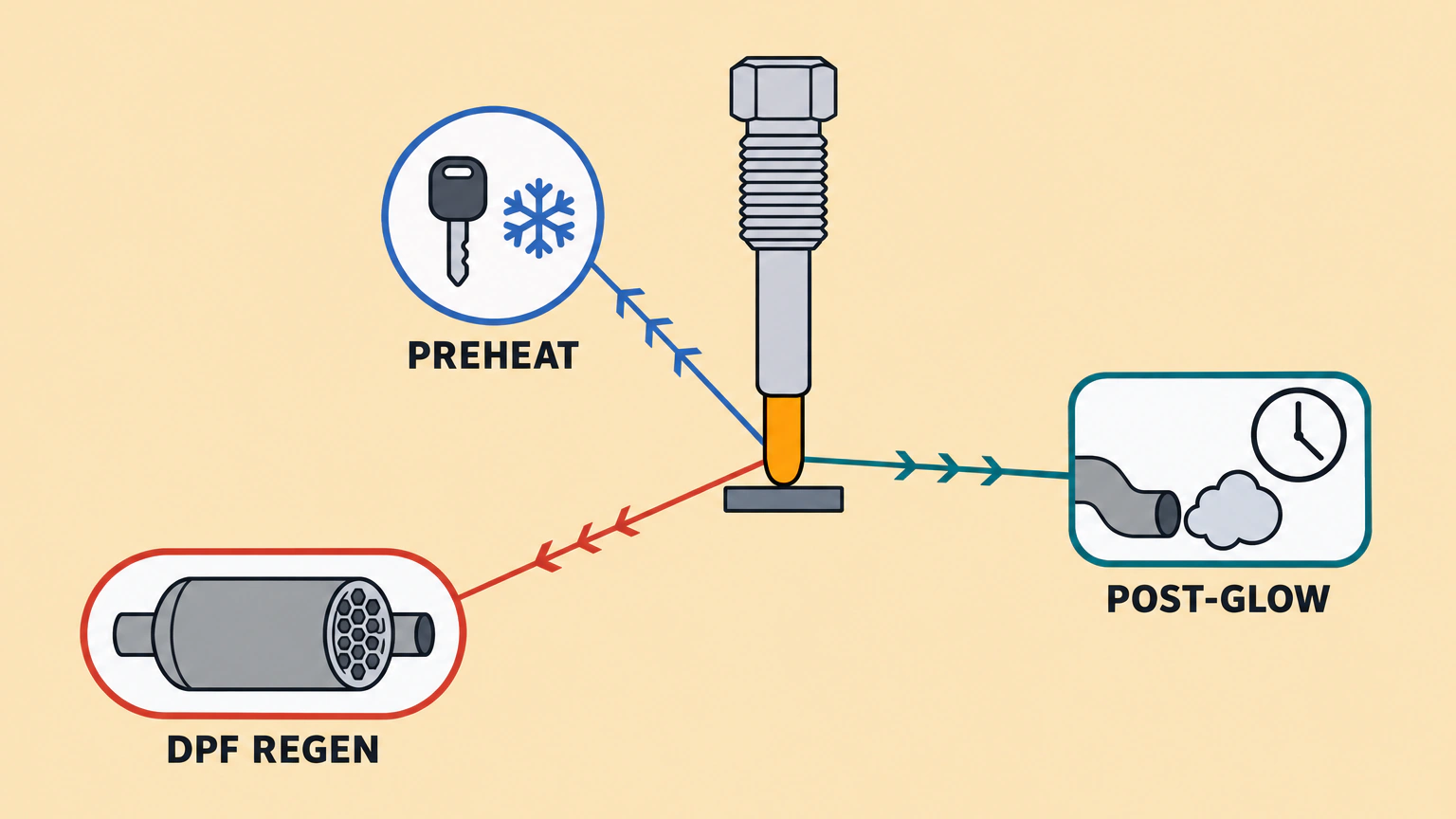
The last job is the expensive one to lose. NGK doesn't hedge: "DPF regeneration will not operate with defective glow plugs". That's why a flashing coil and a DPF warning can arrive together. The link isn't universal, though. Some Ford vans heat the filter another way.
How a good garage tests glow plugs
A proper diagnosis has a shape, and once you know it you can tell it from guesswork.
It starts with the fault codes, then moves to the plugs themselves.
Testing a plug takes a meter, and it's simple. NGK measures the resistance between the plug's terminal and its metal body. A broken heating coil shows no circuit at all. A healthy metal plug reads under 5 ohms, and a ceramic one usually under 1. Nobody should test a plug by wiring it to the battery to watch it glow. NGK warns the coil can be damaged that way, and that there's "a great risk of personal injury".
So ask: which plugs failed, and what did they read?
What glow plug replacement costs in the UK
The plugs are the cheap part. ClickMechanic puts standard ones at around £15 to £20 each, so most of what it costs to replace glow plugs in the UK is labour. That depends on access.
Two things push the bill up. Plugs with a pressure sensor built in cost more, and they're fragile: Champion warns that a drop of just 2 cm can damage the sensor. NGK recommends changing the whole set, because "if one glow plug is faulty, the probability is that the others are not too far behind". NGK sells glow plugs, of course, but most of the labour is in reaching them, so the logic holds.
| Make | ClickMechanic average | FixMyCar average |
|---|---|---|
| Audi | £185 | £198.23 |
| BMW | £280 | £231.65 |
| Citroen | £239 | £214.86 |
| Ford | £290 | £240.68 |
| Mercedes-Benz | £204 | £228.98 |
| Nissan | £178 | £193.13 |
| Peugeot | £230 | £227.34 |
| Renault | £180 | £186.09 |
| Toyota | £183 | £175.88 |
| Vauxhall | £181 | £230.43 |
| Volkswagen | £188 | £191.86 |
Both columns are each site's own averages, not quotes. ClickMechanic says its prices cover replacing every glow plug. Its overall average is £170 on a range of £125 to £250, though its Ford and BMW averages sit above that range. FixMyCar's overall average is £212.85, and it doesn't say how many plugs that covers.
The two sites disagree, and that's the useful part. On Ford, BMW and Vauxhall their averages sit nearly £50 apart. Location moves the price too: ClickMechanic's city averages run from £181 in Sheffield to £257 in Bristol. Use the glow plug replacement cost for your make as a sanity check, then get a firm price from local garages or a mobile mechanic.
When an old glow plug snaps
Here's why one driver pays £170 and another pays far more for the same job. After years in an alloy cylinder head, a glow plug can seize with carbon and corrosion, and a thin plug that's forced will shear. NGK and Champion both build their removal advice around that risk.
How a careful garage gets old plugs out
Patience does most of the work. Both makers say to soak the threads in synthetic oil first. NGK would ideally leave it "at least a week". Champion says overnight "or longer".
Then comes heat. Champion's method is to run the engine until it's warm. The plug is turned with a manual torque wrench, and the mechanic stops at the limit instead of forcing it. Champion's routine for a stubborn plug is three steps: slightly loosen, warm up, unscrew. A vibrating removal tool with controlled torque is another way to loosen a seized plug while reducing the risk of breakage. Afterwards, NGK wants the carbon cleaned from the hole with a reamer before the new plug goes in.
Getting a snapped plug out with the head still on
A snapped plug doesn't have to mean the cylinder head comes off. Specialists extract broken plugs with the head still on the engine, and two publish what snapped glow plug removal costs. UK Injector Removal, in the North East, gives £150 a plug as a guide price, with discounts for several and no charge if it can't get the plug out. A Walsall garage lists the job from £120 plus VAT, which is £144 all in. Its page title says from £100, so treat both as starting points.
Taking the head off is a far bigger job. The inlet and exhaust manifolds, turbo, fuel pipes, injectors and timing belt or chain all come off first. The head is then checked or skimmed and refitted with a new gasket and bolts. That's UK Injector Removal's own list, and it explains the gap between the bills. If you're told the head has to come off, ask whether extraction with the head on was considered, then get a second view from an engine specialist.
What to agree before the work starts
The conversation that decides who pays for a snapped plug happens before the job, not after.
Citizens Advice draws the line. A quote is a promise to do the work at an agreed price. An estimate is a best guess, and the garage can charge more "within reason". If no price was agreed, you only have to pay a reasonable one. So ask before you hand over the key.
- Is this a fixed quote for the whole set, or an estimate that could go up?
- Will you test every plug and tell me which ones failed and what they read?
- Have you checked the relay or control module and the wiring, not just the plugs?
- If a plug won't turn, will you stop and call me before going any further?
- Do you soak and warm seized plugs and use a torque wrench or torque-limited tool?
- If one snaps, will you have it extracted with the head on, and what would that cost?
- Can I have the old plugs back?
If it's already gone wrong, work that wasn't done with "reasonable skill and care" has to be done again or discounted, Citizens Advice says. Here's how to complain about a garage.
For everyone else, the order is simple. Get the codes read, then book the test with these questions in your hand.
Frequently asked questions
Can you drive with the glow plug light flashing?
Usually, yes, but gently and not for long. A flashing coil means the engine computer has logged a fault, and on some cars the engine drops into an emergency mode as well. Volkswagen's advice is to drive slowly and carefully to a repairer without delay. If the car loses a lot of power, smokes heavily or shows a red warning too, stop somewhere safe and call for help.
Will a flashing glow plug light fail an MOT?
It can. In Great Britain the MOT fails a diesel first used from 1 July 2008 if its engine management light shows a fault. The rule never names the coil lamp, but on some diesels, Volkswagen's among them, the coil is the engine management light. A coil that only indicates preheating is outside this MIL check. Other defects can still fail the car.
How long do glow plugs last?
NGK, which makes them, puts the average at around 160,000 km, roughly 100,000 miles. They can go much sooner. NGK names old age, too much voltage from a faulty controller and heat from a leaking injector as the usual killers. A plug that fails young is worth asking about, because the new one can go the same way.
Should all the glow plugs be changed at the same time?
Usually, yes. NGK recommends changing the whole set, because once one has failed the others aren't far behind. Standard plugs are cheap, often £15 to £20 each (ClickMechanic), and most of the cost is getting to them, so doing all of them in one visit saves paying that labour twice. ClickMechanic's prices are for the full set.
Can bad glow plugs cause loss of power or limp mode?
They can. NGK says faulty plugs lead to "a reduction in vehicle performance", on top of hard starting, misfires and smoke. Limp mode is the engine computer's call. Škoda's Roomster handbook says a coil that flashes on the move means an engine control fault, with the car left to run in "emergency mode". Dead plugs can also stop the particulate filter regenerating, and a blocked filter leaves a car sluggish.
Why doesn't my glow plug light come on?
Volkswagen says its light normally comes on for a few seconds when you switch on the ignition. NGK's ceramic plugs get hot in under two seconds, so the lamp can be easy to miss. If it never lights, even on a cold morning, the lamp or its circuit may have failed. Get it checked before the MOT: where the coil is the car's engine management light, a lamp that doesn't light at all is a fail on its own.
How many glow plugs does a diesel have?
Usually one per cylinder, so four on most four-cylinder diesels (RAC). Some engines differ, so check the handbook or look the car up by registration on a parts site before you buy. If a garage quotes for a different number, ask why.