

On this page
- The quick answer before you lift the bonnet
- What you need, and where to clip on
- Get a true resting reading first
- What your resting reading means
- Watch the voltage while the engine cranks
- Check the charging with the engine running
- Can a battery read 12.6 volts and still be bad?
- Getting it tested properly, and what to ask before you pay
- If it fails: charge it, find the drain, or replace it
- Frequently asked questions
The quick answer before you lift the bonnet
It's a cold morning, the key turns, and the engine drags itself round like it's having second thoughts. Or the car has sat for a fortnight and all you get is a click. Either way, you want a number and a straight answer.
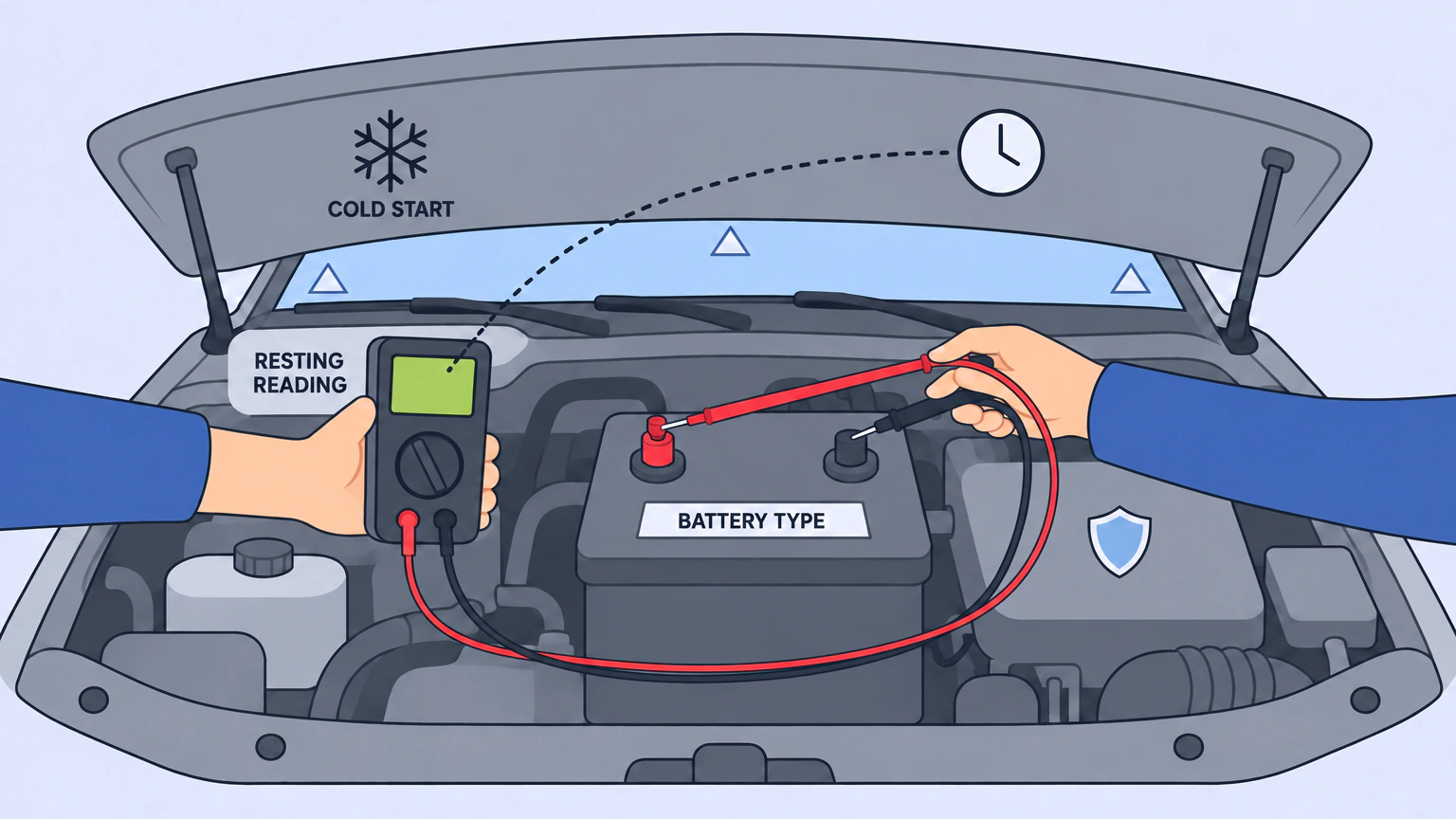
With everything switched off and the car rested, put a multimeter across the two terminals. A standard battery reading 12.6 volts or more is fully charged, and anything under 12.4 volts needs charging before you can judge it at all. That number shows charge, not strength. A battery can pass it and still leave you stranded on the first frosty morning, which is why the cranking and charging checks matter just as much.
Three readings, three jobs. At rest the meter shows charge. During cranking, a sharp drop flags a problem somewhere in the battery or starting circuit. Running, it shows the charging voltage. Take only the first and you risk trusting a dying battery, or paying for a healthy alternator. If the car won't turn over at all, roadside assistance comes first and the testing waits.
What you need, and where to clip on
A digital multimeter on DC volts is the whole toolkit. Add eye protection, and check the handbook for where the battery lives: it isn't always under the bonnet.
East Penn's trade rules are blunt: batteries give off explosive hydrogen and hold corrosive sulphuric acid, so keep sparks and flames well away and never lean over the top of one while you work.
If the battery sits in the boot or under a seat, go to it. Varta says to use that battery's own terminals rather than the jump posts under the bonnet, because the cable run between them skews the reading.
Many hybrids and electric cars also have a separate low-voltage battery, but it may not be a conventional 12-volt one. Check the handbook before testing it. The AA says 12-volt faults are the most common breakdown cause across petrol, diesel, electric and hybrid cars. Leave anything marked high voltage alone, and check whether a garage is trained for electric cars first.
One last look before the probes come out. If the case is cracked, swollen or wet with anything, keep the meter and the charger away and get a garage to look at it today.
Get a true resting reading first
A battery just driven, or just off a charger, flatters itself. Midtronics calls that surface charge: it reads higher than the real state, disperses within minutes, and their rule is to wait 15 minutes. Straight off a short drive, a battery can read healthy and still fail a tester.
Two honest ways round it. Test first thing, before the car has moved. Or switch the headlights on for a few seconds, turn them off and wait 15 minutes. Varta recommends the headlight step. Midtronics supplies the 15-minute wait.
Then read the battery before the meter. The label carries the type, standard, EFB or AGM, and the cold cranking amps with the standard it was measured to. Note both: the type changes how the number reads, and a tester has to be set to it.
Before you trust a resting reading:
- The car hasn't been driven or on a charger since last night.
- If it has, the headlights went on briefly, off again, and you've waited 15 minutes.
- Lights, heater, radio and anything plugged in are off, and the doors are shut.
- The meter is set to DC volts.
- Red probe is on the positive terminal and black on the negative.
- If the battery lives in the boot or under a seat, you're on its own terminals, not the jump posts.
- You've noted the battery type on the label and its cold cranking amps figure.
What your resting reading means
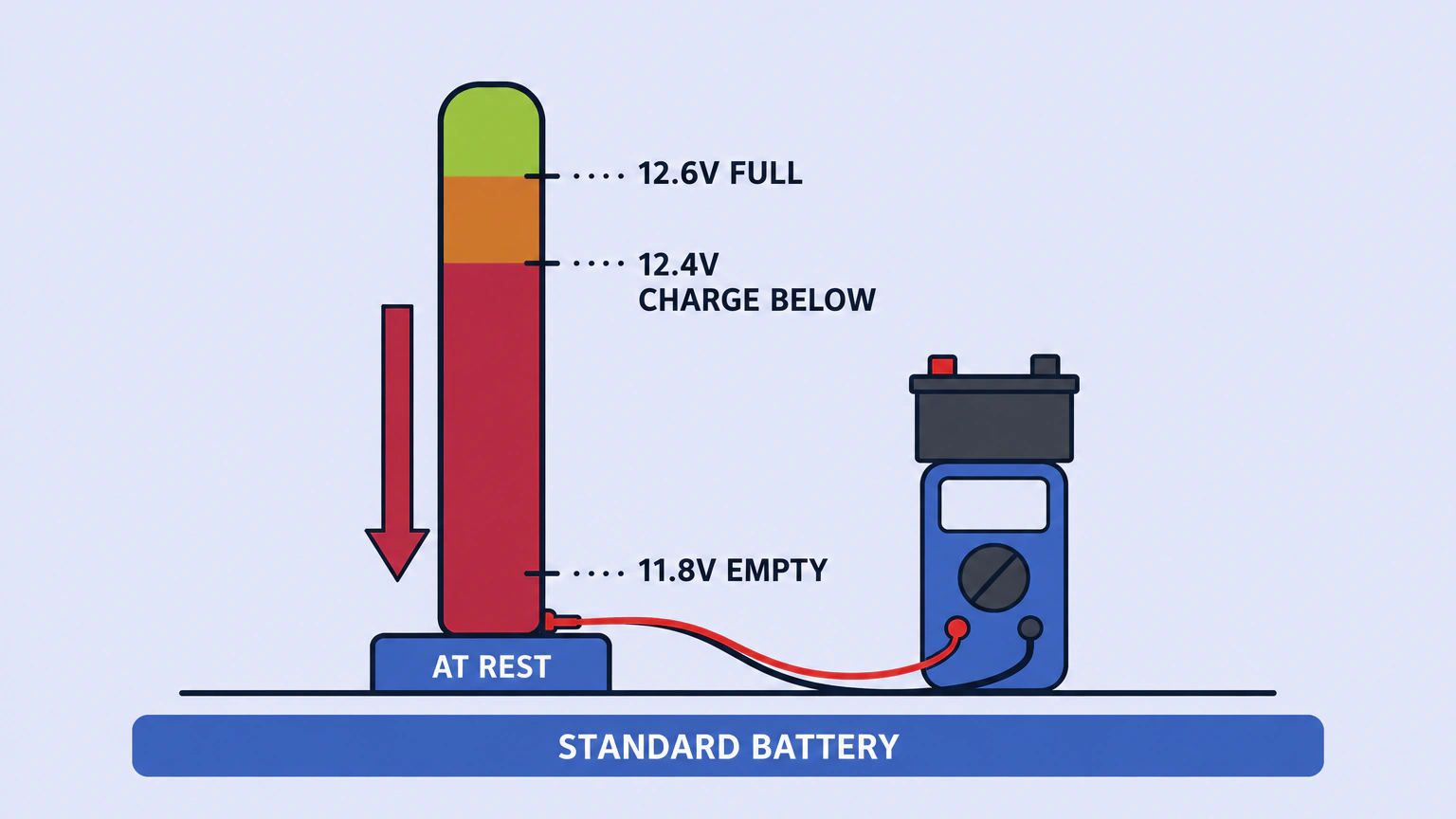
Now the number means something. On a standard battery, every maker we checked draws the same line at 12.4 volts.
| Resting reading | How charged (standard battery) | What to do next |
|---|---|---|
| 12.6 V or higher | Full | Nothing to charge. If it still starts slowly, do the cranking check. |
| 12.4 V to 12.59 V | Between three quarters and full | No charge needed yet. A top-up helps if the car only does short trips. |
| 12.2 V to 12.39 V | Between half and three quarters | Charge it, then test it again at rest. |
| 12.0 V to 12.19 V | Between a quarter and half | Charge it now, then test it again at rest. |
| 11.8 V to 11.99 V | Between empty and a quarter | Charge it now. If it drops back quickly, get it tested. |
| Below 11.8 V | Below the chart's empty mark | Deeply flat. Charge it, then get it tested before you rely on it. |
Charge levels from East Penn's state-of-charge chart for a standard battery. Varta, HELLA, GS Yuasa and East Penn all put the charge line at 12.4 V. On an EFB or AGM battery, go by that line rather than the percentages.
Trust the line more than the percentage. Varta puts a full battery at 12.8 volts, East Penn's chart marks 100% at 12.6, and HELLA calls anything from 12.4 to 13.2 volts a good battery. They agree where it counts: below 12.4, charge before you judge. On an EFB or AGM label, go by that line, because that chart is drawn for a standard battery.
What does your battery reading mean?
This interpreter is for a confirmed conventional 12-volt lead-acid starter battery. If the label or handbook does not confirm that, stop here and use the maker's instructions.
Put in the number your meter showed and when you took it. The same battery reads differently at rest, while it cranks and with the engine running.
Type exactly what the screen showed, like 12.3 or 12.47.
It's printed on the battery's label. Cars with stop-start usually have EFB or AGM.
What that reading tells you
Charge it before you judge it
Between half and three quarters charged
Below 12.4 V, battery makers say charge it. Test it again at rest once it's charged, because a part-flat battery can't show you its real condition.
A standard battery at rest
- 12.6 VFull
- 12.4 VCharge it if it reads below this
- 11.8 VEmpty
Charge levels from East Penn's state-of-charge chart for a standard battery. Varta, HELLA, GS Yuasa and East Penn all put the charge line at 12.4 V.
This ladder is for resting readings only. A reading taken while the engine cranks or runs means something different, and the cranking and charging sections below give those figures.
A meter shows charge, not strength. If starts are slow whatever it says, get the battery load-tested or conductance-tested.
One number sits outside the ladder. Below 11 volts, GS Yuasa tells retailers to scrap stock batteries, because the sulphation that forms down there can't be fully reversed by charging. And a full reading proves less than it looks: charge is what's in the tank, not how hard the battery can push.
Watch the voltage while the engine cranks
This one takes two people. Leave the probes on the terminals, get someone to start the engine, and watch for the lowest figure the meter shows. Keep your hands, sleeves and leads clear of the fan and belts, because a cooling fan can start turning with no warning.
Battery makers use the published temperature figures for a controlled 15-second load test at half the battery's cold cranking amps. They do not turn a brief start at home into a battery pass or fail. If a cranking reading looks low, charge the battery and have the battery, starter and connections tested together.
Watch the dashboard too. The AA says flickering dash lights, or no dash lights at all, can point to a discharged battery.
Check the charging with the engine running
Start the engine, leave the probes where they are, and read it again. The RAC gives 13.7 to 14.7 volts with the engine running. Inside that range, the charging voltage is in the RAC's usual band.
Below it, the obvious answer is a failing alternator. That answer sells parts nobody needed.
Many newer cars run intelligent charging. HELLA explains it plainly: these systems deliberately avoid fully charging the battery, so it can store the energy recovered when you brake, and the charging voltage sits lower as a result. A reading under 13.7 volts can be that system working as designed. One low number is a reason to have the charging tested. It isn't a reason to buy an alternator. If it keeps reading low, an auto electrician can test the charging under load.
Above the range, the caution reverses. HELLA's regulator targets stretch to 15.0 volts, so a high reading on a smart charging system can be normal too. Heat isn't. East Penn's overcharging signs are a battery hot to the touch, or electrolyte bubbling or spewing. Switch off.
Can a battery read 12.6 volts and still be bad?
Yes. A battery can sit there reading a healthy 12.6 volts and still fail you on the next cold morning.
Midtronics puts it bluntly: the voltage can look completely normal while the battery is bad. A meter measures charge and nothing else, so it can't see how much of the battery's original starting power is left, and that power drains away over years while the resting number barely moves.
Stop-start cars widen the gap. Varta judges a stop-start battery on its state of charge, its state of health and how quickly it takes charge back. A meter sees the first and misses the other two. The warning sign needs no equipment: stop-start cutting in less often than before. Varta reads that as the battery management system protecting a tired battery, and as a sign to replace it.
A resting reading still earns its place, mind. Full sits at 12.6 volts, the charge line at 12.4 and empty at 11.8, and those three marks are all a meter sees at rest.
Getting it tested properly, and what to ask before you pay
You don't have to buy a car battery tester. Halfords runs a free battery health check you can book online. A mobile mechanic can test the car on your drive.
The machine is only as good as what gets typed into it. Varta is specific. Set the tester to the right battery type, starter, gel, EFB or AGM. Then enter the cold cranking amps from the label, with the standard it was measured to: DIN, EN, IEC, JIS or SAE. Midtronics spells out the cost of getting that wrong. Feed the tester a lower rating than the battery really has, and the car struggles to start despite testing as good. The clips belong on the battery's own terminals, in the car.
Two jobs a tester can't do. East Penn says conductance testing is ineffective on a discharged battery, and Varta says electronic testers can't judge a new one either.
Varta's rule is CHARGE + RETEST: charge the battery, test again, and replace it only if the second test says the same. A tester weighs state of charge alongside starting power. That's how Varta can rate one battery good at 45% and another as needing replacement at 75%.
And nobody else is checking this for you. In Great Britain the MOT looks at whether the battery is secure and whether it's leaking. That's the lot.
Before you pay for a new battery, ask:
- Was it fully charged before the test? A test on a flat battery isn't a verdict.
- Was the tester set to my battery type, and did you enter the cold cranking amps from the label?
- Was it tested on the battery's own terminals?
- Can I see the result?
If it fails: charge it, find the drain, or replace it
If it's flat and the case is sound, charge it before you judge it. A discharged battery can skew the test. If the label says AGM, use a charger with an AGM setting: East Penn warns that one session on an ordinary shop charger can greatly shorten its life.
If it charges up and goes flat again, the battery might not be the culprit. The AA's list of causes is short: a car left unused or doing only short journeys, a faulty component, a charging-system problem, the battery itself, or old age. Something drawing current overnight needs a drain test, which means an auto electrician.
If it really is finished, HELLA says to fit the type the maker specifies. On a car with a battery sensor, register the new one with a diagnostic tool, or it may never fully charge. That last step is why a home swap can leave a new battery behaving like a tired one, so read what a mobile mechanic can do on your drive first.
On money, our own cost profiles for battery replacement put the average at £169, with jobs running from £66 to £581 across 813 profiles. Our category pages price to a location, so treat those figures as one snapshot rather than a fixed price. Who we are explains where our numbers come from. Get quotes from battery fitters near you with those four questions in your pocket. And while the bonnet is up, checking your coolant before winter is the other job nobody does for you.
Frequently asked questions
Is 12.2 volts OK for a car battery?
No. On a standard battery that's about half charged on East Penn's chart, and every maker we checked draws the charge line at 12.4 volts. Charge it fully, then read it again at rest. If you took it just after a drive, the true figure is lower still.
Does the MOT check your car battery?
Only that it's secure and not leaking. In Great Britain the inspection manual lists three battery defects. Insecure but unlikely to fall is a minor. Insecure and likely to fall or cause a short is a major, and so is leaking. Charge and health aren't tested at all.
Do Halfords test car batteries for free?
Yes. Halfords lists a free battery health check you can book online, and the check itself costs nothing. Take the battery type with you, standard, EFB or AGM, so the tester gets set correctly, and ask to see the result.
How can I test a car battery without a multimeter?
You can't measure it, but you can read the symptoms. The AA names two: the engine cranking more slowly than usual, and a clicking sound when you turn the key. On a stop-start car, Varta adds a third, stop-start working less often than it did. Any of those and it's worth a free check.
How do I know if my car has a stop-start battery?
Look at the label. A stop-start car will usually carry an EFB or AGM battery. Varta describes EFB as built for basic stop-start systems and AGM for more demanding ones with brake energy recovery.
How do I know when my car battery needs replacing?
When a fully charged battery fails a proper load or conductance test, or when its case is damaged or leaking. The signs worth acting on are slow cranking, a click when you turn the key, and on stop-start cars fewer stop-start moments than before. The RAC puts a typical life at three to five years, so age is a reason to check, not to replace.