

On this page
- The short answer, in one box
- What "dangerous", "major" and "minor" actually mean
- Which dangerous defects dominate in Great Britain: DVSA's numbers
- Can you drive it away? Work through it in order
- The retest: four routes, three fee levels
- Northern Ireland works differently
- If you think the failure is wrong, or the garage is pushing you
- What the repairs are likely to cost
- Frequently asked questions
The short answer, in one box
You're holding a refusal notice in the test centre car park, and one question drowns out the rest: can you drive the car home?
Two facts decide it. Whether the tester listed a dangerous defect, and whether your previous MOT certificate is still valid. In Great Britain you may drive away only when the first answer is no and the second is yes. If a dangerous defect is on that notice, the car doesn't move under its own power. Not home, not to another garage. Drive it anyway and you risk a fine of up to £2,500, three penalty points and a driving ban. Use a vehicle with no valid test certificate at all and the fine runs to £1,000. Northern Ireland is stricter still: the DVA treats any failed vehicle as not roadworthy, whatever time is left on your old certificate.
What "dangerous", "major" and "minor" actually mean
The three categories, in DVSA's own words
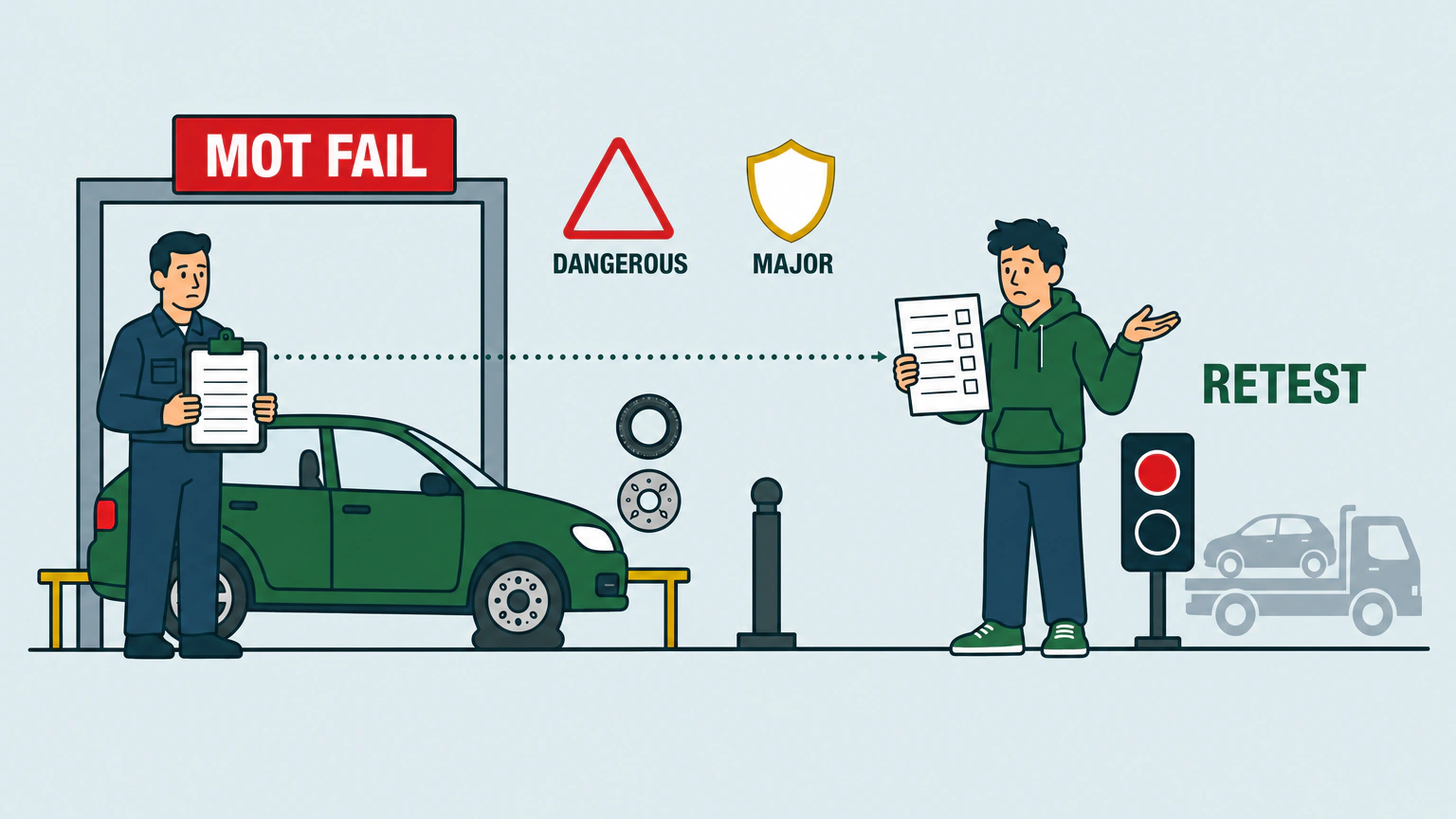
Every fault a tester records lands in one of three boxes. DVSA's inspection manual calls minor defects those that "have no significant effect on the safety of the vehicle or impact on the environment and other minor non-compliances". Major defects "may prejudice the safety of the vehicle, have an impact on the environment, put other road users at risk or other more significant non-compliances". Dangerous defects "are a direct and immediate risk to road safety or having an impact on the environment". Minor faults only and it passes. One major or dangerous fault and it fails.
| Category | What DVSA means by it | Does the car pass? | Can you drive it away? |
|---|---|---|---|
| Minor | No significant effect on safety or the environment, or another minor non-compliance | Yes, it passes | Yes, provided it remains roadworthy |
| Major | May prejudice safety, risk other road users, harm the environment, or be another significant non-compliance | No, it fails | Great Britain: yes, if your existing certificate is still valid and the vehicle remains roadworthy. Northern Ireland: no, see below |
| Dangerous | A direct and immediate risk to road safety or an environmental impact | No, it fails | No, in Great Britain or Northern Ireland |
Why a "major" fail may still let you drive in Great Britain
Here's the distinction most people get wrong in Great Britain. A major defect fails the test, but it does not by itself end the drive-away route, which is exactly why the old certificate matters. There's a floor under that permission. GOV.UK is blunt: the vehicle "must still meet the minimum standards of roadworthiness at all times".
Advisories are not a fail, but they are not nothing
An advisory can record an item that has not deteriorated enough to justify rejection, or another issue the tester thinks you should know about. It can sit quite happily on a pass certificate, but it may worsen before the next MOT, so keep an eye on it and get it repaired on a sensible timetable.
Which dangerous defects dominate in Great Britain: DVSA's numbers
Tyres and brakes are nearly nine in ten dangerous defects
The concentration in DVSA's own records is startling. Of every dangerous defect logged on cars and light vans in 2024-25, tyres accounted for 60.12% and brakes for 29.01%. Nine in ten of the faults that strand a driver, from two families of part. Tyres must meet the 1.6 mm tread minimum and be free of serious defects. Brake failures span component condition, operation, balance and measured performance.
The most common failure is not the most dangerous one
Lamps, reflectors and electrical equipment cause failures on 10.89% of all tests, more than any other category. They account for just 1.27% of dangerous defects. A lamp or electrical defect can fail the test, but this category seldom produces a dangerous defect.
How likely is a dangerous fail, really?
About one tested car or light van in four fails first time: 28.08% in 2024-25. Of all tests, 7.70% failed with at least one dangerous defect, against 20.38% on major defects only. Roughly one test in thirteen, then, produces a vehicle the driver may not legally take home. October to December has been the highest-failure quarter in each of the last four financial years.
| Defect category | Share of all dangerous defects | Dangerous defects as % of all tests | Failures of any severity as % of all tests |
|---|---|---|---|
| Tyres | 60.12% | 4.74% | 6.39% |
| Brakes | 29.01% | 2.58% | 6.63% |
| Suspension | 5.34% | 0.50% | 8.73% |
| Body, chassis and structure | 1.82% | 0.18% | 3.41% |
| Lamps, reflectors and electrical equipment | 1.27% | 0.13% | 10.89% |
| Steering | 0.99% | 0.10% | 1.97% |
| Road wheels | 0.81% | 0.08% | 0.38% |
DVSA MOT testing data, class 3 and 4 vehicles (cars, vans and passenger vehicles up to 12 seats), Great Britain, 2024-25. Percentages are of initial tests only, excluding retests, abandoned and aborted tests. These seven categories account for 99.36% of all dangerous defects.
Can you drive it away? Work through it in order
Step 1: check the refusal notice for the word "dangerous"
Ask for the refusal of an MOT test certificate, form VT30, before you leave the counter. Every fault on it is printed with its category beside it, so you're reading a fact rather than asking for an opinion. Photograph every page while you're standing there.
If a dangerous defect is listed
The car stays put. Not home, not to another garage, not "just up the road to my mate's place". Driving a vehicle that failed its MOT because of a dangerous problem can cost you up to £2,500, three penalty points and a ban.
A dangerous fail doesn't oblige you to buy the repair from the test centre. Who does the work is still your call, and once the test charge and any other agreed bill are settled, you can have the car recovered to the repairer you choose. You just cannot drive it there yourself.
If only major defects are listed
Now the old certificate decides. GOV.UK's rule reads: "You can take your vehicle away if your current MOT is still valid" and "no 'dangerous' problems were listed". Check that expiry date first, on the printed certificate or through the free MOT history service. Then book the work in anyway, because a failure does not extend the certificate you're relying on.
If the MOT has already run out
Two journeys are open to you and no others: to or from somewhere for repairs, and to a pre-arranged MOT appointment. Both only if the car is genuinely roadworthy. Anything else and you can be fined up to £1,000 for using a vehicle without a valid test certificate.
Getting it home when you cannot drive it
Three options, cheapest first. When the fail item is a tyre, a bulb, a wiper or a battery, mobile mechanics who come to you can often fix it where the car stands, which beats paying to move it at all. When they can't, vehicle recovery services will shift it, and our own cost profiles put recovery at an average of £146, most jobs between £67 and £329. The third option avoids recovery and can make the retest free: leave the car at the test centre for repair and have it retested within 10 working days.
Red flag: four things that should make you pause.
- "You can drive it home, it's only a minor problem", said about an item the notice lists as dangerous. Read the paperwork yourself. The category is printed next to the fault.
- A retest price quoted before any repair has been agreed. The retest fee is capped by the MOT fee scale. Ask which of the four retest routes applies to you.
- "You have to buy the repair from us" after a dangerous fail. The failure doesn't choose your repairer. Once any agreed bill is settled, you can arrange recovery elsewhere. You just cannot drive the car there.
- Repairs starting while you are still questioning the result. Ask them to stop. Changing the vehicle before the appeal is considered may affect the outcome.
Can I drive it — and what will the retest cost?
Answer five questions about your own MOT failure. Great Britain figures are maximum fees for a class 4 car; Northern Ireland figures are DVA's published Class IV car fees.
Can you drive it?
You may drive it — but get the faults fixed before your certificate runs out.
Nothing on the notice is dangerous and your old certificate still has time left on it, so you can drive — provided the car is genuinely roadworthy, and provided the faults are put right before that certificate runs out.
Most you should be charged for the retest
Up to £27.42
Partial retest at the same test station. A partial retest fee may be charged, capped at half the full test fee.
MOT fees are maximum fees and carry no VAT. Many garages charge less, and some charge nothing for a retest.
Great Britain free and reduced-fee routes require the same test station not to have changed ownership; if that has changed or you are not sure, check with the station before relying on the lower figure.
Half of £54.85 is £27.425; this figure is rounded down to the nearest penny, so treat it as an upper limit.
Only one partial retest is allowed per full test. If the car fails the partial retest, the next one is a full test at the full fee.
Class 4 cars only. Other vehicle classes have different fees — see the GOV.UK MOT fee table.
Every route, at a glance
Can you drive it?
- You may drive it.Great Britain, no dangerous defect listed, and your previous MOT certificate is still valid. The car must still be genuinely roadworthy.
- Only to repairs or a pre-arranged test.Great Britain, no dangerous defect, but the certificate has run out. Any other journey risks a fine of up to £1,000, and the car must be genuinely roadworthy.
- Do not drive it.A dangerous defect in Great Britain, where driving one risks a fine of up to £2,500, three penalty points and a ban. Also every Northern Ireland failure: the DVA treats a failed vehicle as not roadworthy.
Most you should be charged for the retest — Great Britain, class 4 car
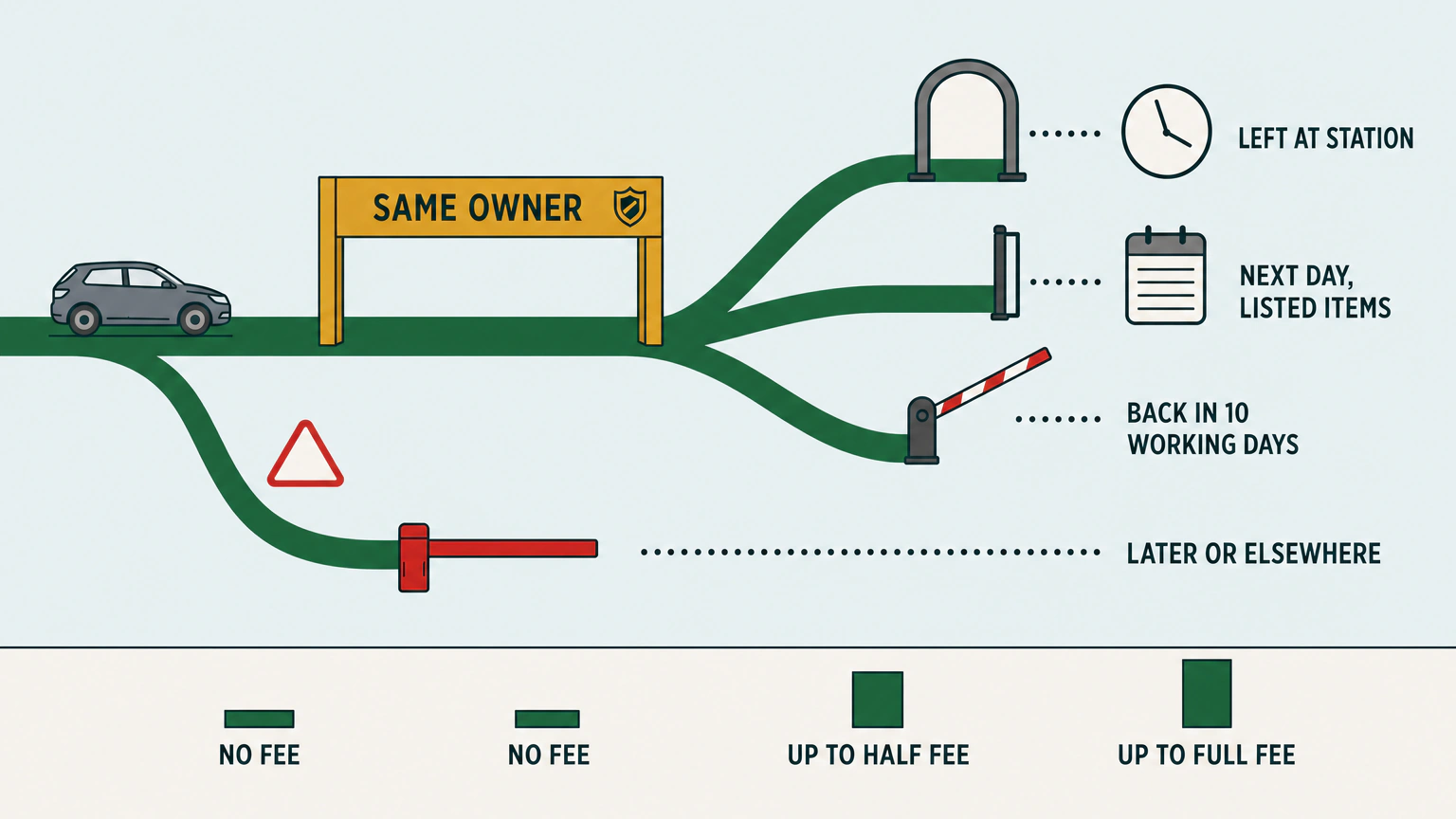
- Left at the station, kept there, retested within 10 working days, same owner£0.00
- Back at the same station by the end of the next working day, listed items, same owner£0.00
- Back at the same station within 10 working days, same ownerUp to £27.42
- Later, a different station, changed ownership, or a second retestUp to £54.85
Northern Ireland — Class IV car tested by the DVA. A failed vehicle must not be driven at all.
- Apply within 21 days and complete within 60 days£29.50
- Apply after 21 days or complete after 60 days£38.00
The retest: four routes, three fee levels
Leave it at the test centre (no fee)
This route, like every free or reduced-fee route, requires the test station not to have changed ownership since the original test. Leave the car there throughout the repair, have it retested within 10 working days, and it's a partial retest on which no fee may be charged. Cheapest square on the board, and the one that suits a dangerous fail best, because the car never moves. The trade-off: the garage that failed it also prices the work.
Take it away and return by the end of the next working day (no fee, listed items only)
The rule almost nobody publishes. Bring the car back to the same test station before the end of the next working day and the partial retest is free, provided the failure was on one of a specified list of items. That list runs to wheels and tyres, lamps other than headlamp aim, mirrors, doors, the horn, registration plates, seat belts, the windscreen with its wipers and washers, the VIN and the tyre pressure monitoring system, among others. Same station, next working day, listed item. Miss one of the three and a fee may be charged.
Return within 10 working days (partial retest fee)
Back at the same centre inside 10 working days and you get a partial retest for which a fee may be charged. DVSA's VT9A poster, the one every MOT centre has to display, sets that fee at half the test fee: for a car, half of £54.85, so a little over £27. May is the operative word. Plenty of garages charge nothing, so ask before you book.
Anything later: a full test at the full fee
Go back later than 10 working days, or to a different test station, and it's a full re-examination at the full fee, up to £54.85 for a car. One more rule sits on top of all four routes: only one partial re-examination is permitted per full examination.
| What you do | Type of retest | Maximum fee | The catch |
|---|---|---|---|
| Leave it at the test centre, retested within 10 working days | Partial | No fee may be charged | The car stays there, so the garage that failed it does the work |
| Take it away, back to the same centre by the end of the next working day | Partial | No fee | Only for failures on the listed items |
| Take it away, back to the same centre within 10 working days | Partial | Half the test fee, so half of £54.85 for a car | The fee may be charged, so ask which route you are on |
| Later than 10 working days, a different test station, or a second attempt | Full test | The full fee, up to £54.85 for a car | Only one partial re-examination is allowed per full examination |
MOT fees are maximum fees. They carry no VAT, and they have applied unchanged since 6 April 2010.
Pro tip: you get one partial re-examination per full test. If the car fails the partial retest too, the next one is a full test at the full fee. Before you take it back, ask the garage to confirm that every item on the refusal notice has been dealt with, not just the one that was easiest to reach.
Northern Ireland works differently
The DVA rule: a failed vehicle is not roadworthy, full stop
If you test in Northern Ireland, none of that applies. nidirect puts it without qualification: "If your vehicle fails an MOT test it is treated as not being roadworthy and it should not be on the road, regardless of whether you have time remaining on an existing MOT certificate." The Great Britain escape route, valid old certificate plus no dangerous defect, does not exist here. The law underneath is different too: the offences sit in the Road Traffic (Northern Ireland) Order 1995, not the Road Traffic Act 1988, which does not reach across the Irish Sea.
Retest windows: apply within 21 days, test within 60
DVA counts in calendar days, not working days, and runs two clocks at once. Apply within 21 days of the original test and you pay the retest fee, £29.50 for a car against £38 for a full test. Apply later and it's the full fee again. Either way the retest has to be completed within 60 days. One local quirk to check: Temporary Exemption Certificates still extend some private cars' MOT validity here. We list garages across Northern Ireland by town.
| Great Britain (DVSA) | Northern Ireland (DVA) | |
|---|---|---|
| Who tests | DVSA-authorised test stations | DVA-run test centres |
| Drive away with a valid old certificate and no dangerous defect | Yes | No. A failed vehicle is treated as not roadworthy regardless |
| Free partial retest | Yes, if station ownership has not changed and the car is left there and retested within 10 working days, or returned to the same station by the end of the next working day on listed items | Not published in those terms. A retest fee applies instead: £29.50 for a car, against £38 for a full test |
| Retest deadline | Within 10 working days for a partial retest | Apply within 21 days; the retest must be completed within 60 days |
| Appeal deadline | Within 14 working days of the test, to DVSA | Within 14 days of the test, to DVA, or ask the centre manager before you leave |
| Statutory basis for the driving offences | Road Traffic Act 1988, ss. 40A and 47 (England, Wales and Scotland) | Road Traffic (Northern Ireland) Order 1995, arts. 54 and 63 |
If you think the failure is wrong, or the garage is pushing you
Appealing an MOT result
Talk to the test centre first, before anybody picks up a spanner. In Great Britain, send DVSA the complaint form within 14 working days of the test. They will be in touch within five days, and if they decide to recheck the car you pay the full test fee again, refunded if the appeal succeeds. In Northern Ireland, ask the centre manager to look again while you're still there, or appeal to DVA within 14 days by phone or email, and they offer a recheck appointment within five working days. Have no repairs done until the appeal is settled, because changing the vehicle may affect the outcome.
Your rights if the repair itself is the problem
The MOT rules split at the Irish Sea. Your consumer rights do not. Section 49 of the Consumer Rights Act 2015 covers the whole United Kingdom, and it requires a trader supplying a service to perform it with reasonable care and skill. That bites on the repair work, not on the test result. Where a garage subscribes to The Motor Ombudsman's Service and Repair Code, approved by the Chartered Trading Standards Institute, its commitments include invoices that match the price quoted and a straightforward complaints procedure. An unresolved dispute can go to the ombudsman. Plenty of good garages are not members. Where no scheme applies, contact Citizens Advice in England or Wales, Advice Direct Scotland in Scotland, or Consumerline in Northern Ireland. Suitable complaints can be passed to Trading Standards.
Getting a second quote before you authorise anything
A refusal notice is a portable document. Nothing ties the work to the garage that failed it, and for a car that cannot be driven you choose where it is recovered and who prices the repair. If the figure feels heavy, take the notice to other MOT and vehicle inspection centres near you and have it priced again.
Seven things to do before you leave the test centre:
- Ask for the refusal of an MOT test certificate (VT30) and photograph every page.
- Ask the tester to point to the word "dangerous", or to confirm in writing that it does not appear.
- Check the expiry date on your existing certificate before you decide whether to drive away.
- Ask what a partial retest would cost, and whether the free next-working-day route covers your fail items.
- Ask which items are advisories rather than fails, and get the two separated on paper.
- Do not authorise any repair on the spot.
- If you disagree with the result, say so before any work starts. Changing the vehicle may affect the appeal outcome.
What the repairs are likely to cost
Where our own cost profiles land
Our category pages carry cost profiles submitted by people who have paid for the work, and they land on the parts that fail MOTs. Brake repair specialists average £196 across 678 profiles, which matters because brakes are 29% of every dangerous defect recorded. Two gaps worth naming: we publish no cost panel for MOT testing itself or for tyres, so neither of those numbers is ours to give.
These are our own aggregates, not a national market average and not a quote for your car.
| Service | Preferred Mechanic average | Range (minimum to maximum) | Cost profiles in the sample |
|---|---|---|---|
| Brake repair and services | £196 | £55 to £717 | 678 |
| Vehicle recovery | £146 | £67 to £329 | 575 |
| Steering and suspension | £996 | £664 to £5,567 | 617 |
| Mobile mechanic | £156 | £124 to £581 | 625 |
| General mechanic shops | £710 | £323 to £3,219 | 581 |
Why the same job varies so much
Same fault, same car, three different prices, and none of them dishonest. Parts choice is one large lever: original equipment, equivalent-quality aftermarket, or remanufactured. Labour rates swing by region and by whether you're in a main dealer's reception or an independent's yard. Then there's the fail item that turns out to be a symptom rather than the fault, which is how a £90 job becomes a £400 one. An average is a sanity check on a quote. It's never the quote.
Frequently asked questions
Can I drive home after a failed MOT?
In Great Britain, yes, if no dangerous defect was listed, your previous certificate has not expired and the car remains roadworthy. Miss any condition and do not drive it. In Northern Ireland the answer is no, whatever time is left on the old certificate.
How long can I drive after a failed MOT?
In Great Britain, you can use the ordinary drive-away route only until the existing certificate expires, and only while the car remains roadworthy. The failure does not shorten or extend that certificate. After expiry, the only permitted journeys are to a pre-arranged test and to or from repairs, again only if the car is roadworthy. Northern Ireland does not allow the ordinary drive-away route after a fail.
Can I drive a failed MOT car to another garage?
Not if a dangerous defect was listed; that car has to be recovered, whatever its destination. In Great Britain, without a dangerous defect and with a valid certificate, you may drive it to another garage only while it remains roadworthy. If the certificate has run out, the repair journey is one of the two exceptions, again only if the car is roadworthy.
Is a partial MOT retest free?
In Great Britain, sometimes. Provided the test station has not changed ownership, it is free if the vehicle stays there and is retested within 10 working days, or if it returns to the same centre by the end of the next working day on a listed item. Otherwise a fee may be charged.
How much is an MOT retest?
In Great Britain, a full retest costs up to the full class fee, £54.85 for a car. If the car qualifies for a partial retest at the same test station and its ownership has not changed, that fee is capped at half the test fee, a little over £27. Both are maximums rather than prices: many garages charge less, and some charge nothing.
What counts as a dangerous defect on an MOT?
A defect that is a direct and immediate risk to road safety or has an impact on the environment, in DVSA's words, and the category is printed on your refusal notice. In practice it's nearly always tyres or brakes, which together account for about 89% of dangerous defects on cars and vans.
How do I appeal an MOT test result?
Raise it with the test centre first. If that gets nowhere, send DVSA the complaint form within 14 working days of the test, or in Northern Ireland contact DVA within 14 days. Have no repairs carried out until the appeal is decided, because changing the vehicle can affect the outcome.
How much is an MOT retest in Northern Ireland?
£29.50 for a car, against £38 for a full test, provided you apply within 21 days of the failed test. Apply later and you pay the full test fee again. Either way the retest has to be completed within 60 days of the original test.
MOT rules, fees and DVSA's failure data all move. Two pages are worth bookmarking: GOV.UK's Getting an MOT guide, and nidirect's After the MOT/vehicle test if you test in Northern Ireland.
Pro tip: the updated VT9A poster, which MOT centres had to display from 12 June 2026, says the MOT Testing Service holds an image of the vehicle taken during the test. DVSA controls those images under the UK GDPR and the Data Protection Act 2018. One more reason to argue from the record rather than from memory.
This is general information about the MOT scheme in the United Kingdom, not legal advice, and your refusal notice is the authority on your own car. Whether yours is safe to drive is a judgement only someone standing next to it can make, so if there is any doubt, leave it where it stands and get it recovered.