

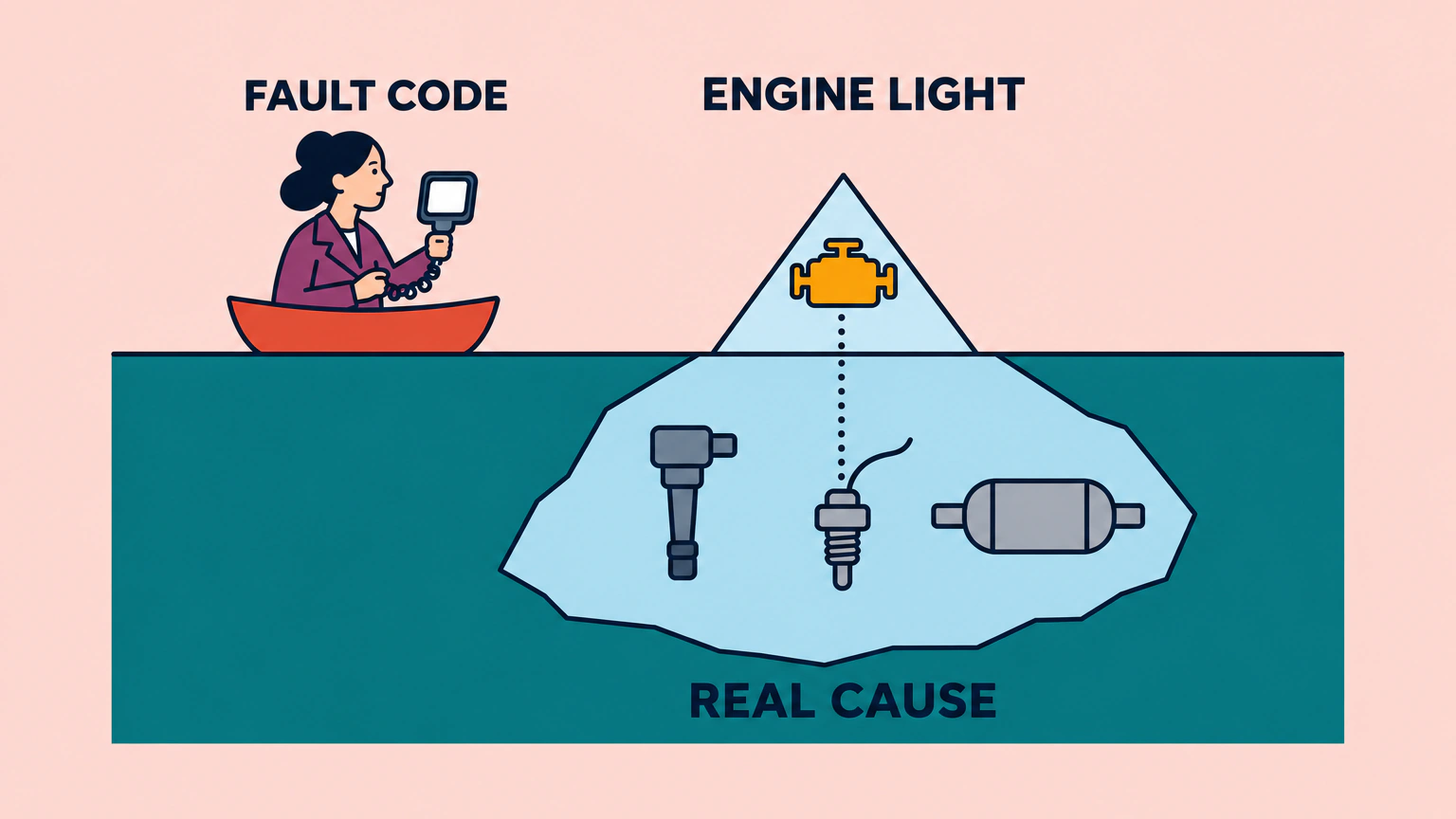
The engine management light means the car's computer has logged a fault, usually one that affects emissions, and on its own it doesn't tell you which part has failed. If it's steady and the car drives normally you can usually finish your journey gently and get the code read soon, but if it's flashing, red, or comes with lost power, juddering or smoke, pull over when it's safe and switch off.
Three questions usually follow, in this order. Can I keep driving? Will it fail the MOT? And what will a garage charge just to tell me what's wrong?
On this page
What the light is actually telling you
DVSA's MOT manual calls it the "Engine malfunction indicator lamp (engine management light or 'EML')". Kia's UK warning-light guide puts its job plainly: it's "a part of the Engine Control System which monitors various emission control system components".
It lights when you switch on and goes out a few seconds after the engine starts. That's the bulb check, and DVSA notes that "On some vehicles it will be necessary to start the engine before the MIL goes off". Lit with the engine running, it means the computer has logged a fault.
The AA's usual suspects include an oxygen sensor, a blocked diesel particulate filter (DPF, which traps exhaust soot), a mass airflow sensor, an ignition fault and even a loose oil dipstick. The lamp names none of them. It stores a code a garage can read, and that's where the real answer starts.
Steady, flashing or red: how far can you drive?
Steady and smooth, to the end of your trip. Flashing, red or rough, to the next safe stop.
For a steady amber light, the AA's advice is to "try to avoid heavy acceleration and high engine speed". The AA also says two things that don't sit well together. In one place you "can continue driving to your destination". In another, "It's not advisable to drive more than another couple of miles without getting your car checked by a professional mechanic." Here's our ruling. If the light is steady and the car feels normal, a gentle drive to where you were going, or to a garage, is fine. Leaving it for weeks isn't.
The stop signs come from the AA too: strange noises or smells, smoke, a drop in performance, or a light that's red or flashing. Any one of them means you pull over as soon as it's safe, switch off and call your breakdown provider.
| What you see | What it usually means | What to do |
|---|---|---|
| It lights when you switch on, then goes out once the engine runs | The normal bulb check | Nothing |
| Steady amber, and the car drives normally | The engine computer has logged a fault, often in the emissions system | Drive on gently, avoid hard acceleration and high revs, and get the code read soon |
| Steady amber with lost power, juddering, smoke or a strange smell | A fault that's changing how the engine runs | Pull over when it's safe, switch off and call your breakdown provider |
| Flashing amber | On a petrol car, usually a misfire that can damage the catalytic converter | Ease off and pull over when it's safe. On a diesel, check the handbook too |
| Red engine light | A serious fault | Pull over when it's safe, switch off and call your breakdown provider |
| It doesn't light at all when you switch on | The lamp or its circuit may have failed | Get it checked before the MOT, because a dead lamp can fail too |
Your handbook's advice for your model comes first, and it may be stricter.
We can't see or hear your car. If the light comes with anything that worries you, treat it as a breakdown and get help where you've stopped.
Flashing on a petrol car usually means a misfire
On a petrol car, the AA says the light "will only flash if there's a potentially serious issue with your car, such as a misfire". The part at risk is the catalytic converter, the box in the exhaust that cleans up the gases. One of Kia's owner's manuals is blunt about it: if the light "begins to flash ON and OFF, potential catalytic converter damage is possible which could result in loss of engine power".
The money shows why that matters. ClickMechanic's price guides put a replacement ignition coil at £70 to £220. A catalytic converter runs £175 to £900.
The experts don't quite agree on what comes next. Volkswagen UK's triage asks whether the car is "vibrating and down on power". If it isn't, and you can get there safely, Volkswagen says to "Take caution while driving to an authorised repairer". The AA's advice for a flashing light is firmer: pull over, switch off and call for help.
We'd follow the AA. A worn coil or spark plug is the cheap end of a misfire. The converter is the expensive part you're protecting.
Flashing on a diesel can mean something else
Diesels muddy it. The same Kia manual gives a blinking light on a diesel two other meanings. One is "some error related to the injection quantity adjustment", which can bring "loss of engine power, combustion noise and poor emission". The other applies to cars with a DPF. There, the light "may stop blinking" after about 25 minutes of driving, either above 37 mph or in third gear or higher at 1,500 to 2,500 rpm. If it keeps blinking after that, have it checked at a local garage, because Kia warns that driving on with it blinking "for a long time" can damage the DPF and worsen fuel use.
On some diesels, Volkswagen's among them, one coil-shaped lamp does two jobs. Volkswagen calls it the "Glow Plug/Diesel engine management light". If your diesel's warning is that coil, read up on the glow plug light as well.
In the end, your handbook says which meaning your diesel uses.
It came on, then went off
It's a relief, but it isn't an all-clear. The AA says a light that comes and goes "is due to the fault only being detected by the sensor at certain times".
Two first steps cost nothing. Volkswagen's triage for a steady light starts with the key out for 30 seconds, then a restart. The AA suggests parking somewhere safe and restarting the engine after 2 minutes.
The light going out doesn't wipe the record, though. Under the type-approval rules modern cars are built to, the on-board diagnostic system "may erase a fault code and the distance travelled and freeze-frame information if the same fault is not re-registered in at least 40 engine warm-up cycles or 40 driving cycles". Freeze-frame data is a snapshot of what the engine was doing when the fault set. So the record can outlive the light, and that's your chance to get it read.
A light that keeps coming back is a fault that's still there.
Will the engine management light fail an MOT?
On most cars, yes. DVSA's MOT inspection manual tells the tester to "Turn on the ignition and check that the engine malfunction indicator lamp (MIL) illuminates and then goes off". It lists "Engine MIL inoperative or indicating a malfunction" as a major defect. Steady or flashing makes no difference, and a lamp that never lights fails too.
A major defect isn't a dangerous one. In Great Britain, GOV.UK's MOT guidance says you can take the car away if your current MOT is still valid and nothing is marked dangerous. If emissions failures came on the same sheet, our guide to failing the MOT on emissions covers both. The retest and the drive home are in our guide to driving after a failed MOT.
Which cars the tester checks
It comes down to fuel, seats and one date, the day the car was first used. DVSA's manual sets three gates. Petrol cars with up to eight passenger seats, petrol hybrids included, are checked if they were first used on or after 1 July 2003. Diesels, diesel hybrids included, are checked from 1 July 2008. So are petrol vehicles with more than eight passenger seats, and gas and bi-fuel cars with up to eight. Kit cars, amateur-built vehicles and American pickups don't have to have the lamp at all.
| Your vehicle | Great Britain (DVSA test) | Northern Ireland (DVA test) |
|---|---|---|
| Petrol, including petrol hybrids, up to 8 passenger seats, first used on or after 1 July 2003 | Checked. A light that stays on or never comes on is a major defect, so the car fails | Checked, with the same result |
| Diesel, including diesel hybrids, first used on or after 1 July 2008 | Checked, with the same result | Checked, with the same result |
| Petrol with more than 8 passenger seats, or gas and bi-fuel with up to 8, first used on or after 1 July 2008 | Checked, with the same result | Checked, with the same result |
| Older than those dates, with an engine light fitted | Not checked | Fails if the light is on showing a fault. A dead lamp isn't checked |
| Kit car or amateur-built car | Not checked | Doesn't have to have the lamp |
DVSA also leaves American pickups out of the check. 'First used' normally means the first registration date, or six months after the car was built if that's earlier. For an import, it's the date of manufacture.
You'll see other rules online. One garage page says the light fails any car first used from 2009. Another says a 2026 update has testers checking the car's readiness monitors, its own self-tests. DVSA's lamp rules mention neither. In Great Britain, a car first used before its gate isn't checked at all, lit or not.
Northern Ireland can fail an older car too
Northern Ireland runs its own test at DVA test centres, and nidirect puts a car's first test at four years old, against three in Great Britain. The DVA's inspection manual uses the same dates for which cars must have the lamp. Then it adds a rule DVSA doesn't have. On older cars, "if an engine MIL is fitted, the inspection is limited to an engine MIL that is illuminated, indicating a fault". The DVA rejects that as MAJOR.
So picture a 2001 petrol car with its engine light on. In Great Britain it's outside the lamp check. In Northern Ireland, it fails.
The rule cuts the other way too. On those older cars, a lamp that doesn't work at all isn't checked.
Clearing the code before the test
The tester checks the lamp on the day. Clear the code the night before and the lamp goes out. The fault stays, though, and the light returns once the car detects it again. The AA's warning about resetting it any way other than a repair is plain: "you may be ignoring a potentially critical issue with your car". Pulling the bulb won't work either on a car new enough for the full lamp check, because a lamp that never lights fails as "inoperative".
For a used-car buyer, a recent MOT pass proves the lamp behaved on test day, and nothing more.
We'd fix the fault and let the light go out for the right reason, then book the test. In Great Britain that's at one of the MOT test centres near you, and in Northern Ireland it's with the DVA.
A fault code is a lead, not a diagnosis
The RAC gives three examples of what a fault code looks like: "P0300: Random/Multiple Cylinder Misfire Detected", "P0420: Catalyst System Efficiency Below Threshold" and "P0171: System Too Lean (Bank 1)".
Notice what's missing. A code names the condition the computer saw, not the part that caused it. P0171 says the mixture is lean, with too much air for the fuel. It doesn't say why. The RAC's own line is that "interpreting the results needs expertise".
A good diagnosis runs in order. Read the codes and the record of when they set, check live data (the sensor readings as the engine runs) and test the suspect part. Only then replace it, clear the codes and drive the car to prove the fix.
It goes wrong when someone skips the middle. A part goes on because a code named its circuit, the light comes back, and you pay for a second visit. One engine fault can also set several codes and bring other lights on with it, traction control among them. The first code on the list isn't always the one to chase. That judgement is what you pay an auto electrician near you for.
What a diagnostic should cost, and what you should get for it
Three companies publish averages for a diagnostic check, and they run from about £52 to £104.
| Who publishes it | What the figure is | Price |
|---|---|---|
| RAC Mobile Mechanics | Average quoted for a car diagnostic, January to March 2025, for a flat-rate visit of up to 30 minutes with a report | £104 |
| ClickMechanic | Average diagnostic check | £65 |
| FixMyCar | Average car diagnostic test booked (its engine light page says £51.66) | £51.53 |
| FixMyCar | Average electrical diagnostic booked | £62.34 |
Each figure is that company's own average, not a price list for every garage.
The RAC's figure buys a flat-rate visit. Its mobile mechanics spend "up to 30 minutes" on the car and give you "a report for your records". For auto electrical work, the trade that traces these faults, our own indicative cost for a fault-code read and report is £25 to £75 per session. That covers the scan and an explanation. Electrical fault-finding, meaning testing and diagnosis, runs £70 to £180 for the initial hour.
Then there's the law. If you didn't agree a price, the Consumer Rights Act 2015 says you pay "a reasonable price for the service, and no more". Under the same Act, anything the garage tells you that you rely on, such as 'the scan comes off the repair', becomes part of the deal. Citizens Advice separates a quote, which is a promised price, from an estimate, "a trader's best guess". Only an estimate can grow, and then only "within reason".
To be fair to the trade, diagnosis is paid time, even when the answer so far is only 'it isn't this'.
What to ask for before you pay
Before you hand over your card, ask for these five things. An honest garage gives you all of them without being asked.
- Every fault code written down with its description, or a printed report.
- What the car was doing when each fault was stored, and how far it's gone with the light on. Modern cars keep both.
- The test that confirmed the faulty part, not just the code that pointed at it.
- A written quote for the repair before any work starts.
- In writing, whether the diagnostic fee comes off the repair bill.
Frequently asked questions
Is it illegal to drive with the engine management light on?
No. The light on its own isn't an offence. Driving a car whose condition puts people in danger of injury is, in every part of the UK. The AA warns that a flashing amber or solid red light, together with visible problems, could get you pulled over and fined for exactly that.
Why is my engine management light on when the car drives fine?
The computer has logged a fault that hasn't changed how the car feels yet, often in the emissions system. Kia's UK warning-light guide says the car can generally still be driven. It also warns that driving on for long with the light lit can damage the emission control system. We'd get the code read within the week.
Can I read the fault code myself?
Yes. A plug-in code reader connects to the car's diagnostic socket, usually under the dashboard, and shows the stored code. The RAC's view is that interpreting the result needs expertise. Write the code down before anyone clears it, and take it with you to the garage.
Can low oil turn the engine management light on?
Rarely, the AA says. Low oil has its own warning light, usually shaped like an oil can, and that's the one to watch. If an oil light comes on red, stop as soon as it's safe. Volkswagen's advice for its red oil pressure light is to switch the engine off straight away, not restart it, check the oil level, and call for help if the level is fine.
How long does a diagnostic check take?
ClickMechanic says a diagnostic inspection usually takes under an hour. The RAC puts diagnostic tests at anything from 30 minutes to a few hours, depending on the fault. A fault that comes and goes can take longer, because it has to show itself first. Agree a time limit or a price cap before the garage starts.
What if the light comes back after the garage fixed it?
Take it back. The AA's advice is to return the car if the light comes on again after a repair. If the work wasn't done with reasonable care and skill, the Consumer Rights Act 2015 lets you ask for it to be done again. If that's impossible, or the garage is too slow or causes you real hassle redoing it, you can ask for a price reduction. Citizens Advice suggests a second garage's opinion to settle what's reasonable, and if the first garage still won't put it right, here's how to complain about a garage.