
Brake fluid ages even when you don't drive: Volkswagen's UK advice is a first change within three years of buying the car and every two years after that. A standalone change costs about £50 to £60 at the big UK chains. The MOT doesn't test the fluid for water, so if a garage tells you yours "failed", that verdict came from its own test. It's worth asking which one.
Fifty quid isn't a silly price for this job. But "failed" on its own tells you nothing. Before you say yes, find out what was tested, and when the fluid was last changed.
On this page
Your garage says the fluid failed. What did it actually test?
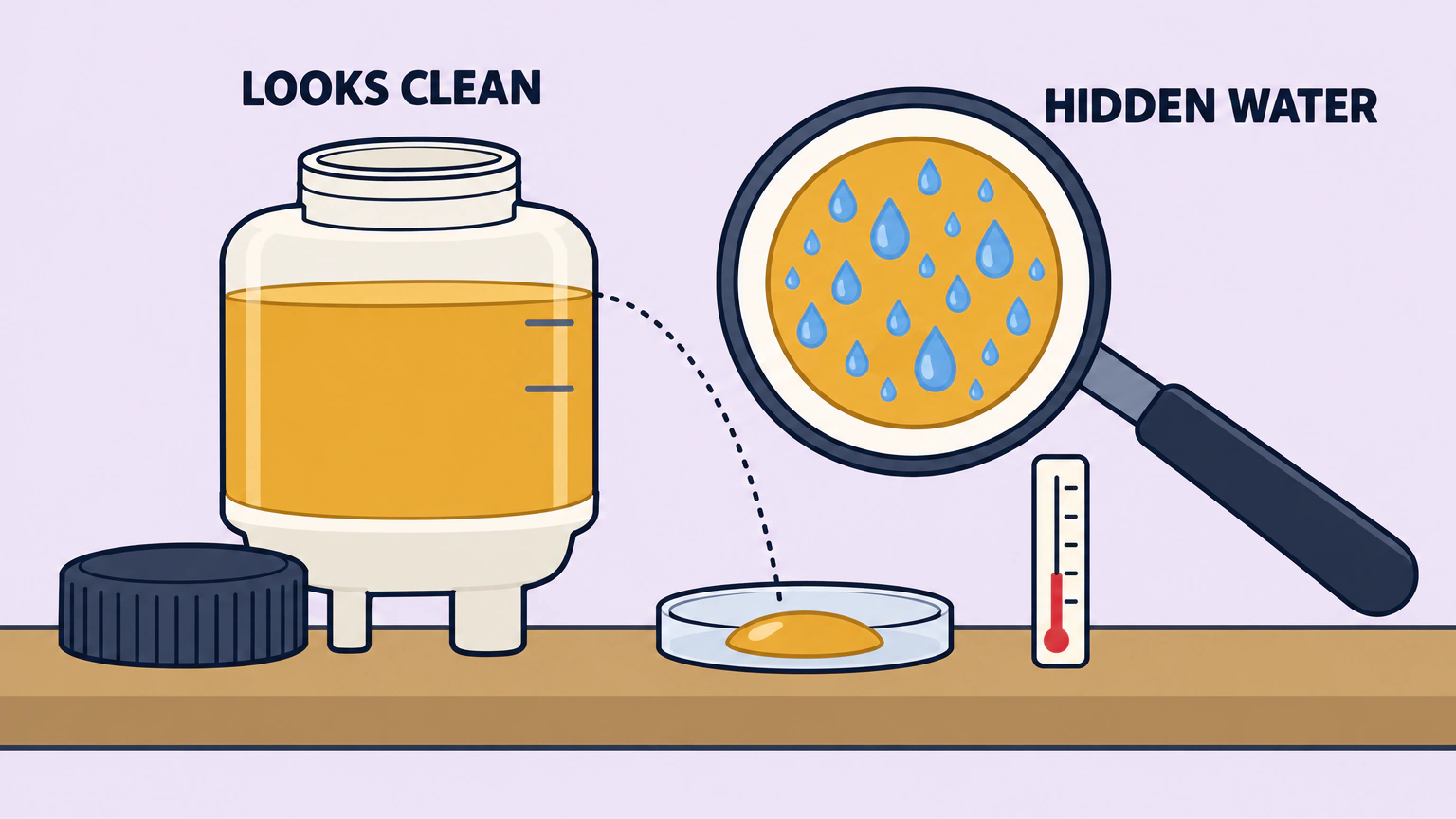
"Failed" isn't one test. Glycol-based brake fluid soaks up water from the air, and water lowers the temperature the fluid boils at. Some garage tests are trying to judge that, directly or by a rough guess. One of them doesn't measure water at all.
A free brake check can bring that verdict. National offers a "FREE brake check", and Kwik Fit describes "our free comprehensive brake check". There's nothing wrong with either offer. A free check is a fair way for a garage to find work. The question is what the check measured.
Three tests, three different things
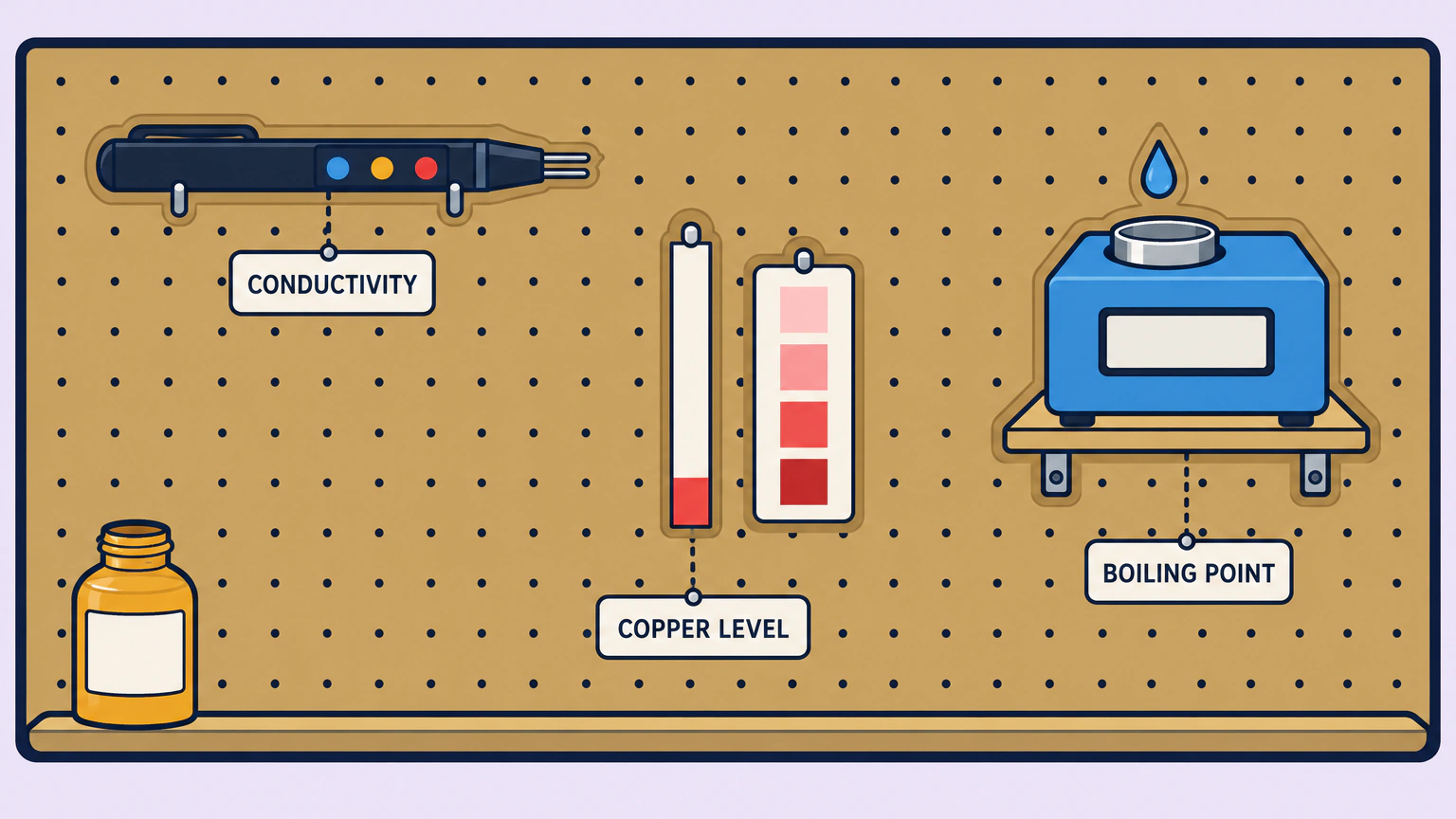
A garage can judge your fluid four ways: by eye, with a conductivity pen, with a copper test strip, or with a boiling-point tester. Three of those are tools you might see in the technician's hand, and they don't measure the same thing.
The eye catches only what's visible. Haynes is blunt about it: "You're not going to see the moisture in the fluid." Clean-looking fluid can still be carrying water.
| Test | What it actually reads | What a fail tells you | What to ask for |
|---|---|---|---|
| A look at the reservoir | Colour and clarity through the reservoir wall | Only contamination you can see. Water mixed into the fluid stays invisible | Look yourself. The level should sit between the minimum and maximum marks |
| Conductivity pen | How easily the fluid carries a current, turned into a water estimate | A rough warning. Readings vary with the brand and grade of fluid | The pen's lights or percentage |
| Copper test strip | Copper dissolved in the fluid, matched to a colour chart in ppm | Copper picked up from inside the brake system, a sign of corrosion. It doesn't measure water | The strip held against the chart |
| Boiling-point tester | The temperature a small sample actually boils at | The fluid's real boiling point, the property that matters when brakes get hot | The reading in °C |
A pen turns conductivity into a water estimate. NAPA's UK technical guide calls that method "dangerously flawed", because new fluids conduct differently depending on the maker and the grade. Unless the pen is calibrated for the one fluid it's testing, NAPA says, its answer can be badly wrong.
A copper strip doesn't look for water at all. Phoenix Systems, which makes copper strips, says they measure "signs of internal ABS corrosion", meaning copper the fluid has picked up from the metal inside your brakes.
A boiling-point tester is the direct one. It heats a small sample and reads the temperature it boils at. NAPA recommends a change once that reading drops below 200°C, and an immediate one below 180°C.
Why the trade can't agree on which test counts
You won't find this argument on the booking pages. NAPA says brake fluid "should be tested with a boiling point device". Phoenix argues the opposite. Copper, it says, flags far more cars for a flush than a boiling-point test does, and there's "no basis or standard for changing brake fluid based on moisture or water levels".
Bear in mind who's talking. Phoenix sells the strips, and its own page pitches them to garages as a way to sell more flushes. NAPA sells brake fluid.
Tesla's 2020 to 2024 Model Y service manual uses the strip. If the pad comes out darker than the chart's 100 ppm sample, Tesla recommends a flush. If it matches the 30 ppm sample or comes out lighter, the advice is to check again in four years.
The MOT, for its part, only fails fluid that's clearly contaminated. And if anyone quotes you a boiling point off a strip, they've mixed up two different tests.
Our view is simple. Any of these readings beats "failed" with no number attached. Ask for the reading and the date of the last change, then weigh the two together.
Five questions to ask before you say yes
These turn a verdict into evidence, and you don't need to know how to bleed brakes to ask any of them.
- Which test did you use: a look, a pen, a strip or a boiling-point tester?
- What was the actual reading? Ask for the number in °C, the strip against its chart, or what the pen showed.
- When was the fluid last changed? Check your invoices, then the interval in your handbook.
- Which grade will you put in? It should match the one your handbook names.
- Does the price include bleeding the ABS unit? Kwik Fit says most modern cars need a diagnostic tool for that step.
The reading tells you about the fluid in your car today. The calendar tells you whether it was due anyway.
How often brake fluid really needs changing
Use the interval in your handbook. It usually comes round every two or three years.
| Carmaker | What its own page says | What that means for you |
|---|---|---|
| Volkswagen UK | "for the first time at the very latest three years after buying the car, and then every two years" | First change within three years of buying the car, then every two years |
| Renault UK | "every 3 years or 74,500 miles even if the vehicle is not driven very much", and lower on the same page, "around every two years" | Two answers on one page. Your service book settles it |
| Tesla | "Brake fluid health check every 4 years (replace if necessary)" | A test at four years, and new fluid only if the test calls for it |
Volkswagen and Renault from their UK owner pages, Tesla from its Model Y service schedule. Other makes and models differ, so check your own handbook.
Volkswagen's line is the clearest of the three, and Renault's is the one to settle with your service book. Tesla tests its Model Y every four years and replaces the fluid if needed. Heavy braking from towing, mountain descents or performance driving can shorten that interval, especially in hot, humid conditions.
The chains mostly use one line, "every 24 months or 24,000 miles, whichever is sooner", which is Halfords' and National's wording. Kwik Fit says "at least every two years". ClickMechanic goes further, with "every 12 months or 12,000 miles". And a few paragraphs down its own page, Kwik Fit also says "every 2 to 3 years".
Our verdict: find the date in your handbook or service book, then dig out your invoices for the last change. A stamped service book isn't proof on its own, because plenty of services check the fluid without replacing it. You want the words "brake fluid" on a bill. If you'd rather hand the whole schedule to someone else, look for garages that service to your carmaker's schedule.
Why time matters even when you don't drive
Brake fluid is hygroscopic, which means it pulls water out of the air. A sealed system doesn't stop it. NAPA notes that water vapour "can gradually penetrate flexible rubber brake hoses", and Renault says the change is due "even if the vehicle is not driven very much". A car that sits on the drive all winter still ages its fluid.
Water lowers the boiling point, and the US standard behind the DOT grade on the bottle shows how far. New DOT 4 must boil no lower than 230°C. After the standard's damp test, which soaks a reference fluid until it holds about 3.7% water, the floor drops to 155°C.
That matters because brakes get hot. If the fluid beside them boils, it makes bubbles of vapour, and those squash when you press the pedal, where liquid wouldn't. NAPA's guide calls this "vapour-lock" and warns it can mean "a complete loss of braking". The water also corrodes metal parts from the inside.
We can't see your car from here. If the brake pedal suddenly feels soft or sinks towards the floor, stop driving and get the brakes checked, whatever your service book says.
Does the MOT check your brake fluid?
Yes, but only what a tester can see with the cap on. DVSA's manual puts it plainly: "Reservoir caps should not be removed." On contamination it adds, "You should only fail a vehicle if you can clearly see that the fluid is contaminated." In Great Britain, contaminated fluid became a fail on 20 May 2018, when it joined a list of new brake failures.
| What the tester finds | Great Britain (DVSA) | Northern Ireland (DVA) |
|---|---|---|
| Fluid below the minimum mark | Minor | Minor |
| Fluid significantly below the minimum mark | Major | Major |
| Fluid so low it can't be seen | Dangerous | Dangerous |
| Reservoir cap missing | Major | Major |
| Brake fluid warning light on, or not working | Minor | Minor |
| Fluid clearly contaminated | Major | Major |
| Water content or boiling point | Not tested, and the cap stays on | Not tested, and the cap stays on |
Minor items still pass and are noted on the result. Major and dangerous items fail, and after a dangerous fail the car shouldn't be driven until it's repaired.
Two things are easy to miss. First, a low level is often pad wear, not a leak or old fluid. Haynes points out that the level drops as the pads wear down. At the MOT, fluid below the minimum mark is only a minor defect. Don't top it up to the maximum on worn pads, either. When new pads go in, the pistons push that fluid back up and it has nowhere to go. Our guide to checking your brake pads shows what worn pads look like.
Second, no MOT tests the fluid's water content or boiling point, in Great Britain or in Northern Ireland. Water content or a low boiling point alone won't fail the MOT. A garage can still recommend a change on the strength of its own test, and that's a fair conversation to have with the reading in front of you.
For the test itself, find an MOT centre near you. If the car does fail on something else, check whether you can drive it after a fail before you leave.
What a brake fluid change should cost
About £50 to £60 at the big chains, and anywhere from £40 to over £120 across the other prices we found. Here's the brake fluid change cost as seven companies publish it.
| Where | Price | What the price covers |
|---|---|---|
| Protyre | £49.99 | Fully fitted, including VAT |
| Kwik Fit | £52.95 | Booked online, the same for every size of car |
| Halfords | From £59.99 | Set by your nearest garage |
| National | £59.99 | Booked online at a local branch |
| BookMyGarage | £70 average | Its published average, October 2026 |
| ClickMechanic | £50 average, £40 to £90 | Its averages for 15 makes run from £62 to £90 |
| RAC | From around £90 | More for large or premium cars, and over £120 with higher-quality fluid |
Prices as each company publishes them. ClickMechanic's £50 headline sits below all 15 of its own make averages.
Protyre, Kwik Fit, National and Halfords sit within about £10 of each other, and Kwik Fit charges the same whatever you drive. BookMyGarage lists a £70 average. ClickMechanic's make averages start at £62, so don't expect your own quote to match its £50 headline. RAC starts at about £90 and goes past £120 with a better fluid.
Haynes put main-dealer labour alone at about £150 back in 2019. That's an old figure. We don't publish a brake fluid replacement price of our own, so each price comes straight from the company named beside it.
What the price should cover
A proper job is more than a top-up, and Kwik Fit's own description is a good yardstick. A pressure bleeder pushes new fluid in. Each brake is then bled in turn at its bleed nipple, "until clean fluid is seen in the bleed bottle". After that, on most modern cars, a diagnostic tool runs the ABS unit's bleed function, which Kwik Fit says "ensures that all the old fluid is purged from the different pathways and valves within the ABS pump".
The new fluid should be the grade your handbook names, poured from a sealed bottle. "Only use new fluid from a sealed container," says Haynes, because an open one soaks up moisture. Comma gives each bottle a three-year shelf life, counted from a date code printed on it. Electric and hybrid cars narrow the field: Kwik Fit does them "at selected centres only".
Ring the garage the same day if the pedal feels different afterwards.
If your fluid is due by date, book it as its own job with brake specialists near you. Keep the invoice. It's your proof the work was done.
Which brake fluid does your car need?
The grade in your handbook, and on a modern car that's usually DOT 4. Comma's DOT 4 page calls it "The current standard brake fluid for most manufacturers". Tesla's 2020 to 2024 Model Y service manual tells its own technicians to "Check the service history of the vehicle to determine which type of brake fluid the brake system is filled with."
| Grade on the bottle | Type and colour | Boils no lower than, new | Boils no lower than, after the damp test |
|---|---|---|---|
| DOT 3 | Non-silicone, colourless to amber | 205°C | 140°C |
| DOT 4 | Non-silicone, colourless to amber | 230°C | 155°C |
| DOT 5.1 | Non-silicone, colourless to amber | 260°C | 180°C |
| DOT 5 | Silicone, dyed purple | 260°C | 180°C |
Minimums from FMVSS 116, the US standard the DOT grades come from. Good fluids beat them. Comma's standard DOT 4 lists 265°C new and 160°C after the damp test.
Two things matter in a workshop. First, some handbooks ask for a thinner DOT 4, the kind sold with ESP (electronic stability control) in its name. Comma's DOT 4 ESP is about half as thick as its standard DOT 4 at minus 40°C, meets ISO 4925 class 6, and is sold "For improved braking and faster anti-skid reaction at low temperatures". Use it where the handbook calls for it.
Second, mixing. Motul says DOT 3, DOT 4 and DOT 5.1 can be mixed. Silicone DOT 5 never goes in with them, and Motul and ATE both say so. Comma's own directions put one line first, under the word "IMPORTANT": "Follow vehicle manufacturer's recommendations." That goes for the grade, and for the date.
Brake fluid questions people ask
Do I need to change brake fluid when I change my brake pads?
Not because of the pads. A pad change doesn't call for new fluid, but worn pads do explain a level that's been falling: Haynes notes the level "goes down as the brake pads wear, so don't automatically think that there's a leak". If your fluid is due by date anyway, ask for both on one visit. Our guide to checking your brake pads shows what to look for.
Is a brake fluid change included in a car service?
Usually only in a major service. Halfords and National both change the fluid in their major service, and National says plainly its interim and full services don't include it. Kwik Fit checks the fluid's condition and boiling point at its interim and full services but doesn't replace it. Our guide to car service prices compares what each package covers.
Can I just top up my brake fluid instead?
A top-up doesn't take out the water already in the fluid. And a level that keeps dropping is a clue in itself: worn pads or a leak, both jobs for a garage to find. At the MOT, fluid below the minimum mark is a minor defect and fluid significantly below it is a major one.
Can you mix DOT 4 and DOT 5.1 brake fluid?
Yes, as far as the fluids go. Motul's DOT 4 data sheet calls it "Mixable with DOT 3, DOT 4 and DOT 5.1 NON SILICONE BASE products". The one you can't mix in is DOT 5, which is silicone-based and dyed purple. Continental's ATE brand says its DOT 5.1 "must never be mixed with silicone-based DOT 5". Your handbook still decides the grade.
What happens if you never change your brake fluid?
Glycol-based fluid keeps taking on water, even in a sealed system, and its boiling point keeps falling. Under long or hard braking the fluid near the brakes can boil, and vapour squashes where liquid wouldn't. NAPA's technical guide calls that "vapour-lock" and warns it can mean "a complete loss of braking". The water also corrodes metal parts from the inside.
How long does a brake fluid change take?
Allow an hour or so. Kwik Fit gives it up to an hour and a half, which includes its free brake check. ClickMechanic puts the job at one to one and a half hours, and BookMyGarage says it can take as little as 30 minutes.
Do electric cars need their brake fluid changed?
Yes, they still use it. Tesla checks its Model Y's brake fluid and replaces it when needed. Not every garage takes them: Kwik Fit says its brake fluid change on hybrid and electric vehicles is "currently available at selected centres only". Our guide to EV servicing covers which garages can work on them.