

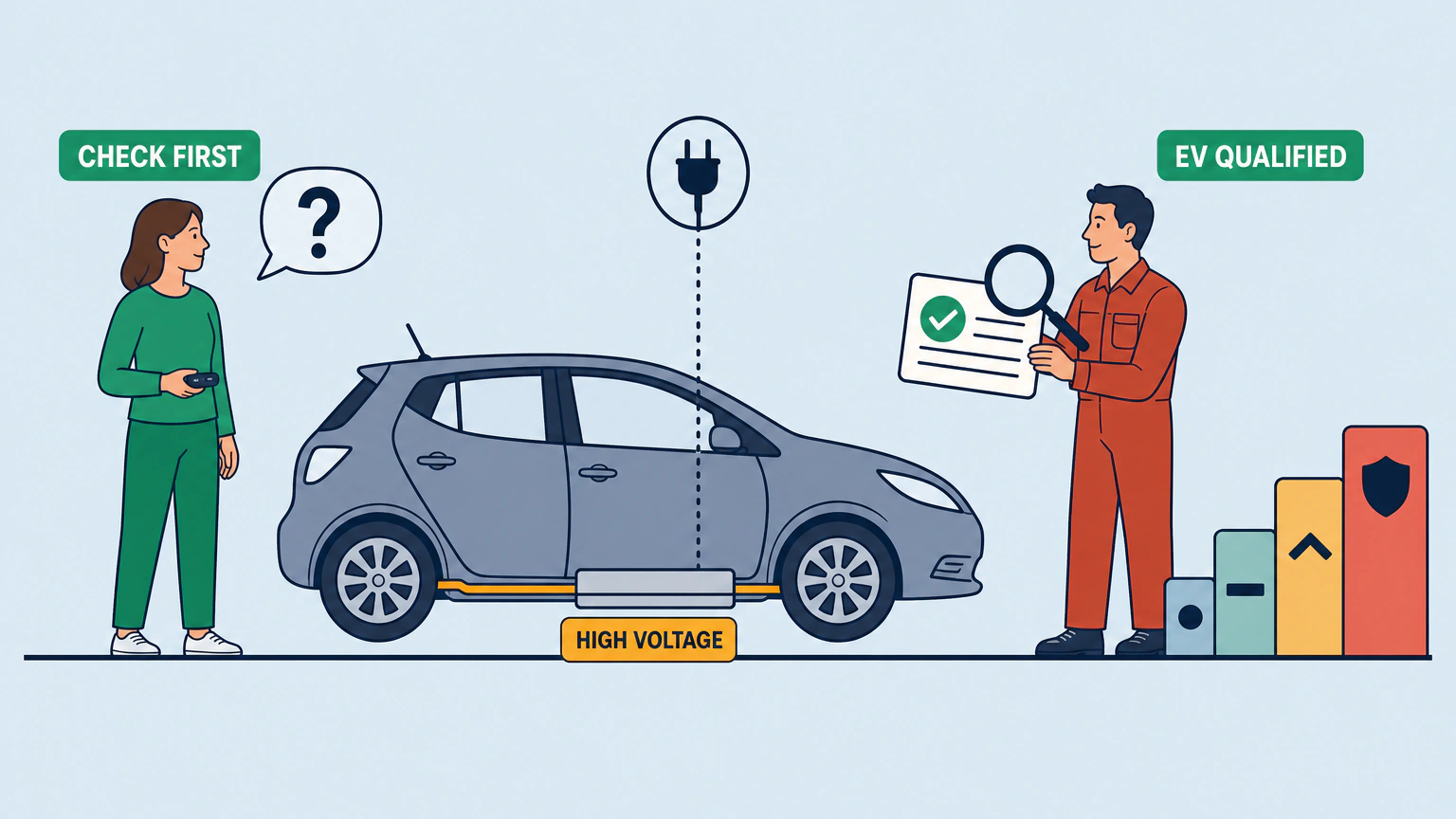
They are. Whether any garage can service an electric car is barely a legal question: the state licenses gas engineers and driving instructors, but it has never licensed mechanics. What it demands instead is that whoever does a safety-critical job has the knowledge, or the supervision, that job needs. A few tasks carry their own qualification, such as recovering F-gas refrigerant from air conditioning.
Permission isn't the problem. Competence is: only 35% of UK technicians hold an EV qualification, on the Institute of the Motor Industry's own count. Ask which level covers your job.
On this page
- The short answer, in two sentences
- What UK law actually requires of a garage working on your EV
- The HSE's four categories of EV work — and where your booking sits
- The four IMI qualification levels, and the one that sounds like enough
- How many technicians are EV-qualified, and where
- What routine work may not require a formal EV qualification
- How to check one specific garage before you book
- Servicing outside the dealer network: warranty, and what the block exemption really says
- What EV electrical and diagnostic work costs
- Frequently asked questions
The short answer, in two sentences
No UK law licenses mechanics, so any garage may take the booking, but it still has to put people on the job who know it or are supervised by someone who does. Ask which IMI level the technicians touching your car hold, whether it covers the job, and whether any part of it needs a qualification by law.
Five checks turn that into a two-minute conversation.
What UK law actually requires of a garage working on your EV
Most drivers assume somebody hands out a mechanic's licence. Nobody does. The government keeps a public register of every occupation that legally needs a qualification, and repairing cars isn't on it. That changes what you check, and it doesn't make the workshop a free-for-all.
There is no licence for vehicle technicians in the UK
The whole Regulated Professions Register runs to 281 entries. Search it for "mechanic" and you get dental roles, aviation, hearing aids and vessel traffic. Search "vehicle technician" and 40 entries come back, none of them the person who fixes cars for a living.
That settles a narrow point and only a narrow point: no regulated mechanic profession, which is not the same as no regulation. Two things still bite.
The task-specific legal qualification: recovering F-gas from air conditioning
Search the same register for "motor vehicle" and 16 professions come back: driving and motorcycle instructors, dangerous goods safety advisers, a Northern Ireland vehicle immobiliser role, and exactly one workshop job. F-Gas Handler for Air-Conditioning Systems in Motor Vehicles.
That one is real law. Recovering F-gas refrigerant from a mobile air-conditioning system in a covered passenger or light-goods vehicle takes a suitably qualified person, so if your service includes air-con work that pulls refrigerant out, that's who has to do it. What it isn't is a mechanic's licence. Nothing on that register licenses anyone to work on a high-voltage battery.
What the law does demand: competence for the job in hand
The rule is Regulation 16 of the Electricity at Work Regulations 1989: "No person shall be engaged in any work activity where technical knowledge or experience is necessary to prevent danger or, where appropriate, injury, unless he possesses such knowledge or experience, or is under such degree of supervision as may be appropriate having regard to the nature of the work."
The duty attaches to the work, not the job title: the same technician can be right for a set of tyres and out of their depth on an inverter. Nobody publishes a register of who complies, so qualifications are what you can check from outside.
The HSE's four categories of EV work — and where your booking sits
The Health and Safety Executive splits work on electric and hybrid vehicles into four categories: valeting, sales and other lower-risk activities; incident response including emergency services and vehicle recovery; maintenance and repair excluding high-voltage electrical systems; and working on high-voltage electrical systems. Its own line on competence matters: "the levels of competency required will vary greatly and are dependent on the type of work that people are expected to do".
Work out which category your booking sits in before you judge a garage. A routine service is likely the third. That isn't the same as no EV precautions: HSE still expects suitable competence for maintenance and repair, and expects the high-voltage battery isolated unless the task needs the vehicle energised. The hazard isn't theoretical. HSE treats 60 to 1,500 volts direct current as high voltage, warns that the cabling is usually orange, and lists stored energy that can cause fire or explosion, retained dangerous voltage and unexpected vehicle movement.
Safety note: we can help you check somebody else's competence. We can't make this work safe for you to do. Never go near a traction battery, motor, inverter or orange high-voltage cabling.
The four IMI qualification levels, and the one that sounds like enough
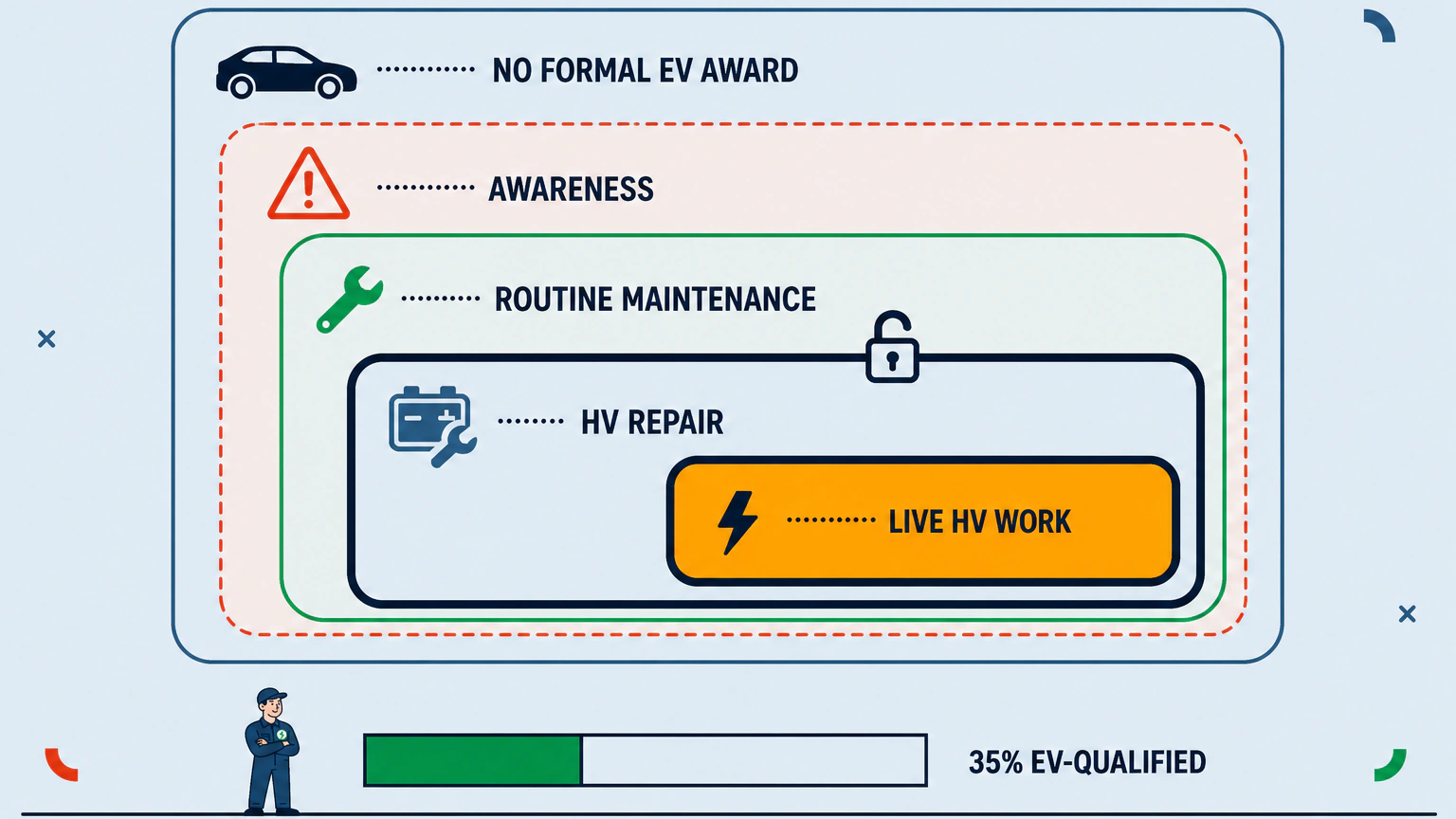
The Institute of the Motor Industry is the sector's professional body and an Ofqual-regulated awarding organisation. Its EV ladder has four rungs, each containing the one below.
Levels 1 and 2 — awareness, and safe isolation
Level 1 is three hours of awareness training, written for people who work around electric cars rather than on them: valeters, sales and parts staff, recovery crews, dismantlers. Sensible training. Not a repair qualification.
Level 2 is the rung that sounds like enough. Fourteen hours on the hazards of high-voltage components and on isolating and reinstating the system so routine maintenance is safe. Then the IMI's own page adds the sentence hardly any driver sees: "this qualification does not certify a technician or learner to work directly on a vehicle's high-voltage system."
Levels 3 and 4 — repair, and live high-voltage work
Level 3 is where repair starts. It holds all the Level 2 content and adds diagnosis, testing and repair on high-energy electrical systems, and the IMI says it gives the ability to remove and replace high-voltage components. That's the rung you want if something under the floor has failed.
Level 4 is, in the IMI's words, the first qualification of its kind to address working on live high-voltage systems, developed with EV manufacturers, training providers and the HSE. Nobody holds it without the Level 3 award first, and its specification recommends at least six months of relevant experience.
A note on certificate numbers, because the references changed
If you ask to see a certificate, don't be thrown by the number on it. The predecessor Level 2 and Level 3 awards closed to new registrations on 31 December 2025, and certification for them ends on 31 December 2026. The older number doesn't make a certificate invalid.
What IMI TechSafe adds on top of a qualification
TechSafe sits on top of a qualification. It is recognition within the IMI Professional Register for the safety-critical technologies: electric, hybrid, hydrogen and ADAS-equipped vehicles. Gaining it needs an eligible qualification, keeping it needs mandatory continuing professional development, and a technician's status can lapse quietly. So search the live register, not a saved list.
The IMI keeps calling on government to make TechSafe mandatory, which is confirmation from the body with most to gain that today it's voluntary.
Table A: the four IMI EV qualification levels
| Level and qualification | Ofqual reference | Guided learning hours | What the IMI says it covers | What it does not cover |
|---|---|---|---|---|
| Level 1 Award in Electric/Hybrid Vehicle Awareness | 603/1465/5 | 3 | Safe working practices and EV hazards, for non-technical roles: valeters, sales, parts, recovery, dismantling | Any work on the vehicle's electrical systems |
| Level 2 Technical Specialist in Electric/Hybrid Vehicle Routine Maintenance Activities (Award) | 610/4565/2 (replaces 603/1466/7) | 14 | Hazards of high-voltage components; isolating and reinstating the system so routine maintenance is safe | Working directly on the high-voltage system, which the IMI states expressly |
| Level 3 Technical Specialist in Electric/Hybrid Vehicle System Repair and Replacement (Award) | 610/3970/6 (replaces 603/1468/0) | 34 | All Level 2 content, plus diagnosis, testing and repair on high-energy systems and removing and replacing high-voltage components | Working on systems while live |
| Level 4 Award in the Diagnosis, Testing and Repair of Electric/Hybrid Vehicles and Components | 610/0975/1 | 21 | Repairing live high-voltage components and systems; first of its kind, developed with manufacturers, training providers and the HSE | Nothing further on this ladder |
Those hours are the IMI's published figures. And Level 4 is a specialist addition to existing Level 3 skills, not a longer version of it.
How many technicians are EV-qualified, and where
The national picture
The IMI counts 74,734 EV-qualified technicians, or 35% of the UK technician workforce. Set that against the Department for Transport's 2,012,000 licensed zero-emission vehicles at the end of 2025, up 31.2% in a year out of 42.3 million licensed vehicles in total. It works out at roughly 27 zero-emission vehicles for every EV-qualified technician.
The other 65% hold no EV qualification. It isn't all bad news: 2,792 technicians qualified in the final quarter of 2025, up 6% on the quarter before, though still down 17% on the year. The IMI's forecast has demand outrunning supply by more than 43,000 technicians by 2035. And the shortage isn't spread evenly.
The postcode problem
The IMI's Electric Evolution analysis, back in June 2023, found seven local authorities across England, Wales, Scotland and Northern Ireland where 10% or more of technicians were EV-qualified. More than 150 sat below 2%.
It's an old figure, and little has changed. By February 2026 the IMI still reported EV skills as geographically uneven and concentrated in the franchised dealer market, with independents less able to invest ahead of demand. Outside the larger cities the nearest qualified garage can be a drive. Find that out on a quiet Sunday, not the morning the car won't move.
What routine work may not require a formal EV qualification
Plenty of what a car needs never goes near the high-voltage system. Tyres, alignment, brakes, suspension, steering, filters, wipers, bulbs and the low-voltage battery may all fall outside it, and some can be done on your own driveway by mobile mechanics.
That isn't a free pass. HSE still wants suitable competence from repair and maintenance staff, and whether the high-voltage system must be isolated first depends on the task and the manufacturer's instructions.
Table B: routine work and the competence or qualification to check
| Job | What to check | Why |
|---|---|---|
| Tyres, wheels and alignment | Suitable EV competence; a formal EV award may not be needed | The task may avoid the high-voltage system, but vehicle-specific precautions still apply |
| Brakes and brake fluid | Suitable EV competence; a formal EV award may not be needed | Braking integrates friction and regenerative systems, so follow vehicle-specific instructions |
| Suspension and steering | Suitable EV competence; a formal EV award may not be needed | The task and work area determine the precautions |
| Low-voltage battery replacement | Vehicle-specific procedure | The auxiliary battery is separate from the traction battery, but replacement steps vary by model |
| Cabin filter, wipers, screenwash, bulbs | Vehicle-specific procedure | These are routine items, but access and isolation requirements vary |
| Bodywork and panel repair | Cable location and safe-isolation plan | HSE says to establish where high-voltage cabling runs before panel replacement, cutting or welding |
| Air-conditioning service involving F-gas recovery | Relevant mobile-air-conditioning qualification | A qualification is required to recover F-gas refrigerant from covered vehicle systems |
| MOT | Authorised Class 4 station | An EV car still needs the standard MOT, without an exhaust-emissions test |
| Traction battery, motor, inverter, on-board charger, high-voltage cabling | Scope-appropriate EV training | IMI Level 3 covers repair and replacement; Level 4 adds work on live systems |
Pro tip: check the low-voltage battery first. An electric car still carries a low-voltage auxiliary battery, and if it's flat the car may not start. A car that won't wake up isn't proof that the traction battery has failed. Replacement procedures vary by model, so use a garage or mobile mechanic that follows the manufacturer's instructions. Compare car battery replacement services.
How to check one specific garage before you book
Five checks before you book
- Decide which of the HSE's four categories your job falls into. Do not assume that "maintenance and repair excluding high-voltage systems" means no EV-specific precautions; ask whether the manufacturer's procedure requires isolation.
- Search the IMI Professional Register by business name and by location, and note which technicians are listed and at which level.
- Ask the garage directly: which IMI level do the technicians who will work on my car hold, and does that cover this job?
- Ask whether they have manufacturer-specific diagnostic tooling for your make, and what they can read from your traction battery with it.
- Ask for the work done, the parts or specifications used and any qualification claimed to be recorded on the invoice or service record — you may want that evidence for a warranty claim or a future sale.
Search the IMI Professional Register
The register lists people, not garages. You can search by member name, business name or location, and filter by subsector. Because it lists individuals, a good garage may show only one qualified technician, and that technician may have moved on.
So treat a hit as the start of a conversation. Search the business, then the location, and take what you find into the phone call.
HEVRA, manufacturer networks and franchised dealers
HEVRA, the Hybrid and Electric Vehicle Repair Alliance, is a network of independent EV specialists. Auto Express, reporting on a member workshop, describes members as regularly checked for the right qualifications, tools and equipment. We wanted to confirm that against HEVRA's own criteria and couldn't: the site wouldn't open for us. So take it as Auto Express's reporting, not a published standard.
Manufacturer-approved and franchised dealer networks are legitimate too, particularly under warranty. No single route is the only safe one.
What an accreditation badge does and does not tell you
A badge in the window answers a different question. A garage accredited to a consumer code, say one of the Motor Ombudsman's Codes of Practice, has signed up to conduct standards and given you somewhere to go if the job goes wrong. Worth having. It says nothing about the technician on the ramp.
Trade-association membership and good reviews work the same way. If you're already past that point, here's how to complain about a garage.
The five questions to ask, and what to ask for in writing
A good answer to the qualification question comes back fast and specific: a name, a level, an offer to show you the certificate. On tooling it names the manufacturer's diagnostic platform or the exact aftermarket tool and says what it reads from your pack. A poor one says "we can plug in".
Ask for the level and the work to go on the invoice while you're booking, not while you're waiting for your keys back.
Red flag: four answers that should send you elsewhere.
- "All our technicians are trained on electrics." Twelve-volt experience is not a high-voltage qualification. Ask again in writing, naming the IMI level.
- A level named, but nobody willing to say who holds it or show the certificate. Ask by email. If nothing arrives, book elsewhere.
- "You don't need to worry about that, it's just a service", in answer to a straight question about high-voltage work. Put the question in writing, or book elsewhere.
- A promise to diagnose a traction-battery fault with a generic code reader. Ask what tool, and what it reads. If the answer stays vague, book elsewhere.
None of that accuses anybody of anything. It turns a sales conversation into a specific one.
Servicing outside the dealer network: warranty, and what the block exemption really says
Nearly every page on this subject says a European "block exemption" protects your right to use an independent garage. It doesn't: the instrument they describe, the retained EU Motor Vehicle Block Exemption Regulation, expired at the end of 31 May 2023. They agree with each other because they inherited one stale source. Agreement isn't corroboration.
In force instead is the Competition Act 1998 (Motor Vehicle Agreements Block Exemption) (No. 2) Order 2023 (SI 2023/586), effective 1 June 2023 and ceasing to have effect at the end of 31 May 2029. One trap if you check yourself: an almost identical Order made weeks earlier, SI 2023/501, was revoked before it commenced because it contained an error. A search returns two. Only one is live.
The Order regulates agreements between manufacturers and their networks. Its article 6 says such an agreement must not restrict an independent operator's access to the information, tools or training the manufacturer uses itself or gives its authorised repairers, in a manner that disadvantages that operator. For EVs that's the whole game: manufacturer high-voltage training and diagnostic tooling are the practical barrier for an independent workshop.
The Order doesn't set out consumer warranty rights: the words "warranty" and "consumer" don't appear in its text. But the CMA's motor-vehicle guidance says an authorised-network servicing restriction in a standard or extended warranty may be caught by the Competition Act 1998. That isn't a blanket permission slip. A supplier may still refuse a claim where the problem is causally linked to defective independent work or a third-party part. A manufacturer's guarantee is contractual under its terms and does not affect statutory consumer rights. So follow the manufacturer's schedule and required specifications, keep service records, and read any lease or PCP servicing terms separately.
What EV electrical and diagnostic work costs
Jobs quoted through our car electrical and diagnostic specialists near you category average £200, from £108 to £929. Car battery service averages £169, from £66 to £581. Those are our own aggregates across jobs quoted through our directory rather than a market survey, and they carry no date, so read them as a range to expect rather than a price list.
Battery-health checks and high-voltage diagnostics swing on labour time, tooling and access to vehicle-specific information. Compare what each garage says it can read from your make and model, not just what it charges.
Frequently asked questions
Can any garage in the UK legally service an electric car?
Yes. There is no general licence for vehicle technicians in the UK, so no garage needs one to offer EV servicing. It still has to use people with the knowledge or supervision the job requires, and a few tasks carry a separate legal qualification, such as recovering F-gas refrigerant from air conditioning.
Can my local garage service my EV?
Probably, for the routine half of the list. Tyres, brakes, suspension, filters and the MOT are ordinary work, though your car still needs suitable competence and vehicle-specific precautions. Anything involving the traction battery, motor, inverter or on-board charger is a different question: check the IMI Professional Register and ask which level the technician holds.
What qualifications should I look for in an EV mechanic?
IMI Level 2 covers routine maintenance with the high-voltage system isolated. Level 3 covers high-voltage repair and replacement. Level 4 covers working on live systems. TechSafe recognition on the IMI Professional Register adds what a certificate on the wall can't show you: that the training has been kept current.
Will using an independent garage void my EV warranty?
Not by itself. The block exemption Order doesn't create consumer warranty rights, but CMA guidance says an authorised-network servicing restriction in a standard or extended warranty may be caught by competition law. A manufacturer's guarantee is contractual under its terms and does not affect statutory consumer rights. Follow the schedule, use the required specifications, keep the records. A supplier may still refuse a claim causally linked to defective independent work or a third-party part, and lease or PCP terms can differ.
Do all garages service hybrid cars?
No, and the same ladder applies. A hybrid or plug-in hybrid carries a high-voltage system just as a battery-electric car does, which catches out owners who assume the petrol engine makes it conventional. Routine work can go to any competent garage. High-voltage work needs the same levels.
Does my electric car still need an MOT?
Yes. The first test is due by the third anniversary of registration, as it is for a petrol car, and the maximum fee for a car is £54.85. There is no exhaust, so the emissions part doesn't apply. Northern Ireland tests through the government's Driver and Vehicle Agency rather than private garages. If it fails, here's what happens if your car fails its MOT.
Where can I get an EV battery health check, and does it need a specialist?
It depends on the car: battery-health information and diagnostic access vary by make, model and tool. Ask which tool the garage uses, whether it is compatible with your car, and which measurements or manufacturer reports it can hand you. If the answer stays vague, keep ringing round.
Do electric cars need servicing every year?
Not necessarily. Follow the manufacturer's published schedule, which varies by model and may run annually, every other year or item by item. Fewer consumables doesn't mean no maintenance. Tyres, brakes, filters, fluids and safety checks still need attention when the schedule says so.
A garage doesn't need a general mechanic's licence to service your electric car. It needs competent people for the work in front of them, plus any qualification the law attaches to a particular task. Search the IMI Professional Register for the business, ring them and ask which level covers your job, and if the answer wobbles, compare local garages near you and ask again.