

On this page
- Do the check yourself before anyone quotes you
- Three numbers, and three different people decided them
- The disc carries its own limit, stamped on the disc
- What the noise is actually telling you
- When the problem is the caliper and not the pads
- What pads and discs cost, and what to say if a quote does not match what you found
- Common questions about checking your brakes
Do the check yourself before anyone quotes you
DVSA publishes what its testers find. In the 2024 to 2025 test year, a brake defect turned up in 6.63% of car and small van tests in Great Britain. The other figure matters more: brakes were 29% of every dangerous defect recorded, tyres 60%. That's about nine in ten of the dangerous faults in MOT bays, and both are free to check on your own driveway. So do the brakes today, then look at your tyres.
A torch and level ground are enough for a first look. An accurate measurement needs clear access to the pad. It's what separates arguing with a garage from quoting one a number. The jack stays in the boot.
Turn the wheel to full lock and use a torch
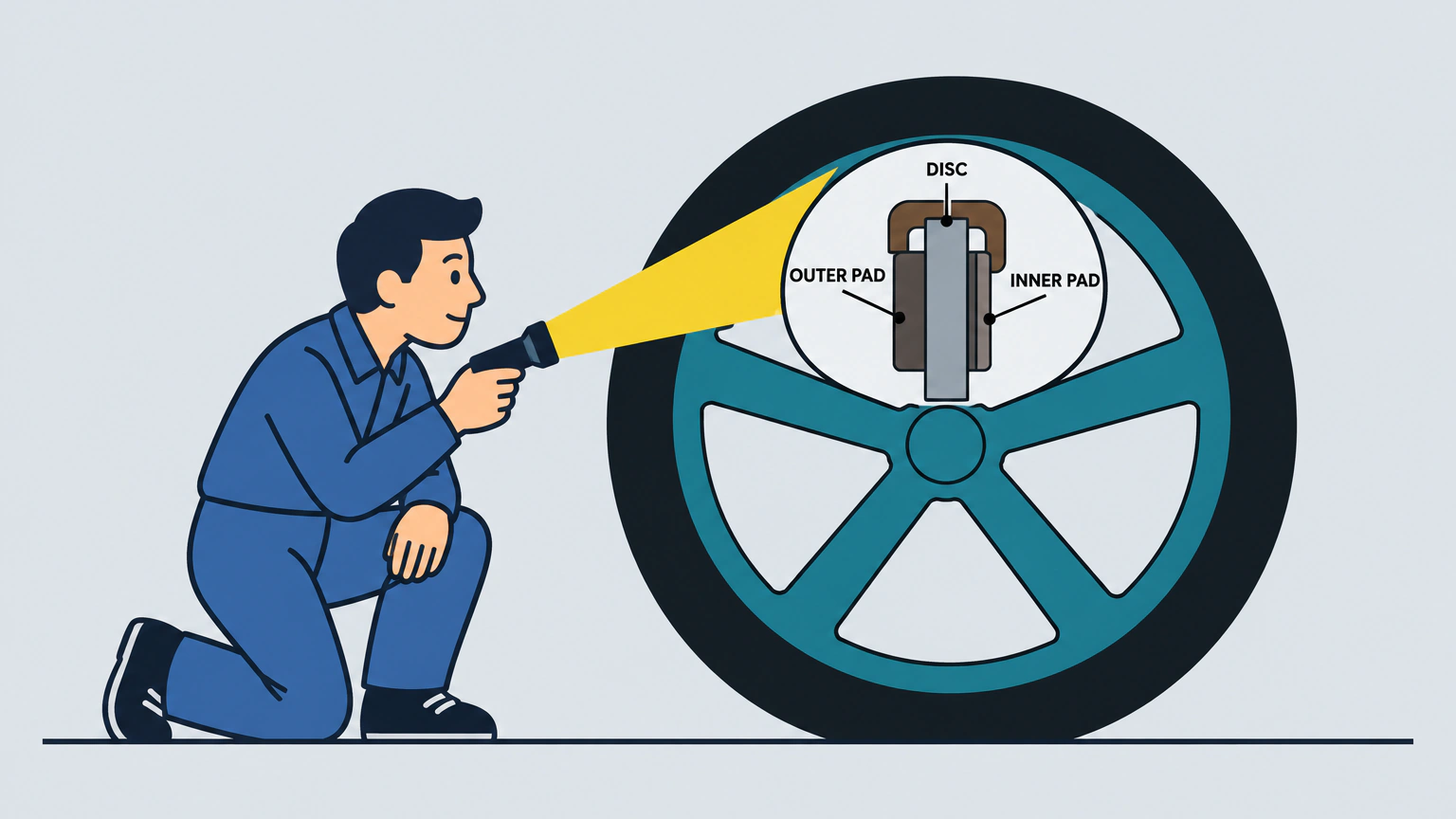
Park level, handbrake on, and let the brakes cool fully if you've just driven. Hot brakes burn. Turn the steering to full lock towards the side you're checking, which opens up the arch, then shine a torch through the spokes. You want the caliper, the clamp over the top edge of the disc, and the block of material squeezed between it and the disc face nearest you. That block is the pad.
This works on open-spoked alloys. If steel wheels, plastic trims or solid-faced alloys block your view, the wheel needs to come off. That's not a failure of the method. From there, it's a job for axle stands or a ramp.
Friction material is the bit that counts, not the metal behind it
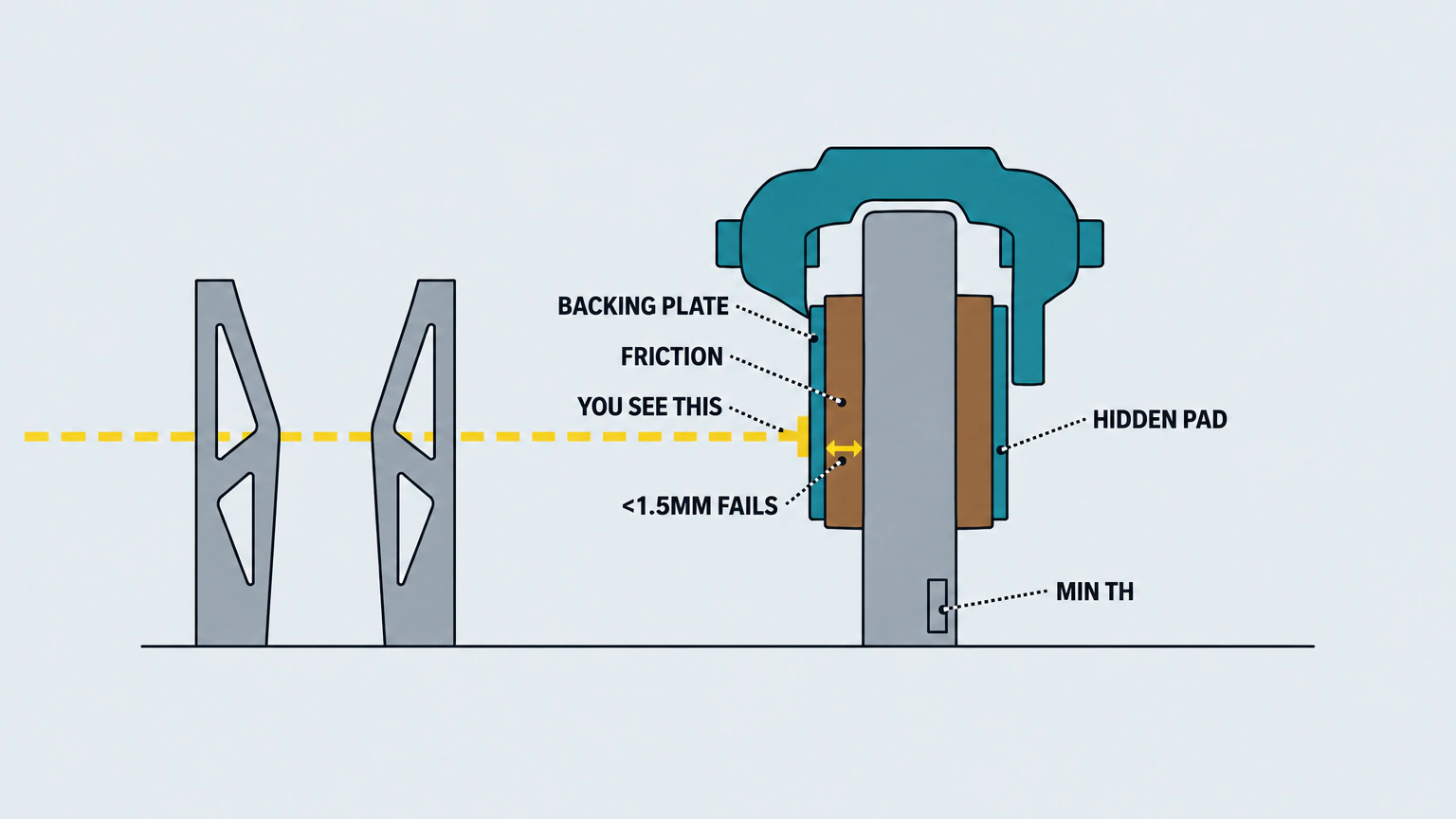
A pad is two things bonded together. Brembo describes it as friction material applied to a metal support: braking compound on a steel backing plate. Only the compound wears, and only the compound counts. Measure the whole sandwich and you'll flatter yourself by several millimetres.
New pads carry roughly 10 to 12mm of compound, on Brembo's figures. If you can't reach or see the friction layer clearly, have the pads measured with the wheel off. Read the thinnest part: pads wear on a taper, and the thin end runs out first.
Check the pad you cannot see
Through the spokes you may see the outer pad. The inner pad sits on the far side of the disc, and a healthy outer pad doesn't tell you how much material is left on it. Both need checking.
The tester works under the same handicap. DVSA's manual says so in its introduction: "The MOT test must be carried out without dismantling, so it is not always possible to inspect some testable items." Wheels stay on. So the pad you measured and the pad the tester saw might both be the healthy one. And inner and outer pads at visibly different thicknesses is a reason to check the caliper.
Brakes are not the thing to leave to a maybe. If your own look leaves you unsure, get the car on a ramp before you drive again.
Three numbers, and three different people decided them
Whoever told you the pads need doing was working to a figure, and that's where the confusion starts: three are in circulation for the same measurement. One is trade advice. One is a test standard with legal teeth. One belongs to your car and nobody else's.
Ask which of the three a quote came from. You'll learn more from the answer than from an hour of haggling.
3mm is the trade's number, and it is advice, not law
Brembo puts new pads at roughly 10 to 12mm and says that below 3mm it's time to replace them. The RAC lands in the same place: "Brake pads with a thickness of 3 millimetres or under should be replaced", and, on the through-the-spokes check, "There should be at least 3mm of pad visible."
Sound advice, worth taking. It just isn't a thickness threshold in the MOT manual. What 3mm buys you is margin before the 1.5mm MOT threshold, but a pad can fail sooner if it reaches its wear indicator. How fast you spend it depends on how you drive: Brembo names city streets, mountain roads and aggressive driving among the things that eat pads quickest.
1.5mm is the DVSA's number, and it is a dangerous defect
The MOT inspection manual is public, and section 1.1.13 covers brake linings and pads. Two entries decide your test. "Brake lining or pad worn down to wear indicator" is a Major defect. "Brake lining or pad worn below 1.5mm" is Dangerous. Both are fails.
Those words carry definitions. DVSA describes a dangerous defect as "a direct and immediate risk to road safety", and with any major or dangerous defect the car "must be failed and a refusal notice issued". No discretion, and no benefit of the doubt at 1.4mm.
If you'd rather have it measured properly than eyeballed through a wheel, that's the job MOT test centres do.
Ask for your own car's pad limit
Neither figure was written for your car. The manufacturer sets its own pad service limit model by model, and it doesn't default to 3mm. Use the service limit for your own model and axle before accepting or rejecting a quote.
Look it up. Ask a franchised dealer for the manufacturer's service limit if your handbook doesn't list it. That's the one written for your car.
| What you are looking at | The number | Who decided it | What it means for you |
|---|---|---|---|
| Pad friction material | Under 3mm | Brembo, and the RAC's own guide | Replace soon. Not a fail on its own |
| Pad friction material | Worn down to the wear indicator | DVSA MOT inspection manual 1.1.13 | Major defect. The car fails the MOT |
| Pad friction material | Under 1.5mm | DVSA MOT inspection manual 1.1.13 | Dangerous defect. Fails, and you should not drive it away |
| Pad friction material | Your car's own service limit | The manufacturer's service information | Use the limit for your model and axle |
| Disc thickness | At or below the MIN TH figure etched on the disc | The disc manufacturer | Replace it, and replace the one on the other side too |
| Disc thickness | Significantly and obviously worn | DVSA MOT inspection manual 1.1.14 | Major defect. Being under the maker's limit is not a fail by itself |
| Brake wear warning light | Lit on the dashboard | DVSA MOT inspection manual 1.1.13 | Not a reason for failure. Still worth checking the pads |
The disc carries its own limit, stamped on the disc
Discs are often part of a brake quote. They're also easier to settle than pads: a disc carries its own answer on the part.
Worth knowing why. A thin disc holds less heat, and Brembo sets out what follows: thermal cracks on the braking surface, deformation you feel as vibration through the pedal, longer pedal travel, and fading, where friction drops away as temperature climbs.
Where to find MIN TH and how to measure against it
The figure is cast or etched into the disc itself, usually round the outer edge or on the hub face, as MIN TH followed by a number in millimetres. Brembo's method is a vernier caliper and measurements "taken in at least 4 different points". The lowest reading is the one that counts. Discs wear unevenly, so one flattering reading proves nothing.
At or below that number and the disc is done. Discs also go on in pairs: Brembo is explicit that they "must be replaced on both sides even if only one of the pair proves to be below the minimum wear level". A quote for one side is worth a question.
The MOT has no thickness number for discs at all
Section 1.1.14 of the same manual sets no thickness for discs at all. It says "A brake disc or drum must be significantly worn before you should reject it", and then the line worth reading twice: "Being worn below the manufacturer's recommended limits is not a reason in itself." The failure entry reads "Brake disc or drum significantly and obviously worn", a Major defect.
Your disc can sit under the number stamped on its own face and still sail through the test.
That doesn't make the disc fine. It shows the MOT is a floor rather than a verdict on condition, and nobody can promise you it'll fail on the discs.
What the noise is actually telling you
Noise sends people to a garage, and the sounds can mean different things.
A first-stop squeal on a damp morning can come from surface rust on the disc and clear as you brake. The RAC says the same: screeching from rust build-up, where "the damage should wear off after driving".
The one to act on doesn't clear. DVSA sets out the mechanism: "Some brake pads have metal wear indicators so that when the pads become excessively worn the metal indicator touches the disc making a squealing sound." Other pads carry a cut that means the same once it wears away. Get a persistent squeal checked rather than assuming it's the wear tab. Go and measure.
The third noise is the one that changes your afternoon. Grinding can mean the compound has gone and the backing plate is chewing into the disc. The RAC's advice is not to drive it and to get the brakes checked as soon as possible. It can also turn a pad bill into a pad and disc bill.
Red flag: If a tester records a dangerous defect, you can't drive the car away, and a current MOT still on the clock doesn't change that. GOV.UK sets both conditions together: you can drive away only if your MOT is still valid and no dangerous problems were listed. Drive it anyway and the penalty is a fine of up to £2,500, three penalty points and a possible driving ban. A pad under 1.5mm is exactly that kind of defect, so read what you can and cannot do after a failed MOT first.
When the problem is the caliper and not the pads
Uneven wear is a diagnosis in its own right, and the one most likely to save you money twice. Inner pad at 3mm, outer at 7mm, and you've got uneven wear to investigate. A sticking piston or slide pins can hold a pad against the disc while your foot is off the pedal. Brembo's list of causes for irregular pad wear names caliper malfunction.
Fit pads and leave that alone and you'll wear the new set out early. A garage should check that the pistons, seals, dust boots and sliding elements aren't corroded and can still move, replace whatever has deteriorated, then clean and grease the contact surfaces. Ask whether that's in the price. A mobile mechanic can do it on your drive.
Five signs the caliper needs checking
- One wheel noticeably hotter than the others after a normal drive. Compare all four after an ordinary run. The odd one out is the finding.
- Inner pad much thinner than the outer pad on the same wheel. Ask to be shown both pads off that corner before they're binned.
- The car pulling to one side under braking. Tell the garage if you've noticed a pull. It needs checking.
- A burning smell from one corner after a motorway run. Stop safely and arrange a brake inspection before driving on.
- Pads worn unevenly across the face of the same pad. Ask the garage to check the caliper and the pad design. Some pads are tapered from new.
Pro tip: After a normal drive, hold the back of your hand near each wheel in turn without touching it. Brakes get warm. One wheel that's far hotter than the other three, or that smells hot when the rest don't, needs a brake inspection before you buy pads.
What pads and discs cost, and what to say if a quote does not match what you found
Numbers first. Across 678 cost profiles in our brakes category, the average brake job comes to £196, with the spread running from £55 to £717 depending on the axle, the parts, and whether discs go on with the pads. That's our own aggregate, priced to a location, so read it as the shape of the market rather than a quote. The RAC puts its own range at £100 to £300. Quoted £700 for a front axle, you're not necessarily being robbed, but you're at the top of ours and entitled to ask what put you there.
Discs are a common add-on. Brembo's rule is discs at every second pad change, so if your car had discs last time and somebody wants to sell you more, ask what they measured. It cuts both ways: where the discs genuinely have gone, Brembo says the pads go on with them.
Then the script. Four questions:
- What did the pad measure, in millimetres?
- Which pad was that, inner or outer, and which wheel?
- Can I see the old parts when I collect the car?
- Can I have the quote in writing before you start?
A garage that measures properly answers all four without blinking, and plenty of the brake specialists near you will. If you've already paid for pads you'd measured as healthy, it's worth knowing your rights if the work was not needed.
Common questions about checking your brakes
How long do brake pads last?
Front pads typically last between 15,000 and 30,000 miles, rears often about double, on Brembo's figures. The spread is about where you drive rather than what: town traffic and hills chew through pads, steady motorway miles barely touch them. Mileage is the wrong instrument. A proper pad inspection gives you the real number.
Can I drive with worn brake pads?
It depends which number you're under. Being above 1.5mm doesn't prove the brakes are safe. Worn pads, noise or poor braking need checking. Under 1.5mm, DVSA classes it as a dangerous defect. Recorded at an MOT, that means the car shouldn't be driven away, and driving it anyway risks a fine, points and a ban.
Do I need new discs every time I have new pads?
No. Brembo's general rule is discs at every second pad change, and the figure that settles it is the MIN TH etched on your own disc, not the mileage or the age of the car. Discs go on in pairs, though, so a quote covering one side of an axle is worth questioning.
Why do my brakes squeak after new pads were fitted?
Bedding in is one possible cause. Brembo says it lasts about 300 km, roughly your first 200 miles, with gentle braking through it. A squeal outlasting that usually isn't the pads. Brembo points at the state of the rest of the system, and at the anti-noise shims, which should be new rather than reused.
Does a brake wear warning light fail the MOT?
No. The inspection manual says it outright: "An illuminated brake wear indicator is not a reason for failure." That doesn't make the light wrong. Something triggered it, and the sensor doesn't monitor every pad. Treat it as an instruction to measure, not an MOT problem.
How many brake pads does a car have?
A car with disc brakes at all four wheels usually has eight, two per wheel, one either side of each disc. They're renewed as a complete axle set of four, all the fronts or all the rears, once any one reaches its limit. That's why a quote for a single wheel is unusual, and why it's fair to ask what the other three measured.