

On this page
- What a worn wheel bearing sounds like, and what sounds just like it
- Which corner is it? The steering test, and why it can fool you
- How a garage checks a suspected bearing
- Will a wheel bearing fail the MOT?
- Can you keep driving on a noisy wheel bearing?
- Why two quotes for one wheel bearing can be so far apart
- Questions to ask before you agree to the work
- Common questions about wheel bearing noise
What a worn wheel bearing sounds like, and what sounds just like it
It starts as a faint drone on the motorway, easy to blame on the road. A few weeks on it's louder, it climbs as you speed up, and the radio is creeping up to cover it. That's textbook wheel bearing noise, and the worry is fair: is the car safe, and how big is the bill?
That low hum that rises with your speed is the classic sound of a worn wheel bearing, and it usually changes when you steer. Worn tyres can make almost exactly the same noise, though, so rule them out before you pay for a bearing. The MOT doesn't fail a bearing for noise on the road. With each wheel raised, the tester spins it to listen for roughness and checks it for play, and a bearing that's excessively rough or has excessive play is a major defect. One that's likely to collapse is dangerous, and the car shouldn't be driven until it's fixed.
A wheel bearing is the ring of steel balls or rollers that each wheel turns on. Once a race (the hardened track the balls run in) or a ball wears, it stops rolling smoothly under load and starts to growl. It turns with the wheel, so the note follows road speed, not engine revs. Audi's own checklist for its dealers starts with three questions: "Does the frequency rise as the speed increases or does the sound get higher?" "Does the noise get louder when steering?" "Is the noise still there when slowing down?" Three yeses make the bearing the first suspect, not yet the guilty party. Several other parts can fake wheel bearing symptoms.
| What you hear | When it's loudest | What it usually is | How it's confirmed |
|---|---|---|---|
| A hum, drone or growl | Rises with road speed, changes as you steer, and is still there as you slow down | A wheel bearing | Wheel raised, spun by hand for roughness and rocked for play, then compared with the other side |
| A hum, drone or roar | Rises with road speed and changes with the road surface | Unevenly worn tyres, such as cupped or saw-toothed tread | Tread checked by hand and eye, and the wheels swapped front to rear to see if the noise moves |
| A knock or click | Tight turns at low speed, such as parking | Usually an outer driveshaft (CV) joint, though a failing bearing can make a brief noise here too | Slow full-lock turns, and the joint's rubber boot checked for splits |
| A squeal or grind | Only when you press the brake pedal | Brake pads or discs | Pads and discs inspected |
A grind that only comes with the brake pedal is the easiest to rule out, and our guide on how to check your brake pads covers it. If the noise started straight after brake work, say so. Debris trapped between the splash shield (the thin metal guard behind the disc) and the disc can scrape as the wheel turns and sound like a bearing.
Tyres are the impostor that costs people money. Cupped or saw-toothed tread hums in almost the same voice. As Michelin puts it, "When tyres wear unevenly, their contact with the road becomes inconsistent, leading to noisy tyres." Nokian says cupped tread can cause vibration and excessive noise, and even Audi admits to its dealers that the two are hard to tell apart. The British Tyre Manufacturers' Association wants tyres checked monthly for irregular wear anyway, so start there. Ask a tyre centre to look at the tread and swap the wheels front to rear. If the noise moves with the wheels, it points to a tyre or wheel rather than the hub.
If it stays put, the next question is which bearing.
Which corner is it? The steering test, and why it can fool you
In a bend, the car's weight leans onto the outside wheels. So a gentle bend to the left loads the right-hand bearings, and a worn one there tends to get louder. That's why wheel bearing noise when turning is the clue everyone reaches for, and Nokian notes that a "roaring noise while changing lanes might indicate issues with bearings".
Treat this as something to notice during an ordinary drive, not a reason to take a noisy car out for a test. At a steady speed, note whether the hum changes through gentle bends.
Now the catch. Audi's own bulletin warns: "It is possible that a noise perceived on the left side of vehicle is caused by the right wheel bearing." Front-end noise also travels up the steering into the cabin, blurring its direction. Schaeffler's troubleshooting guide says there are "no hard and fast answers" to the steering test and tells garages to continue checking on a lift. The road clue narrows the search. The lift check is where the garage tries to confirm it.
We can't hear your car from here. Use these checks to ask sharper questions, and let a garage with the wheel off the ground make the call.
How a garage checks a suspected bearing
A good garage uses the road symptoms and raised-wheel checks to narrow down the suspected corner before it quotes you a penny. FAG, which makes wheel bearings, tells technicians in its own failure guide to "check the wheel bearing for any damage prior to removing it."
Spin it, rock it, and compare it with the other side
This is DVSA's method for the MOT, and good garages use it anyway. Each wheel is raised clear of the ground and spun by hand while someone listens for roughness, then rocked to feel for play, or checked on wheel play detectors, which shift the wheel from side to side. Then the matching wheel on the other side gets the same treatment, because a comparison beats a guess. For a noise that won't show itself, Audi tells its dealers to find the source "with acoustic testers", and some mechanics listen at each hub with a stethoscope.
On cars with ABS (anti-lock brakes), the manual tells testers not to let a raised wheel spin with the ignition on, because "this can cause the ABS system to indicate a fault". So the spin check happens with the ignition off.
Why a noisy bearing can still feel tight
Here's the part that trips people up. SKF says hub units can develop excessive play, growling noise or both, while MOOG says bearing noise may only show up on the road. So "there's no play, it's fine" doesn't clear a humming bearing. And "it's loose" doesn't prove that bearing is the source of the hum you've been hearing. That's why the spin matters as much as the rock. Roughness heard as the wheel turns by hand is exactly what the MOT listens for.
Will a wheel bearing fail the MOT?
Not for noise alone. In Great Britain, DVSA's inspection manual tells the tester exactly how to judge a bearing: "With each wheel raised clear of the ground, spin the wheel and listen for roughness in the bearings." Play is checked by rocking each wheel in turn. A hum on the motorway isn't on the list.
| What the tester finds | Category | What it means for you |
|---|---|---|
| A wheel bearing with excessive play | Major | Fail. You can drive away only if your current MOT is still valid and the car is roadworthy |
| A wheel bearing excessively rough | Major | Fail, with the same drive-away rule |
| Play so excessive the bearing is likely to break up, or steering control is impaired | Dangerous | Fail. Don't drive it until it's repaired |
| A wheel bearing likely to collapse | Dangerous | Fail. Don't drive it until it's repaired |
| ABS warning light showing a fault | Major | Fail. A damaged sensor ring on the bearing is one possible cause |
| Some roughness or play, not bad enough to fail | Advisory, at the tester's discretion | Pass, with a note to keep an eye on it |
These are the Great Britain rules in DVSA's MOT inspection manual, sections 5.1.3 and 1.6. In Northern Ireland, cars are tested at DVA centres.
Two things most drivers miss. The first is the ABS light. On many cars the bearing carries the magnetic ring the wheel speed sensor reads, and a damaged ring or sensor can light the ABS lamp. The manual fails an ABS warning that "shows system malfunction" as a major defect in its own right, whatever the bearing does on the spin test.
The second is the advisory. When a part isn't bad enough to fail, the tester can note it as advice instead. The manual calls it best practice to flag items "near to, but which have not yet reached the point of test failure". A bearing advisory is a pass with a warning attached. Book the check now, not at next year's test.
If it does fail, GOV.UK's rule is simple. After a major fail you can drive away only if your current MOT is still valid and the car is roadworthy. After a dangerous one you can't, and driving it risks a fine of up to £2,500, a ban and 3 penalty points. MOT testing near you runs exactly these checks, and our guide on whether you can drive it after a fail has the full rules, retests included.
Can you keep driving on a noisy wheel bearing?
A hum alone can't tell you whether the car is safe to drive. Nobody can tell you how long a noisy bearing has left. Blackcircles says so plainly: "There's no accurate way to predict how long a wheel bearing will last once it starts to make a noise." It also advises against driving with a failing bearing. GOV.UK allows a major-only MOT fail to be driven away if the current MOT remains valid and the car is roadworthy. Our safety advice is stricter: recover a car with a confirmed bad bearing.
Stop and call for recovery if:
- The hum has turned into grinding or scraping from one wheel.
- The steering wheel shakes or jerks, or the car won't hold a straight line.
- You can feel a vibration through the brake pedal as well as hear the noise.
- The ABS or stability control light has come on along with the noise.
- A tester or garage has recorded the bearing as a dangerous defect.
FAG says "all wheel bearings are designed for the service life of the vehicle", then lists what cuts that short, including potholes, hitting kerbs, heavy loads and poor fitting. Water is the other enemy. FAG's failure guide calls moisture getting in "one of the primary causes of rolling bearing failure" and its advice is blunt: "Do not use high-pressure cleaners." So a bearing that fails early is worth a question.
Why two quotes for one wheel bearing can be so far apart
"A wheel bearing" on a quote can mean two quite different jobs. The price follows the job, not the name.
A bolt-on hub unit or a pressed-in bearing
Schaeffler, the company behind FAG, sorts its bearings into generations. On the newest, Generation 3, the bearing arrives as a complete hub unit that "simply has to be screwed to the steering knuckle", the part a UK garage calls the hub carrier. Schaeffler's repair notes for it add: "no special tools required for removal or press-fitting". Older designs, still in use, are a bare bearing pressed into the hub carrier with a press and matching thrust pieces (adapters that push on the right ring). Generation 2 sits between: it has its own flange but usually still presses in.
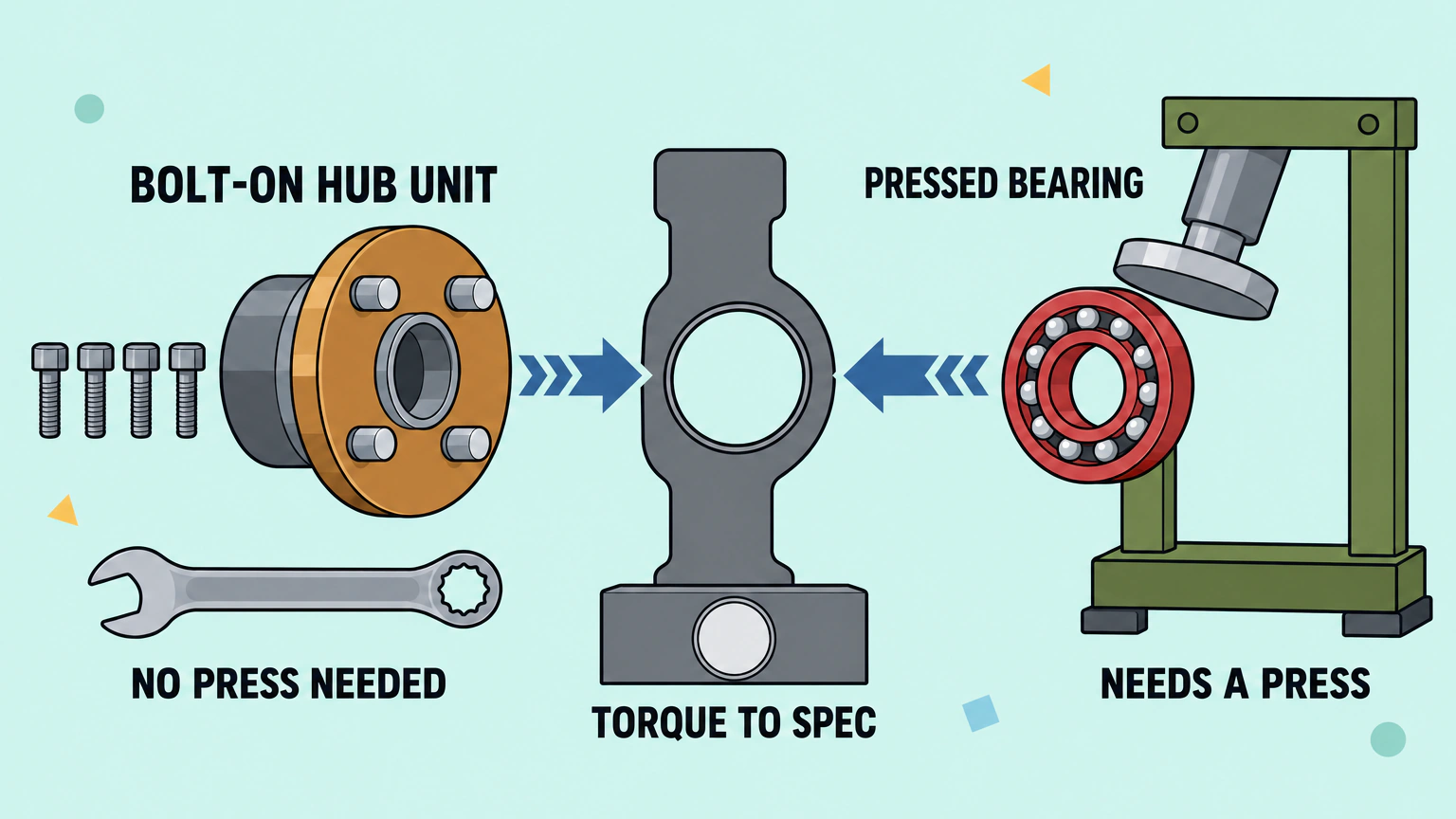
Pressing is more involved. It takes a press and the right adapters, and if the hub carrier has to come off, ask about a wheel alignment check afterwards. Schaeffler says that with the right special tool "the steering knuckle does not have to be removed, which also means axle alignment is not required." Take the hub carrier off, and that reassurance goes. Either way, the bearing must be tightened to the carmaker's torque figure, and on cars with ABS the side carrying the magnetic ring must face the sensor.
What UK price guides say it costs
Most published averages for a wheel bearing replacement land between about £200 and £300. ClickMechanic's own headline of £175 sits below every city and make average it prints.
| Source | What the figure is | Figure | Worth knowing |
|---|---|---|---|
| ClickMechanic | Headline average and range | £175 average; £120 to £300 | Every city and make average it publishes is higher than this headline |
| ClickMechanic | Averages for nine cities | £206 (Sheffield) to £276 (Bristol and Newcastle) | London, at £256, isn't the dearest city on its list |
| ClickMechanic | Averages for 15 makes | £195 (Hyundai) to £293 (Toyota) | Averages across models, not a quote for your car |
| FixMyCar | Average booking | £257.63 | A booking can cover one to four wheels, so this isn't a per-wheel price |
| FixMyCar | Averages for 11 makes | £200.39 (Vauxhall) to £320.22 (Volvo) | Average quotes on its own platform |
| RAC | Rough estimate for one wheel bearing | £150 to £250 | Its table by make repeats FixMyCar's figures |
FixMyCar's £257.63 is a booking average, not a per-wheel price. Labour time explains part of the spread. ClickMechanic puts a front bearing at just over an hour on average and a rear wheel bearing at under an hour, since the front can mean taking more parts off. We don't publish a bearing price of our own, because none of our cost profiles covers this job. Get quotes from local garages and ask each which type of bearing your car has.
One side or both?
The advice splits here. For pairs, FAG sells twin packs and says "the advantages of changing both wheel bearings at once are obvious". RAC calls replacing both on the same axle "usually recommended", and ClickMechanic says doing one at a time is "not advisable". Against, Audi told its own dealers that "the front wheel bearings should not be replaced in pairs" on the models one bulletin covered. The MOT judges each bearing on its own, too. And sometimes a garage finds two bad bearings, or can't pin the noise to one at all.
Our position: pay for the second bearing if it shows roughness or play on the same spin-and-rock test, not because it's the same age. A company selling bearings in pairs isn't a neutral witness.
Questions to ask before you agree to the work
A bearing changed for a noise that came from somewhere else is the one repair that fixes nothing. FAG's failure guide has an entry for exactly that: a removed bearing with "no signs of damage", under the effect "Customer complaint could not be resolved". These six questions expose a lazy diagnosis before the spanner goes on.
- Which wheel is it, and how did you confirm it: spun, rocked and compared with the same wheel on the other side?
- Did you check the tyres for uneven wear first?
- Is my car's bearing a bolt-on hub unit or a pressed-in bearing, and does the price include the pressing?
- Does the hub carrier have to come off, and if it does, is a wheel alignment check included?
- Will it go back with new fixings and be tightened to the carmaker's torque figure?
- If you're quoting for both sides, what did the other bearing show when you spun and rocked it?
Then book the check with steering and suspension specialists near you. If the noise is still there after a new bearing, take the car back to the same garage first. Under the Consumer Rights Act 2015, a garage must do the work "with reasonable care and skill". If it doesn't, you can require "repeat performance" unless that is impossible. If it refuses to put the job right, here's how to complain about a garage.
Common questions about wheel bearing noise
Is it safe to drive with a noisy wheel bearing?
A hum alone can't tell you whether the car is safe to drive. Nobody can say how long a noisy bearing has left, and Blackcircles advises against driving with a failing bearing. GOV.UK allows a major-only MOT fail to be driven away if the current MOT remains valid and the car is roadworthy. Our safety advice is stricter: recover a car with a confirmed bad bearing.
Will a noisy wheel bearing fail an MOT?
Not for the noise alone. With the wheel raised, the tester spins it to listen for roughness and rocks it to check for play. A bearing that's excessively rough, or has excessive play, is a major defect and fails. One that has started to hum but still spins smoothly and feels tight can pass, sometimes with an advisory.
Should I replace both wheel bearings at the same time?
Only if the other one is worn too. FAG, which sells bearings in pairs, recommends changing both, and ClickMechanic calls doing one at a time "not advisable". Audi told its own dealers that front bearings "should not be replaced in pairs" on the models one bulletin covered. The MOT judges each bearing on its own, so ask what the other side showed when it was spun and rocked.
Can a bad wheel bearing make the ABS light come on?
Yes. On many cars with ABS, the magnetic ring that the wheel speed sensor reads is built into the bearing's seal, and Schaeffler lists an ABS or ESP (stability control) warning lamp among the signs of a failing bearing. In Great Britain, an ABS light showing a fault is a major defect at the MOT, even if the bearing itself passes.
Why is my new wheel bearing making noise?
Wrong fitting can damage a new bearing, and sometimes the old bearing was never the source of the noise. Schaeffler warns against pressing a bearing in the wrong way and says the carmaker's tightening torque must be followed. FAG's own failure guide describes healthy bearings removed for noises from shock absorbers, strut mountings, tyres or joints. A garage must do the job with reasonable care and skill. If it doesn't, you can require "repeat performance" unless that is impossible.
How long does it take to replace a wheel bearing?
Usually about an hour. ClickMechanic puts a front bearing at just over an hour on average and a rear at under an hour, with either taking up to two. Fronts take longer because reaching them can mean taking more parts off, and a bearing that has to be pressed in is more work than one that bolts on.