

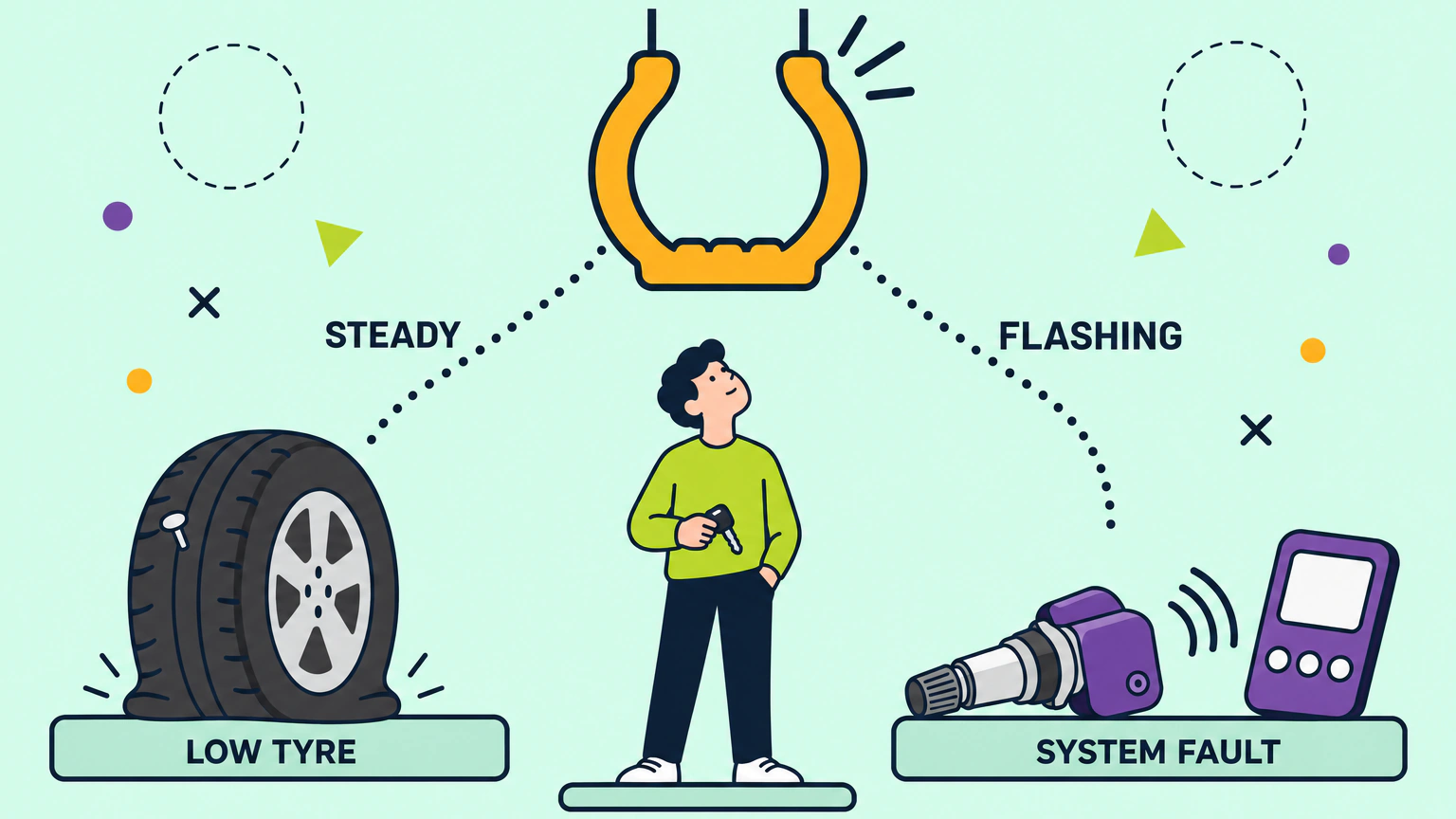
A steady tyre pressure light usually means at least one tyre has lost about a fifth of its pressure, so stop somewhere safe, check all four with a gauge and pump them up to the figure in your handbook. A light that flashes for a minute or so and then stays on means the system itself has a fault, and in England, Scotland and Wales that's a major defect at the MOT on cars first used from 1 January 2012.
So before you do anything else, watch what the light does after you start the car. Steady and flashing are two different problems, and they end in two very different bills.
On this page
- What your tyre pressure light is telling you
- Why the light comes on when the weather turns cold
- Does your car have tyre pressure sensors at all?
- Will the tyre pressure light fail your MOT?
- Can you drive with the tyre pressure light on?
- How to reset the light once the tyres are right
- When it's the sensor: what a replacement costs
- Before you pay for a new sensor
- Tyre pressure light questions
What your tyre pressure light is telling you
Every time you switch on, the lamp should light for a moment and then go out. That's the car checking its own bulb, and both the international approval rule and DVSA's MOT manual describe it. What the lamp does after that is the message.
| What you see | What it usually means | What to do |
|---|---|---|
| Comes on when you switch on, then goes out | The system checking its own lamp | Nothing. It's working. |
| Comes on and stays on, steady | At least one tyre has lost about a fifth of its pressure | Stop somewhere safe and check all four with a gauge |
| Flashes for a minute or so, then stays on | A fault in the system, often a sensor or a wheel it can't read | Check the tyres by hand, then have the system scanned |
| Flashes while you're resetting it | On some cars, the reset in progress | Follow the handbook steps and let it finish |
| Never comes on, even at switch-on | The lamp or the system isn't working | Get it checked before the MOT |
A steady light means a tyre is low
The rule behind the light is UN Regulation 141. It sets how a car's tyre pressure monitoring has to perform before the car can be approved under it, and it's strict about timing. The test uses a 20% drop from warm driving pressure or a floor of 150 kPa (1.5 bar, about 22 psi), whichever is higher. The warning must appear within ten minutes of driving. For a slow leak, the kind that lets several tyres drift down together, even all four, it allows an hour.
Those are deadlines, not targets. A car is free to warn earlier, which is why "about a fifth" is the honest figure. The "around 25%" you'll see quoted, in the RAC's guide among others, matches the American threshold. The US standard uses 25% below the maker's recommended cold pressure, or a higher minimum from its table, and allows 20 minutes.
So what do you do? Toyota's advice is to pull into a safe area and look at the tyres. Don't stop at the one that looks soft, though. A warning light may leave you guessing which tyre is low, so check all four with a gauge.
A light that flashes and then stays on means a fault
The regulation lets a carmaker use one lamp for both jobs. The catch is that a fault must show as a flash at switch-on, then a steady light for as long as the fault lasts, and the same again every time you start the car. Volkswagen's own guide puts it plainly: the lamp "flashes for about a minute and then remains lit up in amber. There is a system fault." DVSA's manual says a faulty system's lamp "may flash a number of times and then remain on".
The usual culprits are a sensor whose sealed battery has gone flat, a damaged sensor, or a wheel the system can't read. FixMyCar calls the flat battery the most common reason sensors fail. Toyota's example of the unreadable wheel is a spare with no sensor in it.
There's one exception. The regulation also lets the lamp flash to show a reset in progress, and on Toyota's button-reset cars it flashes a couple of times and goes out.
While a fault lasts, you can't rely on the pressure warning. Check the tyres by hand until it's fixed.
Why the light comes on when the weather turns cold
Tyre pressure falls with the temperature. Continental puts the drop at 0.07 to 0.14 bar for every 10°C. Nokian says about 0.1 bar.
Here's how cold weather can tip a soft tyre into warning territory. Say your handbook gives 2.3 bar (about 33 psi). Twenty per cent below that is 1.84 bar. A tyre that has crept down to 2.0 bar is about 13% low. Then a morning comes along that's 15°C colder. At Nokian's rate the tyre loses about 0.15 bar and sits at about 1.85. At Continental's higher rate it's down to 1.79. Your car's exact warning point can differ.
The cold is the last straw, not the cause. That tyre was already soft. When the light keeps coming back on a car whose tyres look fine, the likeliest answer is still a low tyre, from a cold snap or from months without a check.
Check the tyres cold, before you drive anywhere. Continental says the right figure is on the fuel filler door, on the door frame or in the handbook. The Highway Code asks for a pressure check every week, before a journey, while the tyres are cold.
Does your car have tyre pressure sensors at all?
Not every car does. A car can watch its tyres in two ways, and Toyota's UK guide explains both. The first is a battery-powered sensor built into each valve, measuring the air inside the tyre. The second uses no tyre sensors at all. The anti-lock brakes already read the speed of every wheel, and a soft tyre is smaller round, so it turns faster than the others. Fitters call the first kind a direct system and the second an indirect one. Toyota fits sensors to most of its range and the wheel-speed system to its Proace Verso, so one maker can use both.
If you don't know which you've got, you're in good company, and it's easy to find out. The regulation makes the handbook say the car has the system, and how to reset it if it can be. A dashboard that shows each tyre's pressure means sensors. And any tyre fitter's TPMS tool (TPMS is the trade's name for the tyre pressure monitoring system) will read them.
Why does it matter? On a car without sensors, there's no sensor to replace. ClickMechanic says as much: "A TPMS sensor replacement therefore generally applies to vehicles fitted with a direct system."
| With sensors (direct) | Without sensors (indirect) | |
|---|---|---|
| How it spots a low tyre | A battery-powered sensor on each valve measures the air inside | The ABS sees one wheel turning faster, because a soft tyre is smaller |
| What it knows | The pressure in each tyre | That one wheel is turning faster than the others |
| After you pump the tyres up | Some clear after a short drive, others need a reset in the menu | Reset it through the menu or button, as the handbook says |
| At a tyre change | The sensor checked and its valve seals and nut renewed | Ordinary valves, plus any recalibration the handbook requires |
| Winter wheels | Need their own sensors, and the car may need reprogramming | No tyre sensors needed. Reset as the handbook says. |
| Can a sensor fail? | Yes. The sealed battery runs down after several years. | There's no sensor to fail |
No sensors, no sensor bill. Cars with an indirect system have nothing in the wheel to replace. They work out a low tyre from how fast each wheel turns. If you're quoted for a new sensor, ask which wheel's sensor the garage's tool couldn't read, and ask to see the reading, before you agree.
Will the tyre pressure light fail your MOT?
It depends on what the light is saying, and on where the car is tested. Some guides, the RAC's among them, say any lit tyre pressure light is an MOT failure. That's not how the testers' manuals read. GOV.UK's rule for results is simple: dangerous or major problems fail the car, while minor ones and advisories are listed for you to fix.
| England, Scotland and Wales | Northern Ireland | |
|---|---|---|
| Cars it applies to | Passenger cars first used from 1 January 2012 | Passenger cars with TPMS first used from 1 November 2014, except quadricycles and vehicles with an IVA certificate |
| Light shows a fault in the system | Major defect, so the car fails | Minor defect, so the car passes with it listed |
| Light doesn't work at all | Major defect, so the car fails | Major defect, so the car fails |
| Light on because a tyre was low | Not a fault in itself. An unclear lamp gets an advisory. | Not listed as a fault |
| A tyre obviously under-inflated | Minor defect | Minor defect. A deflated tyre is major. |
In Great Britain the check leaves out motor caravans, ambulances and hearses approved as cars with a gross weight over 2,500 kg.
We've set out what the testers' manuals say. The tester's judgement on the day is what counts, so get a lit light sorted before you book.
Once it's out and staying out, compare MOT test centres near you.
The rule in England, Scotland and Wales
DVSA's MOT inspection manual covers this in section 5.2.3, and it's worth reading the way the tester does. The check covers passenger cars first used on or after 1 January 2012, apart from a few heavier vehicles approved as cars, such as motor caravans.
At switch-on, the tester expects the lamp to light and go out. If it stays on because the system has seen a pressure loss, the manual says that "does not automatically mean the system has a malfunction". A faulty system's lamp, on the other hand, "may flash a number of times and then remain on". Warning messages on the dashboard aren't a defect in their own right. And if the tester can't tell a fault from a low tyre, the manual says to add an advisory to the result.
The defect list itself is short. A system "malfunctioning or obviously not working" is a major defect, so the car fails. A tyre that's obviously under-inflated is a minor one.
One note on age. New-car rules brought the system in over two years, for new models from November 2012 and for new cars registered from November 2014. So some cars first used between 2012 and 2014 never had it. Check the handbook before you worry. And if a fault has already failed the test, our guide to driving after a failed MOT covers what you can do next and the retest.
How Northern Ireland's test is different
Northern Ireland runs its own test, at DVA centres, from its own manual. On this item it's gentler. The DVA's Light Vehicle Inspection Manual checks the lamp on passenger vehicles first used on or after 1 November 2014 that have the system fitted. They must have four wheels and no more than eight passenger seats. Quadricycles and vehicles with an IVA certificate are exempt.
A lamp that doesn't work where it should is a major defect, and the car fails. A lamp showing a system malfunction is only minor. A pass certificate can list minor defects, nidirect says, so you can deal with them in good time. In practice you drive away with a pass and a note.
Tyres get the same lighter touch. Under-inflation "is not in itself a reason for rejection", the manual says, though its defect list still treats an under-inflated tyre as minor and a deflated one as major.
A minor in Northern Ireland still needs fixing.
Don't take it to the test on the spare wheel
Toyota's UK guide spells out the trap. Fit a spare with no sensor and "the warning light will remain illuminated", and the car "cannot pass its annual MoT test if the warning light is on". The UN rule's own test sets off a fault in just this way, by fitting a wheel the system can't read. In Great Britain that's the major defect, and a fail. In Northern Ireland it's a minor.
Put the repaired wheel back on before the test. And while the space-saver is on, keep your speed down. In Great Britain the law allows a temporary-use spare on a car only up to 50 mph.
Can you drive with the tyre pressure light on?
Yes, gently, as far as somewhere safe to check. Toyota says to pull in and look at the tyres. Pump up any that are low but undamaged, then reset the system. If a tyre is damaged, fit the spare, use the repair kit or call a breakdown service.
Don't push on for days, though. The Highway Code says tyres "MUST be correctly inflated to the vehicle manufacturer's specification for the load being carried". It also warns that your brakes and steering "will be adversely affected" by the wrong pressures. In England, Wales and Scotland the law backs that up. The Construction and Use rules ban using a car on a tyre that isn't "so inflated as to make it fit for the use" it's being put to. Breaking a tyre rule is an offence under the Road Traffic Act, with three penalty points and, for a car, a fine of up to £2,500 in England and Wales.
A flashing light is a different case. The warning is about the system, not a tyre. Check the tyres by hand every week until it's fixed. Volkswagen goes further on its fault page and tells drivers not to drive on: switch off, switch on again, re-synchronise the system and see a workshop if the fault stays. Your own handbook has the final word.
If a steady light keeps coming back after you've pumped the tyres up, you've probably got a slow puncture, and it's time to find puncture repair near you. If the tyre is past saving, our guide to part worn tyres explains whether a cheaper replacement is legal and safe.
How to reset the light once the tyres are right
Order matters: pressures first, reset second. Tyres Anywhere warns that resetting a wheel-speed system "with a low tyre teaches the car that the low pressure is normal".
Volkswagen's steps run like this. Check and adjust all four tyres. Store the pressures through the menu or with the Set button. If the light stays on, check and store the pressures a second time. If it still won't go out, drive carefully to a workshop. Toyota resets through a menu on most models and a button on the GR86 and Land Cruiser. On the button cars the light flashes a couple of times and goes out.
Plenty of cars with sensors need no button at all. Rescue Tyres says most direct systems clear themselves after a few minutes of driving once every tyre reads right. The UN rule's own test allows for it too: inflate, reset as the maker says and, "if necessary", drive until the light goes out. Your handbook tells you which kind you've got.
If the light comes straight back, check the pressures again. If they're right, have the system scanned.
When it's the sensor: what a replacement costs
A sensor's battery is sealed inside it, so when the battery runs down the whole sensor goes. How long that takes depends on who you ask. Toyota says around ten years, ClickMechanic five to ten, and FixMyCar five to seven, or about 100,000 miles. Corrosion and knocks to the valve parts can kill one sooner. ClickMechanic adds that a leaking valve can sometimes be fixed with new valve parts while the sensor stays, so ask before you pay for a whole unit.
The job is fiddly but not mysterious. The wheel comes off, the tyre is deflated and its edge is eased away from the rim, and the new sensor goes in. If the sensor came blank, it's programmed for your car, and the car may then need to learn the new sensor's identity.
| Job | Published price | Who publishes it |
|---|---|---|
| Valve service kit at a tyre change, per wheel | From £5.99 | Halfords |
| Full valve service kit at a tyre change | From £11.99 | Jordans Mobile Tyres, Reading |
| New sensor supplied, programmed and fitted with a new tyre | From £80 | Jordans Mobile Tyres, Reading |
| Replacing one sensor | Around £60 to £150 | ClickMechanic |
| Tyre pressure sensor repair, average price | £108.23 | FixMyCar booking data |
FixMyCar's own page also gives £108.53 as its average quote. Each price is as that business publishes it, for its own jobs and area.
What moves the price of a replacement, ClickMechanic says, is the car, the type of sensor and whether it needs programming. Doing it while the tyre is off anyway avoids repeating part of the job. If your light is flashing now, start by getting the system scanned at a tyre centre near you, so you know which wheel is the problem before anyone quotes.
Why the light can come on after new tyres
Halfords recommends that "whenever tyres are changed on TPMS fitted wheels" the sealing and fixing parts are replaced, and it charges from £5.99 a wheel to do it. On a snap-in valve that means a new locking nut, locating washer, valve stem, core and cap. Toyota says the sensor itself should be checked at every tyre change. Even a sensor that's being kept should get new grommets, washers, collars and cores.
Things can still go wrong. FixMyCar notes that sensors may need a reset after tyres are replaced or swapped round, so the car knows which wheel is where. A sensor can also be snapped by a careless tyre change, because the valve has to sit in the right spot as the tyre comes off and goes back on.
On cars with sensors, winter wheels need sensors of their own, and Toyota's direct systems need the control module reprogrammed for each set. Cars without tyre sensors still need any reset the handbook requires after a wheel change.
If the light comes on within days of new tyres, go back to the fitter first. Next time, ask tyre fitters to quote the valve service along with the tyres. And if a fitter broke a sensor and won't put it right, here's how to complain about a garage.
Before you pay for a new sensor
Run these six checks before anyone fits anything.
- Find out which system your car has. The handbook's tyre pressure section will say, and a dashboard that shows each tyre's pressure means sensors.
- Set all four tyres to the handbook pressure while they're cold, then reset the system the way the handbook says.
- Ask which wheel's sensor the garage's tool couldn't read, and ask to see the reading.
- Ask whether the leak is the tyre or the sensor's valve. A valve service kit costs from £5.99 a wheel at Halfords.
- Check that the price covers the sensor, the fitting and the programming together.
- If new tyres are due soon, ask whether the sensor can go in while they're off.
Tyre pressure light questions
Why does my tyre pressure light keep coming on when my tyres look fine?
Usually because one of them really is low. The warning is built to come on once a tyre is about a fifth down, and a cold morning can tip a slightly soft tyre over that line. Continental puts the drop at 0.07 to 0.14 bar for every 10°C. Check all four with a gauge while they're cold. If they're right and the light still comes back, have the system scanned.
Will a tyre pressure light fail an MOT?
In England, Scotland and Wales it fails when the light shows a fault in the system itself. On cars first used from 1 January 2012, a system that's malfunctioning or obviously not working is a major defect. A light that's on because a tyre was low isn't automatically a fault, and a tester who can't tell can record an advisory. Northern Ireland classes a system fault as minor on cars first used from 1 November 2014. Quadricycles and vehicles with an IVA certificate are exempt.
Can I drive with the tyre pressure light on?
For a steady light, pull in somewhere safe and check the tyres before going further. Follow your handbook if the light flashes and then stays on. If a tyre is flat or damaged, Toyota's advice is to fit the spare, use the repair kit or call a breakdown service. In Great Britain, driving on a tyre that isn't inflated for the job is an offence carrying three penalty points.
How do I reset the tyre pressure light?
Set all four tyres to the pressure in your handbook first, while they're cold, then reset. Volkswagen tells owners to store the pressures through the menu or the Set button. Toyota's cars use a menu or a button. Some systems clear the light by themselves after a short drive. If it won't go out after a second try, have the system checked.
Why is my tyre pressure light flashing?
A light that flashes for about a minute when you start the car and then stays on is reporting a fault in the system, not a low tyre. Volkswagen's guide says exactly that. Common causes are a sensor with a flat battery, a damaged sensor, or a wheel the system can't read, such as a spare without a sensor. On some cars the light also flashes while a reset is running.
How long do tyre pressure sensors last?
Several years, but the estimates vary. Toyota puts the sensor battery at around ten years. ClickMechanic says five to ten, and FixMyCar five to seven, or about 100,000 miles. The battery is sealed inside, so when it runs down the whole sensor is replaced. Ask for the sensors to be checked whenever the tyres come off.
How much does it cost to replace a tyre pressure sensor in the UK?
ClickMechanic puts one sensor at around £60 to £150, and FixMyCar's average price for the job is £108.23. The price depends on the car, the type of sensor and whether it needs programming. If new tyres are going on anyway, Halfords charges from £5.99 a wheel for a valve service kit, and one Reading fitter fits a new programmed sensor with a new tyre from £80.
Why did my tyre pressure light come on after new tyres?
A reset may be needed after the tyre change. A sensor can also be damaged as the tyre comes off. On cars with sensors, the valve's seals and nut should be renewed at every tyre change, and winter wheels need sensors of their own. Go back to the fitter first and ask them to scan all four sensors before you pay anyone else.