

On this page
The short answer
Yes. Part worn tyres are legal to sell in the UK. But the seller has to meet every condition in the Motor Vehicle Tyres (Safety) Regulations 1994, and the one most of them miss is the marking. The word PART-WORN has to be on the tyre, in capitals at least 4 mm high, put on permanently, right next to the E mark. The tread rule is the other trap. A tyre that is perfectly legal for you to drive on can still have been illegal for anyone to sell you.
That sounds like a technicality. It isn't. The seller has a list of conditions to meet before a tyre goes on the rack, and most of the ones that matter are things you can see. Three minutes on a forecourt and you'll know more than the person selling it.
| Which rule | The minimum | Measured where | Who it binds |
|---|---|---|---|
| Selling a part worn tyre | 2 mm | Across the full breadth of tread, right round the circumference | The seller |
| Driving on a car first used on or after 3 January 1933 | 1.6 mm | Within the central three-quarters of the breadth, right round the circumference | The driver |
Two tread rules, and they are measured in different places
You already know the 1.6 mm figure. It's true, and it answers a different question. It tells you when your car becomes illegal to drive. It says nothing about whether that tyre should ever have been sold to you.
The selling rule: 2 mm, right across the tread
Before a part worn tyre can be sold, the grooves of its original tread pattern must be at least 2 mm deep "across the full breadth of tread and round the entire outer circumference". That's regulation 7, in the form a 2003 amendment gave it.
Breadth of tread means the whole strip of rubber that touches the road, measured square across it. Not the middle. Not most of it. All of it, all the way round.
So one worn band anywhere across that strip kills the sale, even if the centre grooves are 6 mm deep. And it binds the seller, not you. You break no law by driving on a tyre that should never have left the rack.
The driving rule: 1.6 mm, and only in the middle
The in-use rule lives in different law, the Construction and Use Regulations. It applies to a car or goods vehicle first used on or after 3 January 1933, plus a light trailer. For goods vehicles, the general limit is 3,500 kg, rising to 4,250 kg for a zero-emission model. The tread must be at least 1.6 mm deep through a continuous band across the central three-quarters of the breadth, right round the tyre.
Read that last bit twice. Central three-quarters. DVSA says the rest out loud in its own MOT inspection manual: "Either side of the central three-quarters of the tyre can be devoid of tread ('bald')."
One more catch from the same manual. Testers count primary grooves only, the deep ones carrying the wear indicators. Sipes and shallower grooves don't count, which is why a busy-looking tread can measure worse than it looks.
Why a tyre can be legal to drive on and still have been illegal to sell
Put the two rules side by side and something falls out.
Picture a tyre with 5 mm through the middle and 1 mm on both shoulders. That pattern can point to underinflation. Bolt it on and the tread depth can still pass an MOT, because the MOT measures the middle. It was never legal for anyone to sell it, because the sale rule measures the lot.
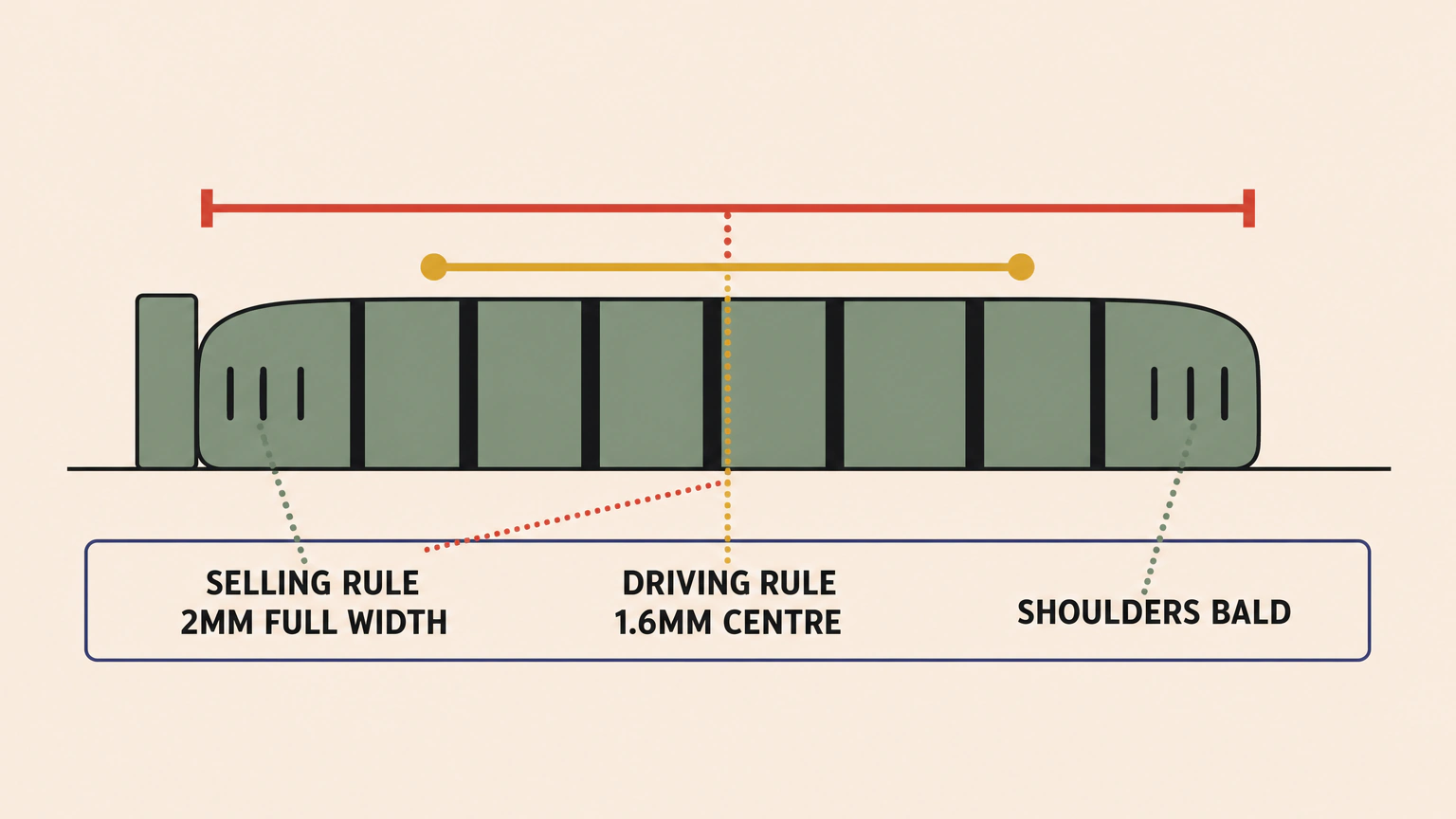
So check the shoulders. Together, they're the quarter of the tread the MOT is entitled to ignore and the sale rule is not. If your tyres wear more heavily on one side, wheel alignment specialists can check the cause rather than just replacing the symptom.
That also finishes off the coin trick. A coin in one groove tells you about the middle. It says nothing about the shoulders, and the shoulders are where the sale rule bites.
What else the seller has to get right
Tread is one condition out of several. The rest cover damage, markings and repairs, and they bite from the moment a tyre is offered for sale. Trading standards guidance is blunt: it's illegal to hold unsafe tyres in your possession for sale, so a tyre sitting unsold on a rack still has to meet the standard.
The damage list, and the inflation check behind it
Four faults stop a part worn tyre being sold at all.
A cut longer than 25 mm, or 10% of the tyre's section width if that's bigger, deep enough to reach the ply or cord. Any lump, bulge or tear caused by the structure separating or failing, inside or out. Any ply or cord showing, inside or out. And any penetration damage that hasn't been repaired.
Then the condition that catches sellers out. The tyre has to be clear of those faults "when inflated to the highest pressure at which it is designed to operate". So a tyre sold loose off a rack still has to be looked at inflated. A bulge that appears only under pressure still counts, and trading standards says selling it anyway is an offence.
The markings: PART WORN, the E mark, the speed and load codes
This is the condition you can check with your eyes. On the evidence, it's the one that gets missed most.
The word PART-WORN has to be on the tyre in capitals at least 4 mm high. The marking must be permanent and legible, applied some way other than hot branding or cutting into the rubber, and it sits immediately next to every approval mark. A cold-vulcanised rubber label is a normal way of doing it.
A tyre that hasn't been retreaded also carries an approval mark, a speed category symbol and a load index, moulded in when it was made. Trading standards guidance gives E11 and 76 S as the sort of thing to look for.
TyreSafe went out and bought fifty part worn tyres to see what the trade was doing. One of the fifty was sold legally and correctly marked. The other forty-nine weren't marked as part worn at all.
Repairs and retreads
A repaired tyre can still be sold, but the repair has to have been done properly, to the British Standard the rules name: BS AU 159f. Here's the wrinkle. The current standard is BS AU 159G, and the rules were never updated to say so. Trading standards flags that and tells the trade to follow the newer one.
That standard covers repairs to your own tyres too, so puncture repair specialists are often cheaper than replacing a tyre at all.
Retreads carry their own marking scheme, and the PART-WORN mark has to sit next to the BS or approval mark, or next to the word RETREAD.
| The requirement | What that looks like on the tyre | Where it comes from |
|---|---|---|
| Tread depth | At least 2 mm across the full breadth, all the way round | 1994 Regulations, reg 7(4) |
| Cuts | Nothing over 25 mm or 10% of section width, whichever is greater, deep enough to reach ply or cord | reg 7(2)(a) |
| Structure | No lump, bulge or tear from the structure separating or failing | reg 7(2)(b) |
| Ply and cord | None exposed, inside or out | reg 7(2)(c) |
| Punctures | No penetration damage left unrepaired, and any repair done to the British Standard | reg 7(2)(d), reg 7(8) and (9) |
| Markings | PART-WORN in capitals at least 4 mm high, next to every approval mark, plus a speed symbol and load index moulded in | reg 7(5) and reg 7(10) |
How to check a tyre before you pay
All of that turns into about two minutes of looking. Do it before the money moves, not after. Once you've paid and it's bolted on, you're arguing about a refund instead of walking away.
The order to check things in
Order matters, because the cheapest checks rule a tyre out fastest.
Markings first. They're binary and they take ten seconds. Then the date code, because nothing else being fine can fix an old casing. Then the shoulders, then the middle, then damage.
And take a gauge. The sale rule covers the full width of the tread, so one reading in the middle settles nothing. A tread gauge costs a few pounds.
- Find the word PART-WORN in capitals next to the E mark. No marking means the seller isn't following the rules, whatever else the tyre looks like.
- Find the E mark, the speed letter and the load number moulded into the sidewall, not stamped or written on afterwards.
- Read the four-digit date code and work out the tyre's age before you look at anything else about it.
- Put a gauge on both shoulders as well as the middle, and take the lowest reading you get anywhere across the tread.
- Run a hand round the inside and outside walls for lumps, bulges, tears and exposed cord, and ask to see it inflated.
- Ask what the fitted price is, including valve, balancing and disposal, and compare that number rather than the one on the tyre.
What a compliant tyre looks like when you find one
Plenty of this trade is straight, and a properly sold part worn tyre is a real product at a real saving.
It carries PART-WORN next to the E mark, in a permanent label rather than a scratch. The wear is even right across the tread, with no step at either shoulder. The date code is recent. And the seller inflates it in front of you without being asked twice.
Listen to the answers, not just the tyre. A good seller tells you what car it came off and what they check before it goes on the rack. A bad one gets vague fast. "They're all checked" isn't an answer. If somebody won't put a gauge on the shoulder while you watch, they already know what it reads.
Walk away if: four things end the conversation, whatever the price is. 1. There's no PART-WORN marking anywhere on the tyre, or it's been cut or burned into the rubber rather than applied to it. 2. The seller won't inflate it for you, or gets irritated when you ask. 3. Any part of the tread across the full width measures under 2 mm, even if the middle is deep. 4. The date code puts the tyre near or past ten years old, or there's no readable date code at all.
We are not a regulator and none of this is legal advice. If a tyre looks wrong to you, don't drive on it.
Does it actually save you money?
The sticker price isn't the number that decides this. You're paying for the millimetres of tread you're allowed to use, and for a casing with some life left in it.
What our own cost profiles say a tyre job costs
We have no tyre to sell you, which makes our own figures the honest place to start.
Across 778 jobs booked through our tyre fitters near you listings, the average tyre job came out at £35, with a low of £22 and a high of £67. That's our aggregate of what people paid through our directory, not a survey of the tyre trade, and it doesn't say whether a job was one tyre or four. We set out how our provider data works on our "Best of" awards page.
Now hold that against part worn money. Protyre reckons a part worn tyre can cost as little as £20. G Tyres, which sells them wholesale, makes the sharper point: a tyre advertised at £30 can be £50 by the time a valve, a balance and disposal are on the bill. Compare fitted prices or you're comparing nothing.
Pay by the millimetre you can legally use, not by the sticker
The sum is simple. Take the fitted price. Take the tread depth on the tyre now, subtract 1.6 mm, and that's the depth you're allowed to wear away. Divide the first by the second.
Use the same floor for both tyres, or the arithmetic lies to you. G Tyres publishes this comparison on its own site: a £45 fitted part worn starting at 5 mm against a £70 fitted new tyre starting at 8 mm, roughly where TyreSafe says a new tyre starts. It then runs the part worn down to 2 mm and the new one to 1.6 mm, which is two different floors. Put both on 1.6 mm, the only depth the law hands you, and the part worn still comes out dearer: roughly £13 a millimetre against roughly £11.
Read that the way the seller asks you to. G Tyres labels its own example "illustrative" and "not a market-average price or predicted lifespan". Treat the sum as a way of thinking about price, not a forecast. How long any tyre lasts depends on the car, the driver and the road.
The one thing no price tells you: how old the tyre is
Price can't see age, and neither can the tread.
Rubber hardens and cracks whether a tyre is driven or parked. The only way to read it is the four-digit code on the sidewall, usually inside a small oval window. First two digits are the week, second two the year: 3519 is week 35 of 2019. DVSA adds that a three-digit code means the tyre is over ten years old.
Of the part worn tyres TyreSafe has inspected, 22% were ten years old or more. The oldest it found was 29.
Don't expect the MOT to save you here either. DVSA only checks tyre age on vehicles with more than eight passenger seats, so on an ordinary car the tester isn't looking at the date at all. A fifteen-year-old casing at £45 isn't a bargain. It's a small bill for a short life.
The tyres that came with your used car are a different question
Here's the exemption almost nobody publishes. Where a complete vehicle is supplied, regulation 7 doesn't apply to any tyre on its wheels, or to the spare that comes with it.
So a dealer who hands you a used car sitting on part worn rubber isn't breaking the tyre supply rules. There's no PART-WORN marking to hunt for, because none is required. Worth knowing before you write an angry email.
It doesn't leave you with nothing, though. It moves the argument. If the tyres were unroadworthy when the car was handed over, that's a complaint about the condition of the car, and it runs against the dealer under ordinary consumer law. Same route as any other fault that was there on day one. If you want a straight opinion on what's fitted, local garages will put it on a ramp and tell you.
If you have already been sold one
Selling a part worn tyre that breaks these rules is a criminal offence, not a customer service problem.
Enforcing it is a duty on every weights and measures authority in Great Britain, which in practice means trading standards, and on every district council in Northern Ireland. In England and Wales, pass the complaint through the Citizens Advice consumer service: 0808 223 1133, or 0808 223 1144 for a Welsh-speaking adviser. Lines are open Monday to Friday, 9am to 5pm, and closed on bank holidays. In Scotland, call Advice Direct Scotland on 0808 164 6000. In Northern Ireland, it's Consumerline on 0300 123 6262.
A seller convicted under the Consumer Protection Act 1987 faces up to six months inside, a fine, or both. In England and Wales there's no upper limit on that fine any more.
Getting your money back is a separate job, and we've written that up properly: how to get a bad job put right.
Frequently asked questions
Can a garage legally fit part worn tyres for me?
Yes, as long as the tyre meets every condition. If the garage supplies the tyre, it's the supplier, and supplying covers offering, agreeing to sell, displaying and even holding for sale. Bring your own tyre and have them fit it, and they aren't the supplier. When the garage supplies the tyre, it has to meet the rules whether it's on a rim or off it.
Will a part worn tyre pass an MOT?
It can, and that's exactly the trap. The MOT measures 1.6 mm across the central three-quarters and checks the tyre's condition. It says nothing about whether the tyre was lawfully sold, and DVSA's inspection manual for this section never mentions part worn tyres once. If yours has already failed on something, here's what a failed MOT actually means.
Where do part worn tyres actually come from?
Scrapped, written-off and dismantled cars, plus imports. TyreSafe says some come from Germany. The honest answer is the one that matters most: a part worn tyre often comes without a fully traceable history. The seller may not know what it has been through.
Can I mix a part worn tyre with new ones on the same car?
Nothing stops you on wear alone. The law restricts mixing tyre structure, not age or depth. Different types of structure must not share an axle, and you must not run a diagonal-ply (crossply) or bias-belted tyre at the back with a radial at the front. A temporary spare is carved out at no more than 50 mph. One part worn tyre alongside three new ones does not breach those mixing rules if the structures are compatible.
The tyres on the used car I just bought are part worn. Was the dealer breaking the law?
No. When a complete vehicle is supplied, the part worn supply rules don't apply to the tyres on it or to the spare that came with it. If those tyres are unroadworthy, that's a complaint about the condition of the car rather than about tyre supply, and it goes to the dealer who sold you the car.
Do part worn tyres affect my insurance?
We looked for a rule treating a legally sold part worn tyre differently from a new one, and we couldn't find one. What we can tell you is the legal side. Driving on a tyre below the limit is an offence in its own right, with three penalty points and an obligatory endorsement. A defective tyre that helped cause a crash becomes evidence. Your policy wording settles the rest.