

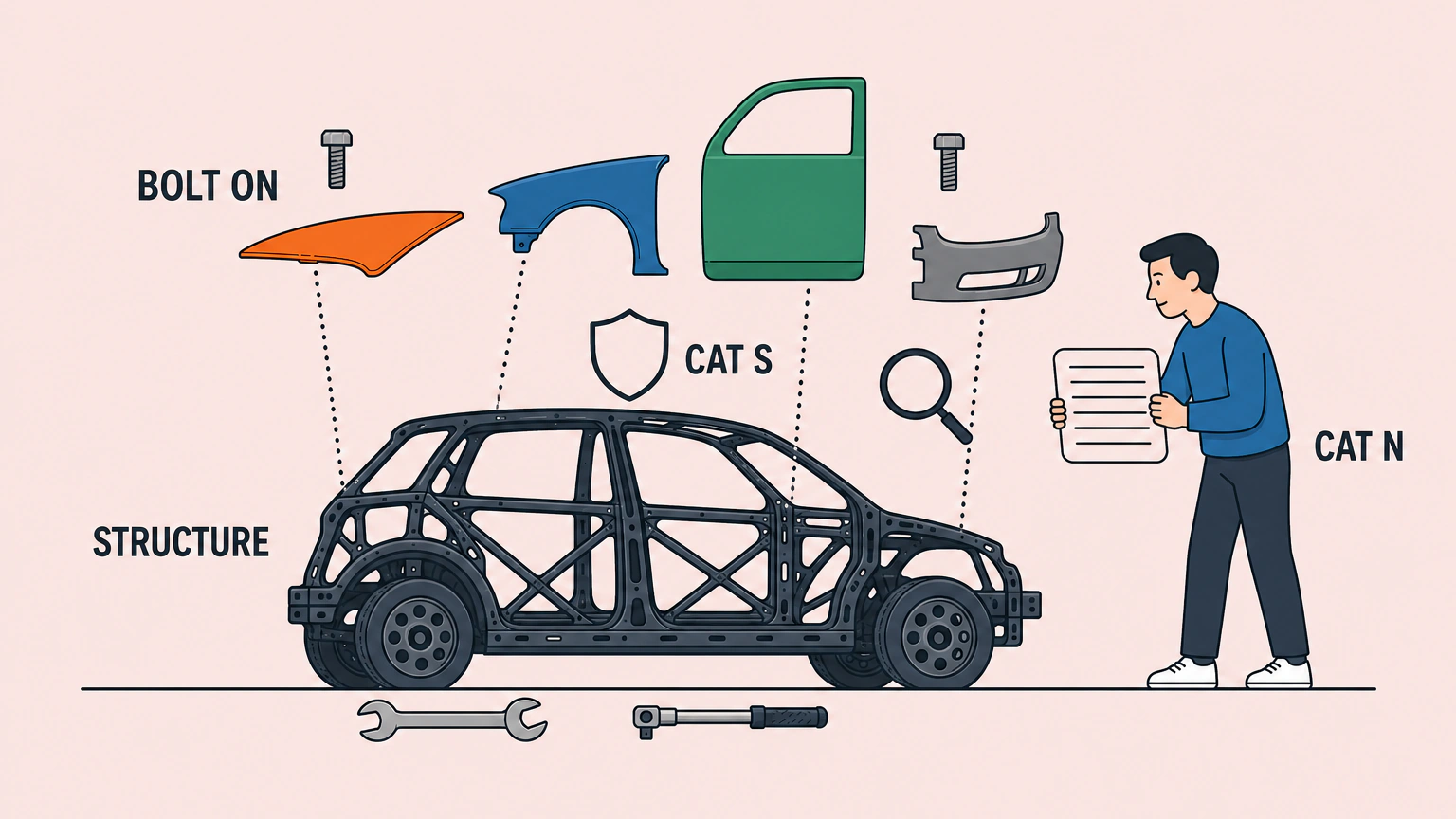
Here's the short answer to should I buy a Cat S car. Cat S and Cat N cars can return to the road once they're repaired to a roadworthy condition, and a well repaired one can be a genuine bargain. But the letter only tells you where the damage was, not how bad it was or how well it was put right. S means the structural frame or chassis was damaged. N means it wasn't. Neither says a word about the quality of the repair. That's the only thing that actually matters, and it's the one thing no letter, no log book and no MOT certificate will tell you.
On this page
What Cat S and Cat N actually mean
Start with what the letters are: they aren't law. They come from an insurance industry code of practice. The current one is the Code of Practice for the Categorisation of Motorised Vehicle Salvage, dated 28 May 2025 and produced by the Association of British Insurers. Its stated purpose is "to protect the public, detect and deter insurance fraud as well as other criminal activities, and to ensure transparency of vehicle history for the benefit of all stakeholders."
So the letter isn't a punishment stamped on a car. It records a judgement someone made about where the damage landed, and you can learn to read it.
The four categories, in the insurers' own words
Two of the four letters end a car's life. Two don't. GOV.UK sets out the ladder, and the code fills in the paperwork.
| Category | What the damage is | Can it go back on the road | What happens to the log book | Where you'll see it |
|---|---|---|---|---|
| A (Scrap / Recycle) | Beyond repair, with nothing worth saving | No. The whole car is crushed | Must be securely destroyed, never reissued | Paid history check |
| B (Break) | The structural frame is beyond repair, though parts can be reused | No. The body shell is crushed | Must be securely destroyed, never reissued | Paid history check |
| S (Repairable structural) | Damage to any part of the structural frame or chassis | Yes, once repaired to a roadworthy condition | Complete log book goes to the insurer, you apply for a free duplicate on form V62, and DVLA records the category in it | On the V5C and on a paid history check |
| N (Repairable non-structural) | Damage away from the structural frame or chassis | Yes, once repaired to a roadworthy condition | You keep the log book you already have | Paid history check |
A and B cars are waste in the legal sense, and the code sends them to an authorised treatment facility to be crushed. If that's the road you're on, here's what happens when a car goes for scrap instead. From here on it's S and N, the two you can be sold.
S and N tell you where the damage was, not how bad it was
The code decides the letter by asking one question: did the damage reach the structure? Its wording is precise. A car becomes a Category S "if any structural element requires repair realignment to original dimensions or replacement." Cosmetic work where nothing has to be pulled back into line doesn't count.
Picture two cars. The first hit a bollard slowly and looks dreadful: bonnet folded, bumper hanging off and a wing crumpled. Those parts sit on the code's own list of non-structural items, along with door skins, the roof panel, the boot lid and the rear quarter panel. Repairable, non-structural, Category N.
The second was nudged in a car park and barely looks marked. But the shove ran through the sill and tweaked the inner B post. Structural. So it's a Category S, and it needs measuring and pulling straight before anyone touches the paint.
Hold on to one more line when you're looking at repair photographs. The assessor must consider "intrusion of damage into structural components that sit behind the outer skin (non-structural) components." Smashed panels can hide a bent frame. Tidy panels can hide one too.
Here's the code's own list of what counts as structural. Names differ between manufacturers, so read it as the shape of the thing rather than a parts catalogue, and note the two castings: these are one-piece components made by high-pressure die casting.
- Fire wall or front bulkhead
- Front header rail
- Roof side cant rail
- Rear header rail
- Rear inner wing
- Rear wheel housing extension
- Inner B post or pillar reinforcement
- Inner sill reinforcement
- Front chassis leg
- Front one-piece mega or giga casting
- Rear one-piece mega or giga casting
- Rear back panel assembly
- Inner A post or pillar reinforcement
- Front upper wing support
- Front inner wing wheelhouse
- Body structure for chassis frame
- Welded chassis frame
- Body side outer, minus the quarter panel
- HGV passenger cab
- Rear chassis leg
Both castings are new since the last edition, which tells you the list moves as cars do.
What happened to Cat C and Cat D
You'll still see Cat C and Cat D in adverts, and they aren't typos. Those were the old letters, and they were largely about money: whether the repair bill beat the value of the car. The current lettering came in on 1 October 2017, and when the ABI announced the change it said the new code put "a greater focus on the condition of the vehicle rather than repair costs."
Cars written off before that date keep their old record. The code says previous MIAFTR entries must be retained. Exceptional circumstances can justify re-categorisation, but there's no conversion table: the old question and the new one are different questions. So read an old C or D the way you'd read any of the others. What was damaged, who repaired it, where's the evidence.
A Cat N car is not automatically a light knock
A common picture of a Cat N is a scuffed bumper, cracked light or some electrical damage. That picture is incomplete, and the code shows why. "Non-structural" is a term about location. It says the frame was fine. It doesn't say the car was.
Flood and fire cars can come out as Cat N
Water first. The code sorts flooded cars by what's left, not by how deep the water got. If nothing can be reused, it's an A. If water got into the passenger compartment far enough to compromise the electrical or safety components, it's a B, with parts salvaged. Then the catch-all: "Category N: All other water damaged vehicles which fall within the CoP." The water-damage ladder itself lists A, B and N.
Fire works the same way, but with an S in the ladder. If heat reached the structural frame or chassis and the insurer decided not to repair, it's an S. If the frame escaped, it's an N.
Both perils can leave damage beyond the bodywork. Water can compromise electrical and safety components without reaching the structure. Fire and smoke can damage parts without reaching the frame. That may not show on a run round the block, which is why the history matters more than the shine.
Steering and suspension may have been replaced
The code's own definition of Category N carries a warning, and it's the sentence to read twice: "Whilst the damage to the vehicle has been noted as non-structural, there may still be some safety critical items that require replacement."
Think about what takes the hit in a knock that leaves the shell straight. Wishbones, track rods, hubs, springs, dampers. DVSA calls that family "highly stressed components", meaning steering and suspension arms, rods and levers, and it gives testers a separate set of rules for them.
So ask the seller: what was replaced, and by whom? Then have the answer checked. Steering and suspension specialists can check whether a corner of the car has been apart. Our own cost profiles for that work put a fair range at £864 to £1,221 across 617 profiles. If the geometry was never reset afterwards, wheel alignment specialists will find it on the rig. Uneven tyre wear is a reason to check the geometry.
Who decides, and what gets written down
Somebody looked at this car and made a call. Knowing who made the final decision, and where it was filed, separates a confident buyer from a hopeful one.
The person who categorises the car has to be qualified for it
The code calls them an Appropriately Qualified Person, and it sets a bar. An AQP is "someone who has a comprehensive technical education and training record, relevant to motorised vehicle repair", who has "passed and hold a current competency-based assessment on salvage categorisation, provided by the Institute of Automotive Engineer Assessors (IAEA) or an equivalent industry recognised body."
They also have to be traceable. The AQP "must be identifiable by their competency based unique identifier", and the code puts the final decision on them, even where two insurers disagree about the same car.
A qualified assessor deciding the frame was hit beats a stranger on a forecourt saying it was only a bump. It cuts both ways, though. The unique identifier makes the decision traceable inside the process. It does not promise that a seller will know the assessor's name.
Why a paid history check knows and a free one does not
The category is filed on MIAFTR, the insurance industry's anti-fraud and theft register. An entry "must be completed in respect of all categorised vehicles", and making it also satisfies the insurer's legal duty to notify DVLA. From there the code explains how the news reaches you: "All notifications to MIAFTR whether indicating theft or damage are passed to vehicle data agencies for a finance check. The data agencies use the information to provide a vehicle check service to the motor trade and the public."
That's the paid check you keep seeing advertised. The free government one is a different animal. DVLA's own page lists what it returns: tax and SORN status, when the MOT expires, first registration date, last log book issue date, year of manufacture, type approval category, weight, engine size, fuel type, emissions and export status. Useful. Just not a write-off search.
Pro tip: Read a history check for two things, the letter and the date. A car categorised nine years ago, repaired by a named bodyshop and driven ever since is a different proposition from one categorised in March. A recent repair has had less time to prove itself on the road, and the seller may also be the repairer. If the check is clean but one panel has fresh paint, believe the car: a clean record does not prove it was never hit or repaired.
The Cat N log book that looks completely clean
Here's the paperwork detail to remember.
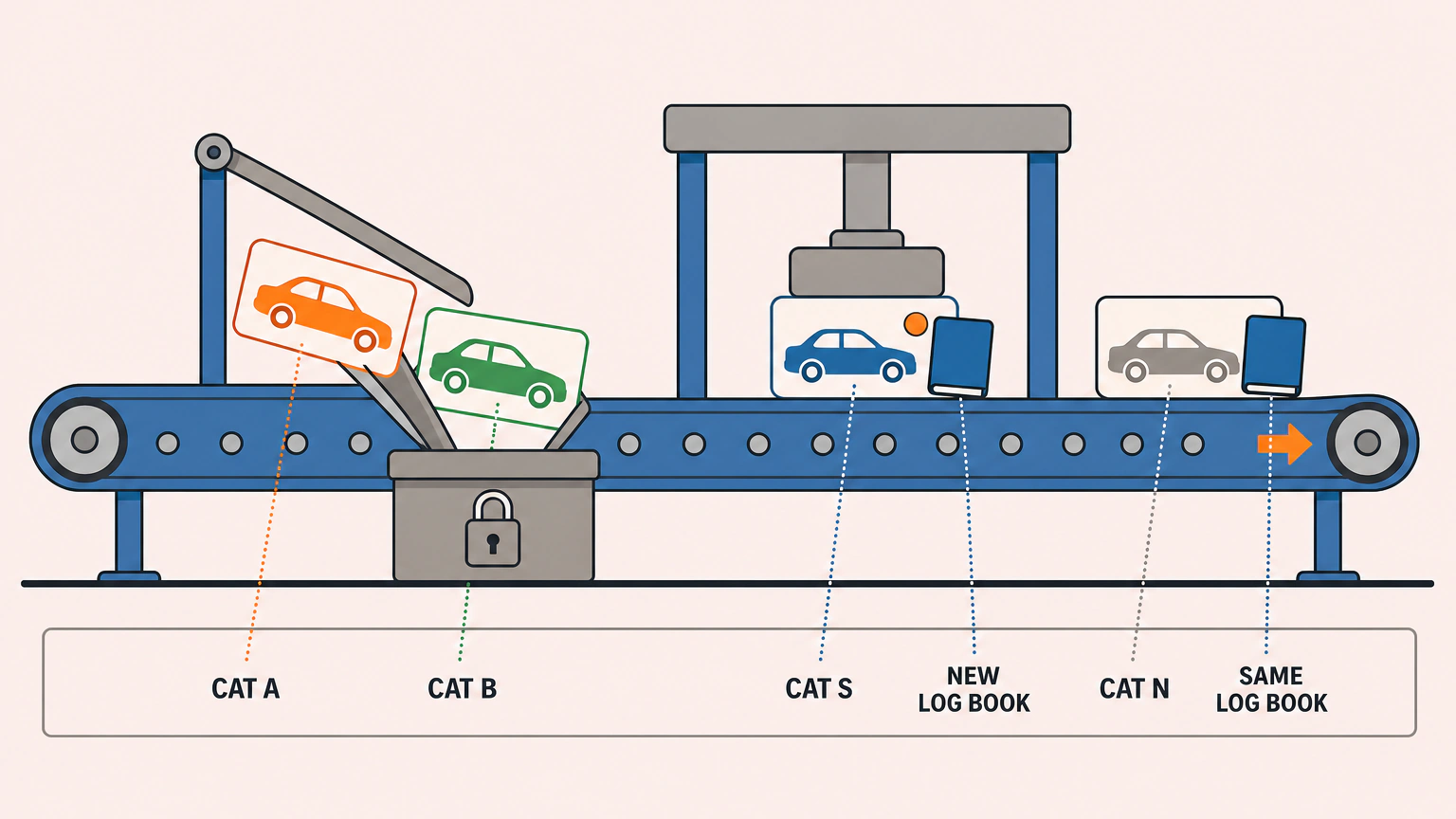
The paperwork isn't symmetrical. To keep a Category S car, GOV.UK says you send the complete log book to your insurance company and apply for a free duplicate using form V62, and "DVLA will record the vehicle's category in the log book." The S follows the car in writing, in the document a buyer actually holds.
For a Category N, GOV.UK is just as clear and says the opposite: "You can keep the log book if you want to keep a category N vehicle." No new document. Nothing added to the one you have.
Read that twice, because it's the trap. A buyer who studies the V5C, sees nothing on it and decides the car has never been written off has been told precisely nothing. The mark lives on MIAFTR, and vehicle data agencies use that information in paid history checks. There's one small tell in the free DVLA data: the last log book issue date. On a Cat S the duplicate is issued after the category is applied. So a V5C issued mid-life on a one-owner car is worth a question.
A fresh MOT is not proof the repair was done properly
An MOT is a roadworthiness test at a moment in time. It's a good test, run to a public manual, and it isn't a repair audit. Read what that manual asks of a tester and you'll stop treating a fresh certificate as evidence about a rebuilt car.
The rules that follow are DVSA's, and they govern testing in Great Britain. Northern Ireland tests through the DVA, and we haven't checked that position.
What the tester has to look at, and what they can skip
The manual names "prescribed areas" and tells the tester to pay particular attention to them. They are the load-bearing parts that testable items bolt to, meaning brakes, steering, axles, wheels, tyres and suspension. The area reaches any load-bearing or supporting structure "within 30cm of the mounting location".
Picture a bubble the size of a dinner plate around every mounting point. Inside it, the tester presses with finger and thumb, taps with a corrosion tool, and rejects holes, softness and inadequate repairs. Outside it the bar changes: a defect only fails if braking or steering is affected by misalignment, or the strength of the overall structure is significantly reduced.
Then the line that decides what a certificate is worth on a repaired car. "You do not have to check areas covered by things like body trim." Some repaired areas sit behind plastic trim. The tester isn't required to remove it.
How the MOT manual judges repair methods
The manual is specific about how structure may be put back together, which hands you the vocabulary to ask a real question. Repairs have to be "properly carried out and appear to be as strong as the original structure". Spot welds are acceptable only where the original panel was spot welded and the old section has been removed. Otherwise, "patch repairs must be continuously seam welded". Where a manufacturer specifies MIG brazing, or bonding combined with riveting, those are fine, because that joint was designed for the car.
On their own, the manual won't accept gas brazing, soldering, adhesive bonding, fibre reinforcement or body filler as repairs to load-bearing members.
Body filler is the one to sit with. It can make a repair look finished and disappear under paint. The MOT manual won't accept it as a repair to a load-bearing member.
The line in the manual that should change how you shop
A tester who meets a repair they can't identify has an instruction, and it sits right under that list.
Red flag: "Sometimes it's difficult to identify the repair method, especially after the repair has been covered in paint or underseal. If you are not sure what the method of repair is, you should pass and advise." That's a sensible rule for this type of test. It's a poor basis for a five-figure purchase. An MOT certificate is not a repair certificate, so budget for an inspection on top of it, and don't let a long ticket talk you out of one.
That isn't a scandal. It's a design limit, and it's honest of DVSA to publish it. But an MOT certificate was never built to answer your question.
What to check before you hand over any money
Buy the repair, not the category. The letter is history. The workmanship is what you'll drive, insure and eventually try to sell, so spend your effort proving it.
The paperwork to ask the seller for
Ask for four things, and watch how the seller reacts, because the reaction is data too.
A full history check showing the category and the date it was applied. The repair invoice, naming the bodyshop, listing parts and labour separately, ideally with a jig or measuring printout attached. Photographs from before and during the repair, if the seller has them. And the V5C, with its details matching the car in front of you.
A private seller who kept none of it may simply be disorganised, and it's fair to ask what they remember. A trader who won't produce the invoice for a repair they carried out is another matter. That document should show what the trader says was done.
What an independent inspection should cover
Book independent vehicle inspection centres rather than the seller's own garage, and hand the inspector this list. Ask them to:
- Measure the shell on a jig or an electronic measuring system, and give you the figures rather than a verdict
- Photograph the underside and inside the wheel arches, and inspect behind trim that the MOT tester doesn't have to remove
- Identify the repair method on any load-bearing member and say whether it's welded, bonded or filled
- Check paint depth on every panel and flag anything that doesn't match the rest of the car
- Check the doors, bonnet and boot open, close and latch cleanly under their own weight
- Put it on an alignment rig and give you the before figures against the manufacturer's tolerances
- Scan for stored fault codes, and check every airbag and restraint warning behaves normally on ignition
- Work from the seller's written answer about what was replaced, obtained before the inspection, and check it against what the car shows
If the inspection turns up work worth putting right, price it before you negotiate. Our own body repair cost profiles put a fair range at £293 to £664 across 904 profiles, against an average of £426. That's a number to hold against a quote from body repair specialists near you.
When to walk away
Some cars aren't worth the discount, and we'd rather name them than leave you guessing at the roadside. Walk away when nobody can say who repaired it or produce a single piece of evidence. Walk away from a Cat S with no measuring or alignment record, because being straight is that category's whole question. Walk away from a flood history, whatever letter it wears. Walk away when a seller won't release the car for an inspection, or wants a deposit before you've had one.
And if this is a first car, skip the category cars altogether. Judging repair quality is a skill, and nobody should learn it on the one car they can afford.
A category is one qualified assessor's call about one car on one day. No guide can tell you whether that particular car was put back together properly, which is exactly why the inspection is the point.
What one of these costs you afterwards
The discount is at the front. The costs arrive later.
Insurance first. Cover is available for repaired Cat S and Cat N cars, but some insurers won't quote and the price can be higher. Get real quotes on the registration before you commit. You carry a duty too. The Consumer Insurance (Disclosure and Representations) Act 2012 says you must "take reasonable care not to make a misrepresentation to the insurer". A dishonest answer always counts as falling short of that care.
Then resale. The record doesn't expire, and the code tells the industry to leave it alone: "Other than to correct errors, MIAFTR data should not be modified or removed." Expect the category to narrow your buyer pool when you sell.
Selling on brings a duty as well, and which one depends on who you are. The Digital Markets, Competition and Consumers Act 2024 has applied to traders since 6 April 2025. A trader risks a misleading omission by hiding material information that is likely to change an average consumer's decision. Giving it too late or unclearly can also count as an omission. Private sellers aren't traders, so those rules don't reach them, but the Sale of Goods Act 1979 still requires goods sold by description to match the description.
If you buy one and find the repair wasn't what you were told, there's a route: here's how to put a bad repair right. Use it early, while the invoice and the seller are still findable.
Frequently asked questions
Is Cat N worse than Cat S?
No, and the question has the wrong shape. The letters describe where the damage was, not how serious it was. S means the structural frame took a hit. N means it didn't. But the code warns a non-structural car may still need safety critical parts replaced, and flood and fire cars can land in N. A badly repaired N is a worse buy than a properly rebuilt S.
Can a Cat S car pass an MOT?
Yes. The MOT checks whether a car meets the standard on the day, and the salvage category isn't part of the test. In Great Britain the tester inspects structural integrity in the prescribed areas around testable mountings, but doesn't have to check areas covered by body trim. So a pass tells you the car met the MOT standard that morning, not that every repaired area or repair method was checked.
Do you have to tell your insurer a car is Cat N?
Answer the insurer's questions honestly and in full. The Consumer Insurance (Disclosure and Representations) Act 2012 puts a duty on you to "take reasonable care not to make a misrepresentation". It treats a dishonest answer as always falling short. If an insurer asks, saying no when the answer is yes can put a later claim at risk.
Do you have to declare Cat N when you sell the car?
A trader should disclose it before the buyer commits. Since 6 April 2025, the Digital Markets, Competition and Consumers Act 2024 has treated hidden material information as misleading if it is likely to change the average consumer's decision. Private sellers aren't covered by those rules, but the car still has to match how they described it.
How much less is a Cat S car worth?
We couldn't find a reliable percentage, and we looked. What moves it is the category, how long ago it happened, what was damaged, how good the evidence is and how rare the car is. So price it yourself. Find three clean examples of the same model, year and mileage, and the gap is the discount you're being offered.
Will insurers cover a Cat S or a Cat N car?
Cover is available, though some insurers won't offer it. A repaired Cat S or Cat N car can return to the road once it is roadworthy. The price can be higher, and some insurers won't quote. Run the registration through a comparison site before you buy rather than after.
Can a Cat A or a Cat B car ever come back?
No. A Cat A car is crushed whole. A Cat B has its body shell crushed, though usable parts can be salvaged from it. For both, the code tells the trade the V5C must be securely destroyed and never reissued. If anyone offers you a car whose history shows either letter, walk away and report the advert.