

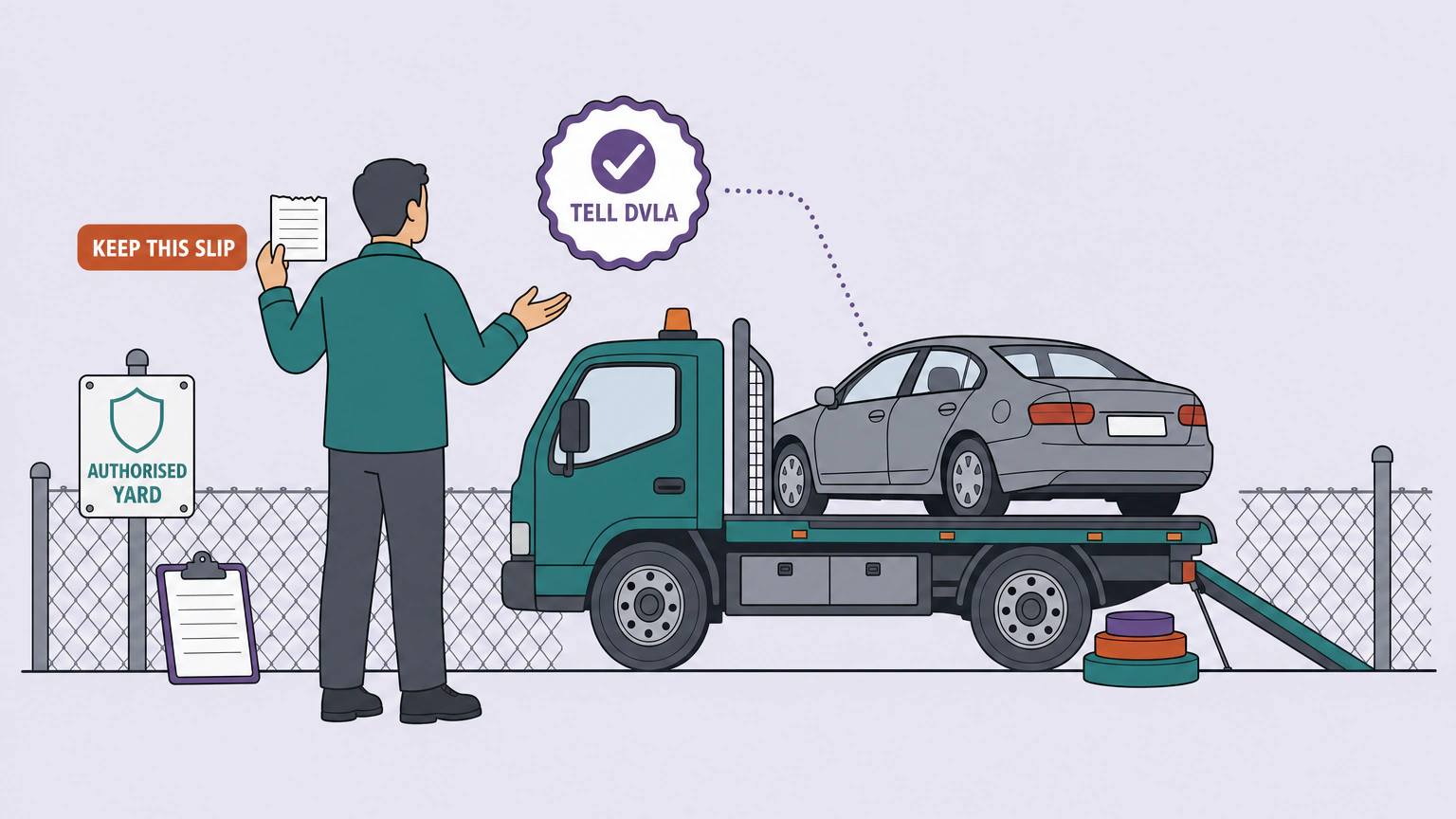
Only an authorised treatment facility, an ATF, may scrap a car in the UK. When an authorised treatment facility accepts delivery of a complete car with no added waste, it cannot charge you just because the car has no market value, and it has to give you a certificate of destruction within seven days, also free. Keep the yellow slip out of the log book. Tell DVLA the same day the car leaves. And don't take cash without asking what is happening to the car. In England, Wales and Scotland, a yard commits an offence if it pays cash for a car being scrapped. If the car will be repaired and sold, cash can be legal but no certificate of destruction will follow.
On this page
- Who is allowed to scrap your car
- What it should cost you, and what you should be paid
- The log book, and the bit you keep
- Tell DVLA the same day you hand the car over
- The certificate that proves the car was scrapped
- If your insurer wrote the car off instead
- Questions people ask before they ring a scrapyard
Who is allowed to scrap your car
You have a number off a leaflet or the first result on your phone, a man who sounds confident, and no way of telling whether he's licensed. The check takes a minute, and it's the only minute in this process that protects you afterwards.
Before you make it, be sure the car is really finished. A refusal notice and a dead car are two different things, so what a failed MOT actually means is worth ten minutes before you write anything off. If it won't start at all, a mobile mechanic can come to the car and may save you a separate recovery charge.
What an authorised treatment facility actually is
An ATF is a scrap yard authorised to take a car apart safely. SEPA, which authorises these sites in Scotland, calls the job depollution: the fluids come out and the hazardous parts come off before anything else happens to the shell. Fuel, oil, coolant, brake fluid, the battery, the airbags. All of it has to go somewhere, and the licence exists so it doesn't end up in the ground.
The name over the gate tells you nothing. SEPA lists the aliases itself: "dismantlers, scrap yards, salvage yards or breakers yards". Any of them can be a licensed ATF. Any of them can also be a man with a lorry and no licence at all. GOV.UK is blunt about using the second sort: "It's illegal to scrap your vehicle anywhere else."
How to check the yard before you ring them
Every nation of the UK keeps a public list, and no single search covers all four. GOV.UK's "Find a vehicle scrapyard" takes your postcode, but it covers England only. Scotland's list is a spreadsheet you download from SEPA. Wales keeps a searchable register at Natural Resources Wales, though the link opens on a Welsh and English language chooser first, so pick English and carry on. Northern Ireland's is a PDF from DAERA, refreshed about once a month.
Ring the yard, ask for the name it trades and registers under, and hold that name against your nation's list before anything moves.
| Where the car is | Register that proves the yard is authorised | How the yard must pay you when the car is scrapped | The rule it comes from |
|---|---|---|---|
| England | GOV.UK, "Find a vehicle scrapyard", postcode search | Non-transferable cheque, or electronic transfer of funds | Scrap Metal Dealers Act 2013, s.12(1) |
| Wales | Natural Resources Wales, end of life vehicles treatment facilities public register | Non-transferable cheque, or electronic transfer of funds | Scrap Metal Dealers Act 2013, s.12(1), extent England and Wales |
| Scotland | SEPA, register of all authorised ATFs, downloadable spreadsheet | Non-transferable cheque, or electronic transfer to a bank or building society account in the name of the payee | Civic Government (Scotland) Act 1982, s.33A(2), inserted by the Air Weapons and Licensing (Scotland) Act 2015, s.69 |
| Northern Ireland | DAERA, ATF public register, a PDF list usually updated monthly | We looked for a Northern Ireland rule on this and found none, so ask for a bank transfer and a receipt whatever is offered | No provision found |
If the register throws up nothing close to you, our own listings of vehicle recyclers and scrap yards near you are a quicker way to build a shortlist. Check every name on it against your nation's register before you ring.
What it should cost you, and what you should be paid
Now the money, which is where most of the damage gets done. Two questions decide it. What the yard may charge you, and how it's allowed to hand over what it owes you.
When the yard may charge you
The rule lives in regulation 38 of the End-of-Life Vehicles Regulations 2003, and it's one line. A facility taking your end-of-life car "shall not impose a charge on the last holder or owner of that vehicle as a result of the vehicle having no market value".
There's one exception, and it's where people trip. A yard may charge you when the car "does not contain the essential components of a vehicle, in particular the engine, transmission, coachwork, catalytic converter and wheels, or contains waste which has been added". Read GOV.UK's plain-English version of that list and you get the engine, gearbox, bodywork and wheels, with the catalytic converter left out. The catalytic converter is valuable, and selling it separately can lawfully turn a free hand-in into a bill.
Free take-back is a different thing from free collection. If the car can't be driven, somebody has to move it, and that's a separate job with its own price. Our own figures for vehicle recovery near you average £146 across 575 cost profiles, so a yard that collects for nothing is handing you something worth having. If the nearest authorised yard is at the far end of the country, vehicle transport services are a different market again, and our average there is £1,496 across 839 profiles.
Nobody may charge you for the certificate
Regulation 28 of the same regulations is a single sentence: "An authorised treatment facility shall not impose any charge on the last holder or owner of an end-of-life vehicle for the issue of a certificate of destruction."
That stands apart from the free take-back, and it survives the charging exception. Even where a yard has lawfully charged you, because you pulled the engine out first, the certificate itself still costs you nothing. So an admin fee, a paperwork fee or a "DVLA fee" for the certificate is a charge for something the regulations make free. Ask for it to come off, and ring the next name on your list if it stays.
How the money has to reach you
This part is criminal law rather than a preference. In England and Wales, section 12 of the Scrap Metal Dealers Act 2013 sets the method. A dealer "must not pay for scrap metal except" by a cheque that can't be passed on to anyone else, or by an electronic transfer of funds. Paying in goods or services counts as paying. If the rule is broken, the dealer, the site manager and whoever makes the payment may each commit an offence. The Act gives the dealer and site manager a defence if they made compliant arrangements and took reasonable steps to enforce them. The penalty is "a fine not exceeding level 5 on the standard scale".
Your old car counts as scrap metal for this. The Act reaches "any product, article or assembly which is made from or contains metal and is broken, worn out or regarded by its last holder as having reached the end of its useful life". A business built on "buying written-off vehicles and subsequently repairing and reselling them" is a scrap metal dealer under the same Act, which shuts the obvious loophole.
Scotland runs its own version, and it bites harder. Section 33A of the Civic Government (Scotland) Act 1982, inserted in 2015, allows a non-transferable cheque or "electronic transfer of funds to a bank or building society account in the name of the payee". The money has to land in an account with your name on it. Not your partner's, not a friend's, and certainly not the driver's.
Red flag: four things that should stop the car moving. - Cash offered on the doorstep. Ask whether the car is being scrapped or resold, then look the yard up on your nation's register before you answer. - No certificate promised, or promised "later". Get the seven-day rule agreed before the car is loaded, or use a different yard. - A fee for accepting a complete car with no added waste. Regulation 38 says the yard cannot charge you just because the car has no market value, so ask what the charge is for, then ring the next name on the list. - A yard that won't give you the name it's registered under. That name is the only thing you can check, and without it there's no deal.
What a cash offer is really telling you
So somebody counts notes into your hand. That's a warning sign, but it's also information, and it forks two ways.
A cash offer can mean the payment is unlawful, or that your car isn't being bought as scrap. GOV.UK sets out the second case plainly: "You will not get a certificate of destruction if the ATF decides to repair and sell your vehicle. You can be paid for your vehicle by any method, including cash." Repairing and reselling is perfectly legal, and a yard is entitled to choose it. What changes is what you're left holding. Nothing was destroyed, so nothing gets certified.
A car nobody scrapped can be fixed, sold and driven back onto the road still wearing the registration you knew it by, while you stand in the kitchen with a handful of notes and no paperwork at all. So when the cash comes out, ask the only question worth asking: is this car being scrapped, or repaired and sold? Then get the answer in writing before the lorry moves.
These are the rules as the regulations state them, not legal advice about your particular car. If money has already gone missing, or the car has vanished, that's a job for Citizens Advice or your local trading standards rather than a web page.
The log book, and the bit you keep
Everything up to here can be undone. You can ring a different yard, or say no on the doorstep. The log book is the one move you can't take back, because once the whole book goes into somebody else's van, your evidence goes with it.
Which section to tear off, and what yours is called
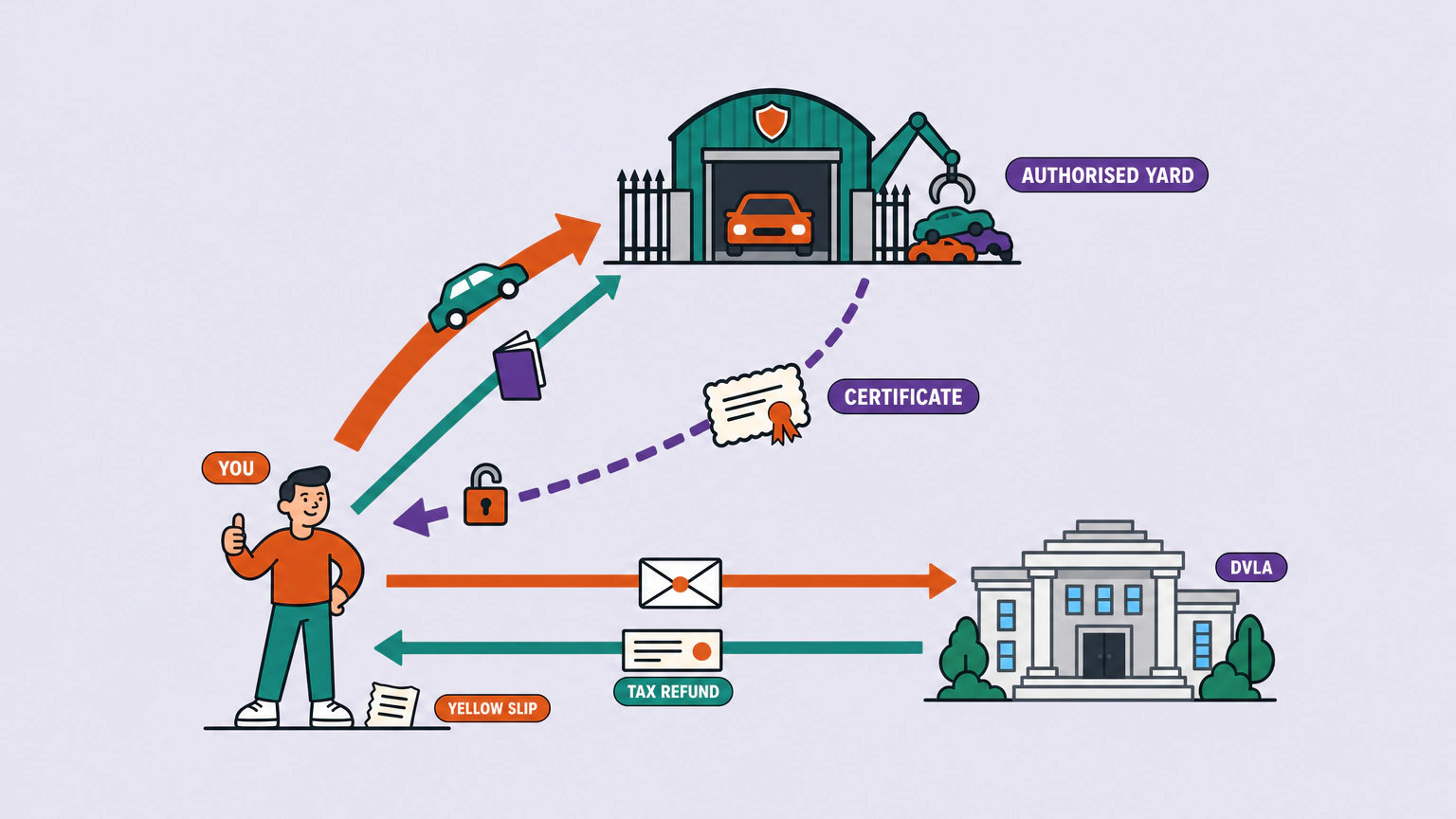
Give the yard the log book, and keep the yellow "sell, transfer or part-exchange your vehicle to the motor trade" section out of it. GOV.UK names that section by its wording rather than by a number, which is exactly how you should ask for it at the gate. If a yard wants the whole book, the answer is no.
Write down the 11-digit reference number from the log book before you hand anything over. You'll need it to tell DVLA online, and by then the book will be somewhere else.
Pro tip: Photograph the log book, both sides, before it goes anywhere near the yard, and photograph the car with its number plate visible on the day it's collected. It gives you another dated record if the handover is ever questioned.
If the V5C has gone missing
Losing the log book slows things down. It doesn't stop the car being scrapped, and it doesn't shift your liability by an inch. You can still scrap the car, and DVLA has a route built for exactly this. Write to them with your name and address, the registration number, the make and model, the exact date the car went, and the yard's name and address. The address is DVLA, Swansea, SA99 1BD.
If you'd rather straighten the paperwork out first, a replacement V5C costs £25 online or by phone and normally arrives in 5 to 7 working days. You have to be the registered keeper to apply, and you'll need the registration number, the VIN and the name and postcode already on the record. Either way, telling DVLA stays your job. A missing book is no defence.
Tell DVLA the same day you hand the car over
The car can be gone before your job is done. Yours ends when DVLA knows. This is the most expensive thing on the whole list to get wrong, and the cheapest to get right.
The fine, and the two ways to tell them
GOV.UK is unambiguous about what silence costs: "You can be fined £1,000 if you do not tell DVLA." However confidently the driver tells you he'll sort it, he can't. The keeper record is yours to close.
Online is the faster route. You'll need the 11-digit reference number from the latest log book, and you enter the scrapyard's name as the trader you sold the vehicle to, even when no money changed hands. Back comes an email confirmation, then a letter saying you're no longer the keeper. By post, the yard fills in the yellow section and you send that perforated part to DVLA, Swansea, SA99 1BD.
There's a wrinkle here that trips people. GOV.UK tells you to keep the yellow section, then its postal route tells you to have the yard fill that same section in and send it on. Both are right. Keeping it means it never stays with the yard. Tell DVLA online and the slip stays with you as your record. Do it by post and the slip is the thing you post. Whichever way you go, give every detail asked for, because a notification missing information can be rejected, and that delays your refund.
Your tax comes back in whole months, so the date matters
You don't apply for the refund. Telling DVLA the car has gone is what triggers it, and GOV.UK puts it simply: "You'll automatically get a refund cheque for any full months left on your vehicle tax." The cheque goes to the name and address on the log book, and a Direct Debit stops on its own.
The refund is worked out from the date DVLA gets your information, not from the day the lorry took the car. Let the notification drift into a new month and it can cost you a month's tax. And whole months means whole months. You get nothing back for a part-month, and nothing for credit card fees, the 5% surcharge on some Direct Debits, or the 10% surcharge on a single six-month payment. If the cheque hasn't arrived after eight weeks, ring DVLA. If it arrives in the wrong name, send it back to the Refund Section, DVLA, Swansea, SA99 1AL, with the right one.
The certificate that proves the car was scrapped
Telling DVLA closes your keeper record. The certificate proves the car was handed over for scrap. It's the document to chase if the yard says the car was destroyed.
What has to be printed on it
Regulation 29 says the certificate must carry at least the information listed in Schedule 3 of the regulations. It's short and specific, so it doubles as a checklist.
- The yard's name, address, signature and its registration or identification number
- The name and address of the authority responsible for that yard's permit
- The date the certificate was issued
- Your car's nationality mark and registration number, with the registration document attached or a statement that it's been destroyed
- The class of vehicle, its make and its model
- The vehicle identification number, the VIN or chassis number
- Your name, address, nationality and signature as the holder or owner handing the car over
Two of those do real work. The yard's own registration number is what lets you match the certificate back to the entry on your nation's list, which closes the loop you opened before you rang anyone. The first item carries a caveat written into the regulations, though: that number "may be waived in the case where the national registration or identification does not provide for such number". A gap there isn't proof of a fake. A missing name, address or signature is another matter.
When it should land, and which vehicles get one
Seven days is the rule. The ATF "will give you a 'certificate of destruction' within 7 days", says GOV.UK, if what you scrapped was a car, a light van or a three-wheeled motor vehicle, though not a motor tricycle. Other types of vehicle do not get one under this process, so check the vehicle class before chasing a certificate.
If seven days pass and nothing lands, ring the yard and ask for it. If it still doesn't come, ask whether the car was scrapped or repaired and sold. A car that was repaired and sold rather than scrapped never generates a certificate. Without it, GOV.UK warns, you could still be liable for traffic offence penalties and vehicle tax on a car you no longer own.
If your insurer wrote the car off instead
If it was a crash rather than a breakdown, the shape of the job changes. Your insurer decides whether the car is written off, and it usually handles the scrapping itself. Your own tasks are smaller, and they're still yours. Send the log book to the insurer and keep the yellow section. Tell DVLA the vehicle has been written off, because the £1,000 fine applies here too. And take the registration number off the car first if you want to keep the plate.
What happens to the car next depends on the category your insurer assigns to it.
| Category | Can it be repaired? | What happens to the vehicle |
|---|---|---|
| A | No | The entire vehicle has to be crushed |
| B | No | The body shell has to be crushed, though you can salvage other parts from it |
| N | Yes, following non-structural damage | You can use it again once it's repaired to a roadworthy condition |
| S | Yes, following structural damage | You can use it again once it's repaired to a roadworthy condition |
Categories N and S can go back on the road, and the insurer will sell the car back to you if you want to keep it. For a category S car, send the complete log book to the insurer and apply for a free duplicate on form V62, and DVLA will record the category in the new book. For a category N car, the log book you already have stays valid.
Questions people ask before they ring a scrapyard
How much do you get for scrapping a car?
It comes down to what the car weighs, what scrap metal is fetching that week, and whether anything on it is worth reselling rather than shredding. Get two written offers. Treat a suspiciously high one with the same care as a low one, and count free collection as part of the deal.
Do I need a certificate of destruction, and what if I never get one?
You need one if the car was genuinely scrapped, and the yard has seven days to produce it. It's your proof the car was destroyed, and without it you can still be chased for traffic penalties and vehicle tax. If nothing arrives, ring the yard and ask a direct question: was the car scrapped, or repaired for resale? Only the first answer comes with a certificate.
Can I scrap a car without the V5C?
Yes. A missing log book doesn't stop a yard taking the car, and it doesn't remove your duty to tell DVLA. Write to DVLA at Swansea SA99 1BD with your name and address, the registration number, the make and model, the date the car went, and the yard's name and address. A replacement V5C costs £25 if you want the paperwork straight first.
Who do I have to tell when I scrap my car?
DVLA, and nobody is doing it for you. Tell them online using the 11-digit number from the log book, or post the yellow section once the yard has filled it in. Then tell your insurer, so the policy stops or moves to another car. The £1,000 fine hangs on the DVLA notification, which makes that the one to do first.
Can scrap yards still pay cash?
Not for a car they're scrapping. In England and Wales the Scrap Metal Dealers Act 2013 allows only a non-transferable cheque or an electronic transfer. Scotland adds that the transfer has to reach an account in your own name. In Northern Ireland, ask for a transfer and a receipt whatever the yard offers. If the yard is repairing and reselling your car instead, cash is legal.
Do I get my road tax back?
Yes, automatically, once DVLA knows the car has gone. A cheque comes for the full months left, worked out from the date DVLA gets your information and posted to the name and address on the log book. Any Direct Debit stops by itself. Part-months never come back, and neither do credit card fees or the Direct Debit and six-month surcharges. Chase it after eight weeks.