

On this page
What a coil spring costs to replace
Maybe it was a bang over a speed bump. Maybe it's an MOT sheet with a line about a coil spring. Either way, there's a quote in front of you, and the coil spring replacement cost on it could mean almost anything.
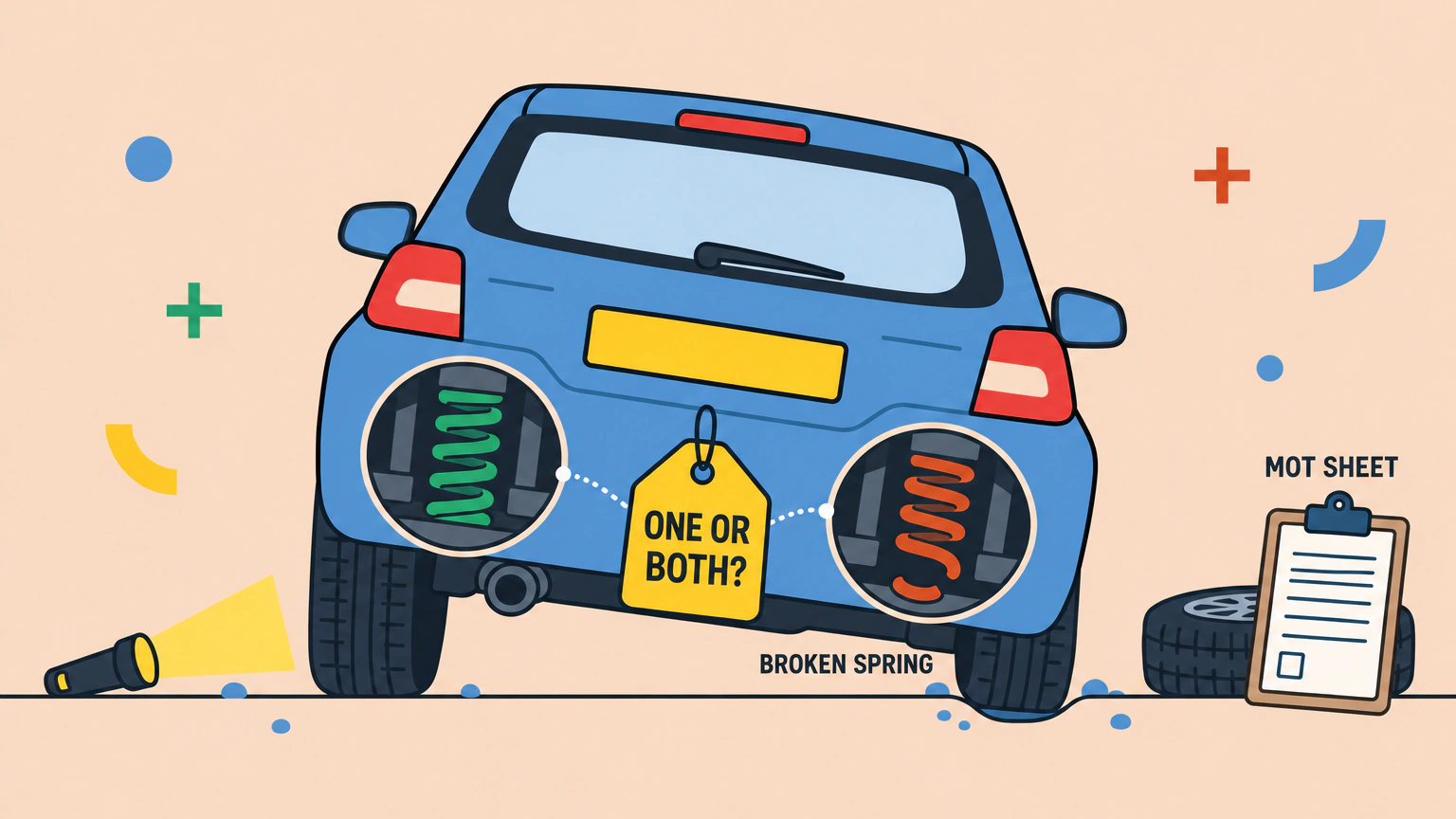
Replacing one coil spring at a UK garage usually costs about £110 to £280 fitted. The pair on one axle runs about £175 to £400, so the first question for any quote is which of the two it covers. On an MOT in Great Britain, "coil spring corroded" is an advisory, not a fail. "Fractured or broken" is a major defect and a fail, though the manual doesn't class it as dangerous.
Three things decide where your quote lands. A front spring costs more than a rear one, because of how it's fitted. The big price sites don't price the same job, so their averages don't compare straight. And labour can cost more than the spring itself.
Why the big price sites don't agree
Look up coil spring replacement cost online and you'll find five numbers that don't agree, mostly because each site prices a different unit.
| Who publishes it | The figure | What it prices | Where it comes from |
|---|---|---|---|
| Fixter, booking page | £111 to £221 front, £111 to £206 rear | One spring, at one corner of the car | Fixter's own price range, headed 2025 |
| Fixter, price guide | £170 to £280 front, £134 to £210 rear | One spring, going by its wording | "Our research", updated November 2025 |
| ClickMechanic | £248 average, £175 to £400 | The pair on one axle | Its own price estimates |
| FixMyCar | £218.47 average, £212.97 rear, £288.58 front | A coil spring job, and it doesn't say how many springs | FixMyCar's own data |
| GSF Car Parts | £250 to £450 | The pair on one axle | A parts retailer's guide that cites another site's guide |
Fixter prices one spring at one corner, though its booking page says £111 to £221 for a front and its price guide says £170 to £280. That's one company giving two answers. ClickMechanic's £248 average is for the pair on an axle. FixMyCar's £218 is an average job, and it doesn't say how many springs went into it. The RAC's guide quotes FixMyCar's figures and credits them, so that's the same number twice, not a second opinion. GSF's £250 to £450 is per axle, and it leans on another site's guide.
So one spring at one site can look dearer than two at another, and nobody's lying. Before you compare anything, ask the garage one question. Is this quote for one spring, or both on that axle?
Where the money goes on one front spring
Most of a broken coil spring repair cost is labour, and a simple sum shows why. A Kilen front spring for a Ford Fiesta was listed at £37.39 at Autovaux, a UK motor factor, when we looked. Fixter found garages charging £72 an hour outside London and £78 in it. It says a front spring takes one to three hours, two on average, against one to one and a half at the rear. ClickMechanic's times agree.
| Time on the job | Labour at £72 an hour | Spring | Total |
|---|---|---|---|
| 1 hour | £72.00 | £37.39 | £109.39 |
| 2 hours, Fixter's average for a front | £144.00 | £37.39 | £181.39 |
| 3 hours | £216.00 | £37.39 | £253.39 |
Fronts take longer because the spring usually sits around the strut, as GSF explains. The strut comes off, the spring is compressed and the unit is rebuilt. Compressing the spring is the risky step. Many rear springs sit on their own.
Fixter puts the average spring from one big parts chain at £109. Swap that in and each total rises by about £72, to £181, £253 and £325. It's a sum from two published figures, not a quote, because garages price parts their own way. For a real number on your car, ask local garages to quote on the same basis.
What pushes a quote up
Extras found while the strut is apart come first, such as worn top mounts and bump stops. A collapsed spring can let the suspension crash into the bump stop, so replacing it can be honest work. Ask whether the parts were found worn, though. A missing bump stop rubber isn't even an MOT fail.
Kilen, the spring maker, recommends checking the wheel alignment after any spring is replaced. Ask whether your car needs it and whether it's priced in.
The car and the town matter too. FixMyCar's averages by make run from £218.17 for a Vauxhall to £361.99 for a BMW. ClickMechanic's run from £243 in Sheffield to £337 in Bristol.
Our own cost profiles for suspension and shock absorber repair, 617 of them, put a fair price at £864 to £1,221. That's a much bigger job. If a quote for one broken spring is heading that way, ask what else is on it.
What your MOT sheet is telling you
The tester doesn't write that line on your sheet. They pick it from a fixed menu, and DVSA publishes the menu. The sheet then adds the corner: nearside or offside, front or rear. Here are the main coil spring lines a tester can choose, under the Great Britain rules.
| What the sheet says | Result | Category | What it means |
|---|---|---|---|
| Coil spring corroded | Not a fail | Advisory | The tester saw rust but judged the spring still strong enough |
| Coil spring corroded so that its cross sectional area is reduced and seriously weakened | Fail | Major | Rust has thinned the wire enough to weaken the spring |
| Coil spring fractured or broken | Fail | Major | Cracked or snapped. The menu has no advisory and no dangerous version of this line |
| Coil spring insecure | Fail | Major | The spring didn't sit back in its seat when the car was lowered |
| Coil spring missing | Fail | Major, or Dangerous if directional control is affected | The spring is gone altogether, as when a broken one falls out |
| Coil spring mounting fractured, or corroded and seriously weakened | Fail | Major | The fault is in the seat or mount that holds the spring. A mount loose enough to see moving is Dangerous |
These are the Great Britain rules: section 5.3.1 of DVSA's MOT inspection manual, with the wording from DVSA's own list of test defects. Your sheet adds the corner, such as nearside rear. In Northern Ireland, cars are tested at DVA centres.
"Coil spring corroded" is an advisory, not a fail
If that's the only spring line on your sheet, you can breathe out. An advisory isn't a fail, and a car with nothing worse listed has passed. The manual says so plainly: "When an item is not sufficiently deteriorated to justify rejection, there may be an option to select 'advisory' to inform the presenter of this fact."
In DVSA's list, "corroded" is the advisory attached to the major defect "corroded so that its cross sectional area is reduced and seriously weakened". So the line means the tester saw rust and judged the wire still thick enough. There's no gauge for it. The manual tells testers to use their "knowledge, experience and judgement".
What do you do with it? Nothing urgent. Have a look at that spring with a torch, and expect the same question again next year. And you're far from alone. Type "rear coil spring corroded" into Google and it offers to finish the line with "nearside and offside".
"Fractured or broken" is a major fail, not a dangerous one
This is the line that decides your week, and most pages either skip its category or get it wrong. The manual's wording is "A spring or spring component fractured or seriously weakened", and the category beside it is Major. The manual defines both categories itself. Major defects "may prejudice the safety of the vehicle". Dangerous ones are "a direct and immediate risk to road safety".
The tester's menu has no dangerous option for a fractured coil spring. For springs, Dangerous is kept for three things: a spring missing with directional control affected, fixings or a mounting loose enough that movement is visible, and a modification that leaves the suspension inoperative. ("A spring main leaf fractured" is dangerous too, but that's a leaf spring, the stacked kind used on many vans.)
A tyre rubbing on the car has its own line, also Major, and the manual says to fail it only "if the tyre is fouling a part of the vehicle at the time of test". And here's one for anyone being upsold: "A missing bump stop rubber is not a reason for rejection."
Why fuss over one word? Because the category printed beside the defect decides whether the car may leave.
Can you drive with a broken coil spring?
GOV.UK's rule is short. You can take the car away if "your current MOT is still valid" and "no 'dangerous' problems were listed in the MOT". A broken coil spring is a major defect, so on paper a car with an in-date certificate may leave.
Then comes the catch. The car "must still meet the minimum standards of roadworthiness at all times". GOV.UK's £2,500 fine, ban and three points are for a dangerous problem. If the old certificate has run out, the only trips allowed are to have the failed defects fixed or to a pre-arranged test, and the car must still be roadworthy "or you can be fined".
Our position is plain. We wouldn't drive on it, because the broken end sits right next to the tyre.
- Look at the inside wall of the tyre on that corner for a cut, a bulge or a freshly rubbed patch.
- Check whether that corner sits lower than the other side, and whether anything is touching the tyre.
- Read the MOT sheet. If anything on it is marked dangerous, the car stays where it is.
- If the tyre is marked or the corner has dropped, don't drive it. Book recovery or a mobile mechanic.
- A clear tyre and a nearby garage do not prove the car is roadworthy. If the spring is broken, book recovery or a mobile mechanic.
If the car shouldn't move, call vehicle recovery or a mobile mechanic. The RAC says its mobile mechanics replace suspension springs at drivers' homes. Our guide to what a mobile mechanic can do on your drive explains why some take the job on and others won't. The full drive-away and retest rules are in our guide on whether you can drive after a failed MOT.
We can't see your car from here. If a mechanic who has looked at it tells you not to drive it, that outranks anything on this page.
Why springs snap, and where to look on your own car
A broken spring can hide near the end of the coil, where you won't spot it from the kerb. Knowing where to look helps you check your own.
Salt, water and the bottom coil
Carmakers have said where some of their springs could break, in their own recall notices on DVSA's list. Fiat warned that plastic shields "fitted to the bottom of the front suspension coil springs may permit the accumulation of a high level of humidity". Add "salt and small stones" and the spring could break, tearing the tyre "as a result of the fractured coils contacting the tyre wall".
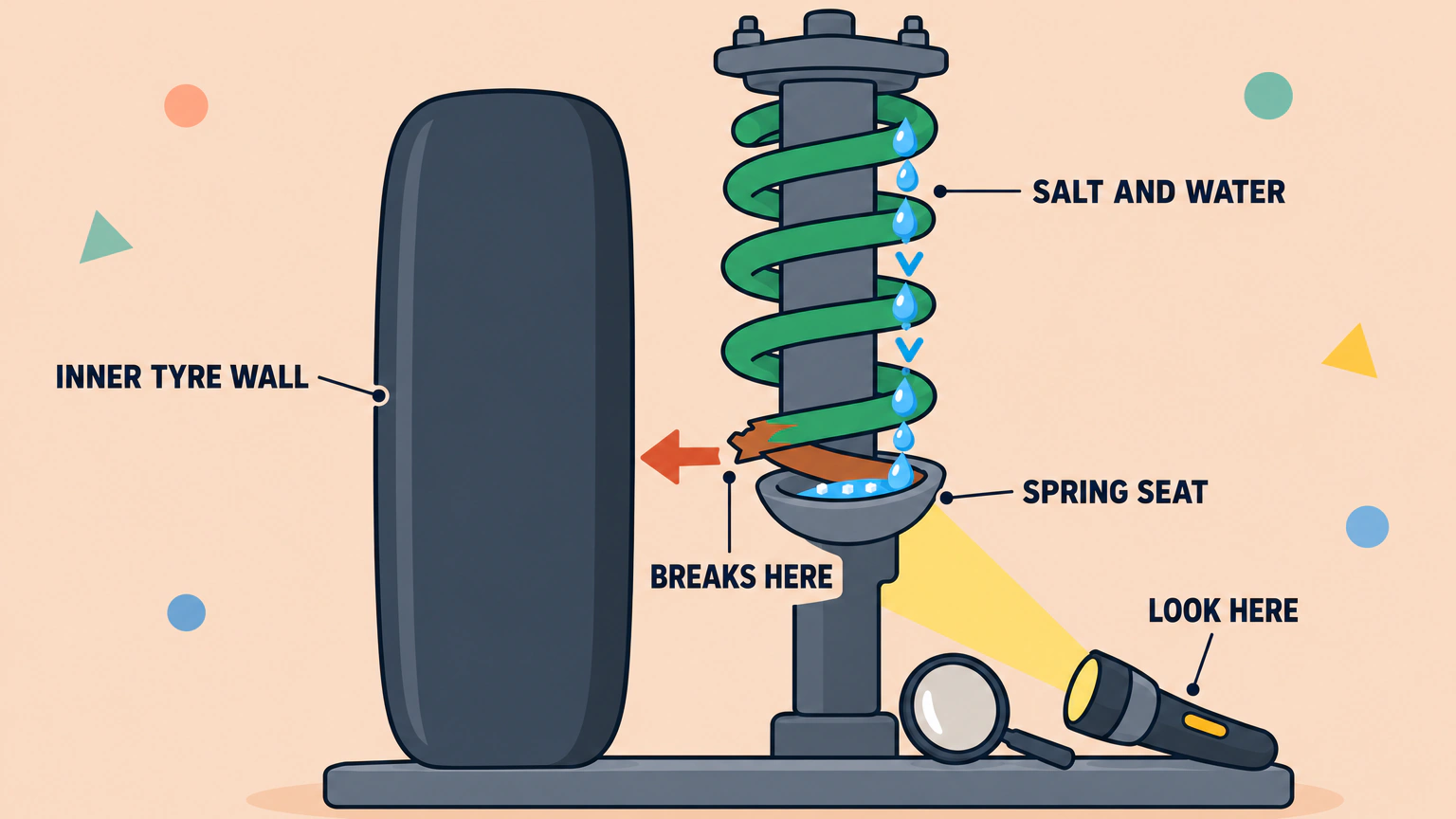
Rover said a broken spring "may in exceptional circumstances damage the inside wall of the tyre". Peugeot blamed a paint layer with "very little resistance to corrosion" in countries "where salt is used extensively on the roads".
This wasn't one bad batch. On the DVSA list we read, fourteen recalls from seven makes between 1993 and 2006 covered 462,026 cars and small vans, all for front springs that could break. Seven of the notices blame corrosion, road salt or trapped moisture. Twelve name the tyre as what gets damaged. In 2005 alone, Peugeot and Citroën recalled more than 300,000 vehicles to fit a cup that keeps a broken spring off the tyre.
Then something has to finish the job. The RAC attended 26,048 breakdowns in 2025 caused by damaged shock absorbers, broken suspension springs or distorted wheels, about 71 a day. Between April and June 2025, broken springs topped that list, with 4,779 of the 6,575 call-outs. The first three months of the year, the RAC says, are "always the worst for pothole-related breakdowns". A small crack lets water in, and rust does the weakening over years. A pothole or a speed bump finishes it.
How to check a spring with a torch
Broken coil spring symptoms can point to one corner: a clunk over bumps, a lean or uneven tyre wear. Start with a torch. Turn the front wheels to full lock, with the engine off and the handbrake on. Shine the torch into the arch and follow the spring down to where the bottom coil sits in its seat. A break can hide there.
The RAC says a broken spring shows a fractured end, a distorted shape or rust around the break. If the end of the coil is missing, a piece has dropped off. Check the top too.
Then run the torch over the inside wall of the tyre for a cut, a bulge or a rubbed patch, and compare the gap between tyre and arch on both sides. The spring sets how high the corner sits, so a low corner points at the spring, not the shock absorber. Don't jack the car or touch the spring. A hum that rises with speed is a different fault, covered in our guide to wheel bearing noise.
One spring or both?
The case for a pair comes from spring makers. Kilen puts it like this: "When only 1 spring is replaced across an axle, the life expectancy of the other spring will decrease and the car may be imbalanced." It lists uneven ride height and extra tyre wear among the effects. Springs also sag with age, as the RAC notes, so a new one beside an old one sits higher.
Some price guides go further and call replacing just one "not possible", or even "dangerous". Those blanket claims go too far. The MOT doesn't require a pair and judges each spring on its own.
Here's where we land. On a car old enough to have rusted through one spring, we'd change both on that axle, because the other has had the same winters. On a young car, or where the other side was replaced recently, one is a fair call. Either way, the garage should tell you what the other spring looked like.
Three checks before you pay
Each takes minutes, and one of them can make the repair free.
Is it a recall?
GOV.UK's recall check takes a registration number and shows "safety recalls that have not been checked or fixed". For a recall, GOV.UK says, "You will not usually have to pay for any repairs or parts."
Now the honest odds. The big spring recalls ran from 1993 to 2006, so the cars they covered are at least twenty years old now. Since then, spring recalls have included small batches of new vehicles with a build fault. One June 2026 recall covered 169 Dacia Bigsters with rear springs that "could lead to breakage". So expect a no. It's still a minute well spent before you pay a bill.
Is the car under warranty? Keep the broken spring
A Motor Ombudsman case shows why. A driver bought a new pick-up in April 2017. In December 2021 a dealer found a rear coil spring missing, and the bill came to nearly £500. The maker's rules said the failed part had to be inspected before a warranty claim could go in. The spring was gone, so no claim went in, and the adjudicator found the dealer had done nothing wrong.
So if your car is under any warranty, ask the garage to keep the broken spring, and say so before work starts. A warranty covers a manufacturing fault, and the old part is your evidence. If your quarrel is with the garage rather than the carmaker, read our guide on how to complain about a garage.
Did a pothole do it?
Report the hole first. GOV.UK's "Report a pothole" page takes a postcode and points you to the local council in England or Wales, while National Highways covers motorways and the A roads it manages in England. Scotland and Northern Ireland have their own routes. Keep photos of the hole and the damage, a note of the place, date and time, the invoice and the broken spring.
Be realistic about a claim. In England and Wales, the highway authority has a duty to maintain the road. It also has a defence if it can prove it took "such care as in all the circumstances was reasonably required". The court asks, among other things, whether the council knew or should have known about the danger. A council that kept the road properly and didn't know about the hole can win.
Six questions to ask the garage
A good garage will answer all six without fuss. Ask them before you book, and write the answers down.
- Is this price for one spring or for both on that axle?
- What did the spring on the other side look like when you checked it?
- Are top mounts or bump stops on the quote because you found them worn, or because the strut is apart?
- Does my car need its wheel alignment checked after this job, and is that in the price?
- Is VAT included?
- Can I have the old spring back?
Then get a second quote on the same basis from steering and suspension specialists near you.
Coil spring questions, answered
Is a broken coil spring an MOT failure?
Yes. In Great Britain the tester records it as "fractured or broken", a major defect, and the car fails. It isn't one of the defects the manual classes as dangerous. A spring that's only rusty usually gets the advisory "coil spring corroded", which is a warning, not a fail.
How long does it take to replace a coil spring?
Usually between one and three hours. ClickMechanic puts a front job at about two hours and a rear one at about an hour, and Fixter's figures are much the same. Fronts take longer on most cars because the strut has to come off and the spring has to be compressed before it can be swapped.
Do coil springs have to be replaced in pairs?
The MOT doesn't require a pair and judges each spring on its own. Spring makers and most price guides recommend changing both on the same axle, because an old spring sits lower than a new one. On an older car we'd do both. Either way, make sure you know whether your quote is for one spring or two.
Is a broken coil spring covered under warranty?
It can be, if the maker accepts that the spring failed through a manufacturing fault. The maker may want to inspect the part before it decides. In one Motor Ombudsman case, a claim couldn't even be submitted because the spring was missing. So if your car is under warranty, ask the garage to keep the broken spring.
Why do coil springs break?
A spring can break after corrosion weakens it and a hard knock finishes the job. Carmakers' recall notices describe road salt and moisture collecting near the bottom of some front springs. Between April and June 2025, the RAC says broken suspension springs topped its three pothole-related categories.
Will "coil spring corroded" fail my next MOT?
Not by itself. The advisory means the tester saw rust but judged the spring still strong enough. It becomes a fail only when corrosion has thinned the wire enough to seriously weaken it, or when the spring cracks. There's no rust gauge for this, so it comes down to the tester's judgement on the day.
What is a coil spring on a car?
It's the steel spring at each wheel that holds the car up and soaks up bumps. Most cars have four. At the front it usually sits around the shock absorber as one strut. At the back it's often separate. The spring sets how high the car rides, which is why a broken one makes a corner drop.