

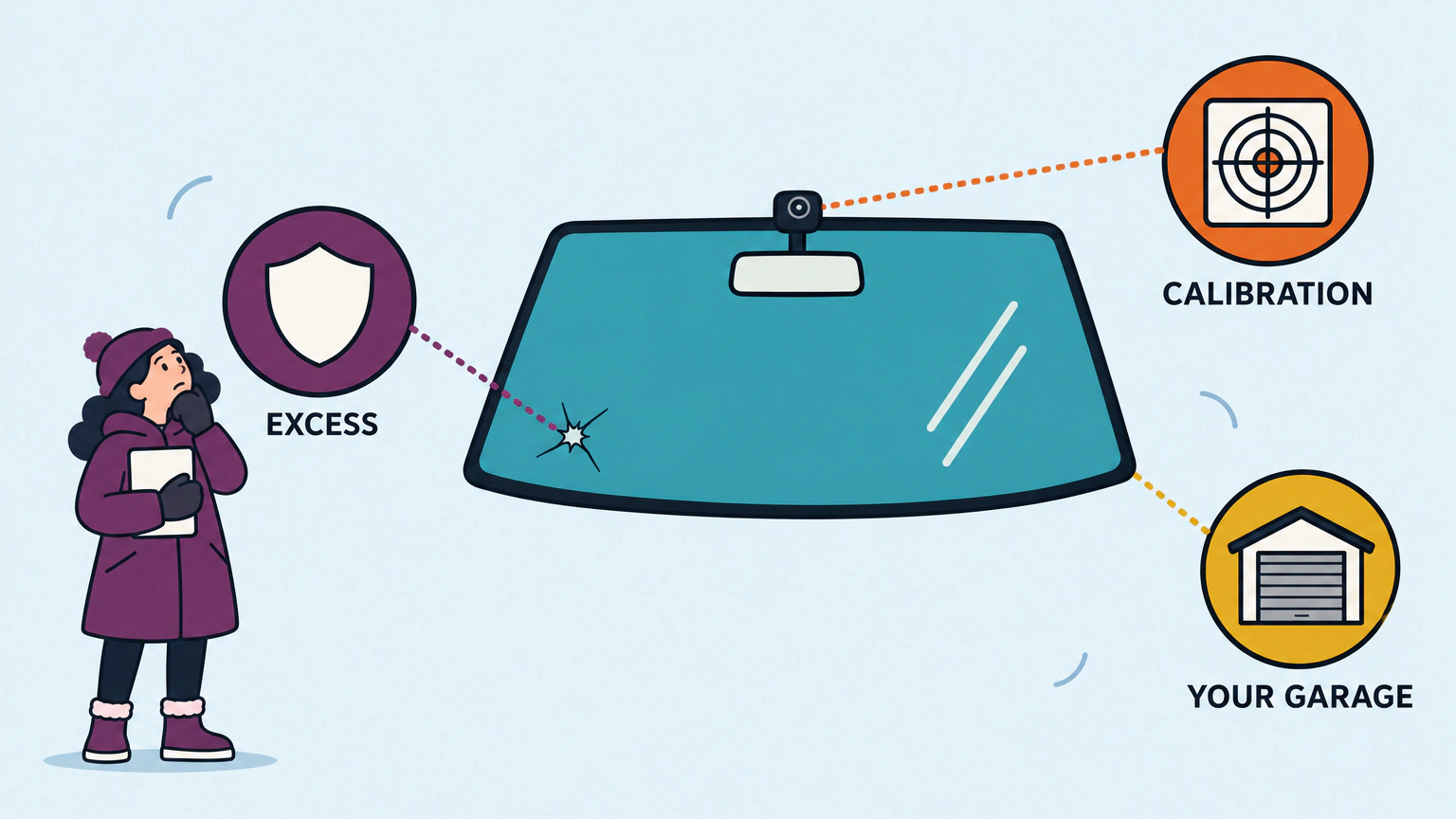
Pay yourself and a replacement windscreen averages £343.83 through FixMyCar. Claim on a comprehensive policy and you usually pay only the glass excess, as long as the insurer's own glass firm does the job. That's £115 for a replacement at Admiral and on Aviva's Signature cover. Choose your own garage or the dealer instead and the policies we read cap their contribution, at £50 towards a replacement in Admiral's case. And a car with a camera on the windscreen also needs a calibration, which several insurers include.
The route you take decides the bill, so start with the plain price.
On this page
- What a new windscreen costs if you pay yourself
- What you pay if you claim on your insurance
- Using your own garage or the dealer: the cap that catches people out
- The camera behind your mirror needs recalibrating
- Repair or replace: where the damage sits decides it
- Will a cracked windscreen fail the MOT, and can you drive on it?
- Before you book: eight things to check
- If the new windscreen leaks or the camera plays up
- Windscreen replacement questions
What a new windscreen costs if you pay yourself
FixMyCar puts the average replacement booked through its site at £343.83, and the make matters more than you'd think. A Ford averages £221.33, a Renault £530.10. The RAC's own guide tells drivers to expect between £150 and £500.
| Make | Average replacement price |
|---|---|
| Ford | £221.33 |
| Citroen | £224.50 |
| Peugeot | £236.17 |
| Vauxhall | £273.99 |
| Volkswagen | £297.89 |
| MINI | £310.40 |
| BMW | £391.67 |
| Nissan | £391.94 |
| Mercedes | £412 |
| Audi | £486.88 |
| Renault | £530.10 |
| All makes | £343.83 |
Make averages are FixMyCar's, from windscreen replacements booked through its site, and RAC's July 2026 table prints the same figures rounded to the pound.
Within one make, the windscreen replacement cost is mostly down to what's built into the glass. Aviva lists cameras and sensors that need calibrating after a replacement, plus built-in radio antennas, heating, and sensors that switch on the lights or wipers. All of them push the bill up. At the top end, the British Insurance Brokers' Association warns that windscreens "can cost over £1,000".
What dealer and own-choice bills looked like in ombudsman cases
The Financial Ombudsman Service publishes its decisions, and the windscreen ones show what people faced off the insurer's route. In a 2025 Churchill claim, a main dealer charged £741.60 to fit the carmaker's own glass. In a 2023 case, a dealer's garage charged £462 in all: £125 from U K Insurance, plus the £337 balance the ombudsman ordered it to pay.
The rest were quotes. An Admiral customer put his at about £1,300, and an Aviva customer found a repairer who'd fit a screen within a day for £550. A dealership told one couple it could do the job for "around £1,000", which the same decision later calls £1,400.
None of that is a price list. It's what happens when an insurer's cap meets a garage invoice.
What you pay if you claim on your insurance
Glass cover is usually its own section of a comprehensive policy, with its own excess. Defaqto's figures, published by GoCompare, find windscreen cover standard on 92% of comprehensive policies. For a repair, 24% charge no excess and a further 61% charge between £20 and £49. A replacement costs you more, and 84% of policies charge £70 or more for one.
Third party, fire and theft is another matter. Direct Line, Churchill and AXA leave glass out of it, and Swinton doesn't include windscreen cover at that level either. Admiral sells it as an extra on its third party policies, and it isn't standard on the Essential tier of its comprehensive cover. So check the glass section, not just the word "comprehensive".
What six providers' policy wording actually says
We read six providers' own documents, glass section by glass section. Where a booklet wouldn't open, we used the provider's windscreen page or an ombudsman decision that quotes its policy.
| Provider | Glass excess | If you use your own glazier | Camera calibration | Glass they may fit | No-claims discount |
|---|---|---|---|---|---|
| Admiral | £25 repair, £115 replacement | Pays up to £25 a repair or £50 a replacement, after the excess | Covered when required. Losses linked to driving without a needed one are excluded | Non-carmaker glass of similar standard and quality | Windscreen payments don't affect it |
| Aviva Signature | £10 chip repair, £115 replacement | A limit on your schedule. It was £50 in one 2024 ombudsman case | Its page says cameras need calibrating, not who pays | Suitable parts not from the original manufacturer | Its windscreen page doesn't say |
| Direct Line and Churchill | On your car insurance details. A 2025 Churchill case showed £115 | A limit on your car insurance details. £125 in that case | Covered where it relates to the windscreen job | Glass made to OEM standards | A glass-only claim keeps your NCD |
| esure | On your schedule. A repair means a smaller excess | The most it pays is £100 | Covered for electronics linked to the windscreen | Its glass section doesn't say | A windscreen claim doesn't affect it |
| AXA | On your schedule | Limited to £175 | Its glass section doesn't mention it | Parts not made by the carmaker | Not affected if glass is the only damage |
| Swinton | £25 repair, £125 replacement | A £200 excess, then at most £100 | Its windscreen page doesn't say | Its windscreen page doesn't say | Windscreen claims don't count against it |
From each provider's own documents: Admiral's Your Car Insurance Guide and windscreen guide, Aviva's windscreen page and a 2024 ombudsman decision quoting its booklet, the December 2025 Direct Line and Churchill booklets and a 2025 Churchill ombudsman decision, esure's 2025 policy booklet, AXA's June 2024 policy booklet and Swinton's windscreen page. Your own schedule beats all of them.
Before you lean on any of it, three points. Your schedule, not the booklet, often holds the excess and the own-glazier limit. Swinton is a broker (its page names the insurance intermediary behind it), so its figures describe its own product. And Direct Line and Churchill both name U K Insurance as the insurer, with one glass wording between them.
The excess and the own-glazier limit matter most, and they tell the same story for all six. Use the insurer's glass firm and you pay the excess. Go anywhere else and the contribution is capped, however big the bill.
Does a windscreen claim touch your no-claims discount?
Not on any wording we read that mentions it. Admiral lists "payments made for windscreen damage" among the claims that don't affect the bonus. Direct Line, Churchill, esure, AXA and Swinton say the same. Autoglass's insurance page agrees that a claim "will not reduce your No Claims Bonus".
Two catches. First, it's still a claim. Direct Line's protected NCD section warns that a premium "may increase if a claim is made even if the NCD isn't affected". Second, the ombudsman has said glass claims "aren't always considered" in claims history, which means sometimes they are. Aviva's windscreen page tells drivers to let a new insurer know about one. So when a quote form asks about past claims, answer the question as it's written.
Using your own garage or the dealer: the cap that catches people out
The dealer can fit the screen tomorrow. The insurer's glass firm can't come until next week. Booking the dealer feels like the obvious fix, until you see what your policy pays towards a garage it didn't choose. Put one £600 quote through five wordings and the gap is plain.
| Policy wording | Through the insurer's glass firm, you pay | At your own garage, the insurer pays at most | So the £600 bill leaves you paying at least |
|---|---|---|---|
| Admiral | £115 excess | £50 | £550 |
| Swinton | £125 excess | £100, after a £200 excess | £500 |
| esure | The excess on your schedule | £100 | £500 |
| AXA | The excess on your schedule | £175 | £425 |
| Churchill, 2025 ombudsman case | £115 excess | £125 | £475 |
The £600 quote is our own round example, not a price from any source. Each row assumes the insurer pays its full limit.
Through the insurer's route, where the excess is published, you'd pay £115 to £125. At your own garage you'd pay at least £425 of the same bill. Admiral's wording is the clearest: "If the repair or replacement is not arranged through our glass helpline, and costs more than your excess, we will pay up to" £25 for each repair and £50 for each replacement.
In most of the decisions we read, the ombudsman let a clear cap stand. In 2023 it backed Admiral's £50 against a driver's quote of about £1,300, finding the terms clearly explained. In 2024 it backed Aviva's £50 against a £550 quote: the limit was "clearly set out" on the schedule, and the 11-day wait for Aviva's own fitter "wasn't unreasonable".
We're not your insurer, and we've only read these providers' standard wording. Your own schedule decides what you're owed, so read it before you book.
When the ombudsman said the cap wasn't fair
Two decisions went the driver's way, both against U K Insurance.
In the 2023 case, the insurer's supplier had no screen and couldn't give a date. The driver waited three weeks with a crack about 200mm long and spreading. She stopped using the passenger seat for safety, then had her dealer's garage fit one. The insurer paid its £125 limit and blamed a global shortage, but the garage had found a screen straight away. The ombudsman ordered the insurer to cover the full cost, subject to any excess. "Insurers have a duty to deal with claims promptly," the decision says.
In the 2024 case, the insurer's agent needed two weeks, and the couple were due to drive abroad on holiday the week before that. Their local dealership could fit a screen at once for around £1,000 (the decision later puts it at £1,400). They hired a car for £2,500 instead, which the ombudsman wouldn't make the insurer refund. It still ordered £1,000 towards their costs. For distress it added £200 to the £150 already offered, taking compensation to £350.
The cases that failed look different. One Admiral driver cancelled the insurer's appointment, went to the carmaker's dealer and was offered £50. Preference didn't move the ombudsman. Necessity did.
Pro tip: Ask before you book. Tell the insurer the date its glass firm offered and why that wait doesn't work for you, then ask it to approve your own garage in writing. In both ombudsman cases that went the driver's way, the insurer's own glass firm couldn't fit the screen in time, and the wait mattered.
Will non-genuine glass hurt your car's warranty?
That worry is the usual reason people go to the dealer. Four of the wordings say plainly the glass may not be the carmaker's own. Admiral may use glass the carmaker didn't supply but "of a similar standard and quality". Direct Line and Churchill fit glass made "to Original Equipment Manufacturer (OEM) standards". AXA allows "parts that have not been produced by the vehicle manufacturer", Aviva "suitable parts not supplied by the original manufacturer".
The ombudsman treats that as fair "unless the manufacturer requires that only a genuine or approved replacement windscreen is used for safety or warranty reasons". In a recent Admiral case, a carmaker's dealer had emailed the driver that an aftermarket windscreen "will not void your warranty". It added that a fault the windscreen caused wouldn't be covered. In the Churchill case, the ombudsman couldn't find the dealer's claimed exclusion on the carmaker's own list.
So ask the carmaker, in writing, whether it requires genuine glass. Expect a dealer to recommend original glass on a camera car. If you go aftermarket, what matters is a reputable brand, clear optics and a camera bracket placed exactly where the original sat.
The camera behind your mirror needs recalibrating
Plenty of newer cars read the road through the windscreen. A camera behind the mirror feeds features such as lane departure warning, autonomous emergency braking and road sign detection, all on National Windscreens' list. Fit new glass and the camera moves with it.
Why new glass means a new calibration
National Windscreens says calibration "is always required after windscreen replacement" on cars with windscreen-mounted cameras. The camera's bracket comes bonded to the new glass, so the camera sits wherever the new screen puts it. Calibration is how it learns that position.
There are two ways to do it. About three in four cameras, National Windscreens says, need a static calibration in a workshop: level ground, good light and target boards set at the carmaker's distances and heights. A dynamic calibration is done on the move. Many won't start until the car is doing about 40mph on a road with clear markings and signs. The tyre pressures get checked first, because they change how the car sits.
Thatcham's code of practice, as the Institute of the Motor Industry describes it, has the repairer record the date, the equipment and "certified evidence of the calibration results". Autoglass puts it plainly: "we strongly recommend getting a recalibration after a replacement windscreen". Whether a driveway fitter can do it depends on the car and the kit. Our guide to what a mobile mechanic can and can't do explains more.
What calibration costs, and who pays
Claim on your insurance and it's usually covered. Defaqto found 69% of comprehensive policies include cover for recalibration, and Admiral, Direct Line, Churchill and esure all name it in their glass sections. Admiral's general exceptions add a sting. It won't pay for loss, damage or liability that comes from driving the car after you've turned down a camera recalibration that was required or recommended. Skip one and keep driving, and a later claim could suffer for it.
If you're paying yourself, one calibration specialist charges £162 including VAT for a front camera at its centres, plus £54 for a diagnostic pre-scan when the job needs one. The same firm says Volkswagen dealer quotes its customers have shown it run £300 to £900 for ADAS work. Whoever fits the glass, get calibration written into the quote, because it isn't cheap.
Repair or replace: where the damage sits decides it
BSI lists BS AU 242b:2022 as the current UK repair standard. It replaced BS AU 242a:1998 after a year's overlap that ended in March 2023. As National Windscreens summarises it, zone A is a 400mm-wide area in front of the driver, centred on the steering wheel. A technician can consider repair there if the damage fits inside a 20mm circle. Elsewhere, in zone B, the limit is a 40mm circle. There's no repair at all in an area that supports a camera, so a chip there means a new screen. Some guides still print four repair zones with other limits, which isn't how the current standard divides the glass.
Catch a chip while it's small and clear of the camera, and car glass specialists can fill it rather than fit a new screen. FixMyCar says a minor chip repair can cost as little as £40.
Admiral lists "cold or hot weather putting stress on the glass" among the causes of cracks. esure tells drivers to claim "as soon as you spot a chip", because it "could quickly turn into a more expensive job". The Highway Code's rule 229 says you must be able to see before you set off, so clear all the snow and ice from your windows, and Northern Ireland's edition says the same. Scrape and use the blowers, not boiling water, which GoCompare warns can make a small chip worse. Then get the chip booked in before the frost gets to it.
Will a cracked windscreen fail the MOT, and can you drive on it?
You can drive on a damaged screen only while it doesn't block your view. In Great Britain the rule is regulation 30(3) of the Construction and Use Regulations 1986. Glass "shall be maintained in such condition that it does not obscure the vision of the driver while the vehicle is being driven on a road". Drive a car that has failed its MOT on a "dangerous" problem, GOV.UK says, and you can be fined up to £2,500, banned and given three penalty points. Using a vehicle with parts in a dangerous condition is endorsement code CU20, also three points.
Northern Ireland has its own construction and use regulations, and the MOT rule depends on which part of the UK tests the car.
The MOT rule in England, Scotland and Wales
DVSA's inspection manual is precise. Zone A sits in the swept area of the windscreen (the part the wipers clear), 290mm wide and centred on the steering wheel. The tester checks for damage more than 10mm across in zone A, and more than 40mm in the rest of the swept area. Both size checks stop where the wipers stop.
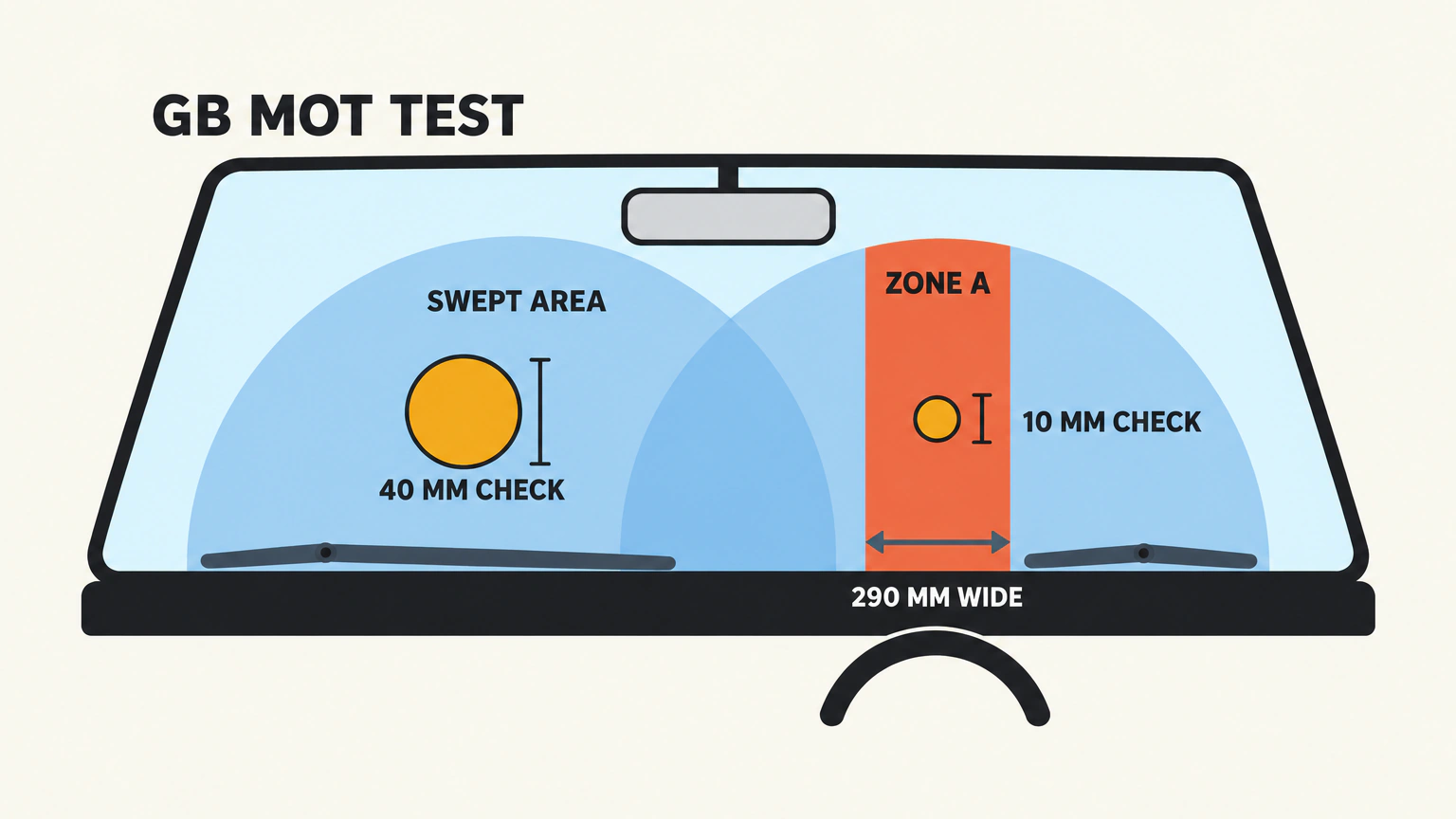
Two conditions matter as much as the millimetres. "Failure for damage is only justified if the damage significantly affects the driver's view of the road." And an "invisible" or barely detectable repair, finished flush with the glass, "does not count as damage". Damage that doesn't affect your view is a minor defect, and damage that does is major. If visibility through the swept area is "seriously affected", it's dangerous.
The MOT's zone A is 290mm wide and the repair standard's is 400mm, which is why "it's under 10mm" and "it can be repaired" are different answers. If the glass fails, take the car back to the same test centre by the end of the next working day. Windscreen glass is on GOV.UK's list of items retested free that way. Find MOT test centres near you to book, and our guide to driving after a failed MOT covers the rest of the retest rules.
Northern Ireland's test reads it differently
Northern Ireland tests cars at DVA centres, under its own Light Vehicle Inspection Manual. It uses the same 290mm zone A, centred on the steering wheel, and calls the rest of the swept area zone B. Then it drops the millimetres. Damage fails "if it impairs the driver's view of the road", and "a greater amount of damage or discoloration could be accepted in zone 'B' than in zone 'A'". A flush, barely visible repair doesn't count as damage there either, even if it's over the limit.
The NI manual adds two points of its own. A crack with noticeable displacement of the glass on either side, enough to affect the wipers, is a major fault. And a temporary windscreen on a car presented for test is a reason for rejection.
Before you book: eight things to check
Work down this list before you ring the insurer's glass line or book one of the windscreen fitters near you.
- Find your glass excess and your own-glazier limit on your policy schedule, not just the booklet.
- Ask the insurer's glass line for its first fitting date and note who told you.
- If that wait leaves the car unsafe or you've a trip booked, ask the insurer to approve your own garage in writing before you book it.
- Ask whether your car has a camera on the windscreen and whether calibration is in the price.
- Ask whether the calibration will be done in a workshop or on a road drive.
- Collect the calibration result or certificate when you collect the car.
- Ask which glass is going in, carmaker-branded or made to the carmaker's standard.
- Ask how long the fitting guarantee lasts and whether it covers leaks.
If the new windscreen leaks or the camera plays up
Which route you took decides who you chase. If you paid the fitter yourself, the Consumer Rights Act 2015 says the job must be done "with reasonable care and skill". If it isn't, you can require the fitter to do it again at its own cost, where that's possible. It must be within a reasonable time and without significant inconvenience. Our guide on how to complain about a garage takes it from there.
If your insurer arranged the work, complain to the insurer. It has up to 8 weeks for most complaints, and you then have 6 months from its final response to go to the Financial Ombudsman Service, which is free.
Don't sit on a leak. A badly sealed screen can let water into the cabin and cause electrical faults, so a fitter's guarantee is worth more than a small saving on the quote. Autoglass, for one, says its guarantee covers you "for as long as you own your vehicle".
If the camera plays up, check for a smeared screen or worn wiper blades first, since the system can switch features off when it can't see. Then go back to whoever calibrated it. And if you found the fitter through us, our guarantee means we'll work with you and the fitter in good faith to sort it out.
Windscreen replacement questions
Is a windscreen replacement classed as an insurance claim?
Yes, it's a claim on your policy, even though most glass wordings leave your no-claims discount alone. Direct Line's booklet says a glass-only claim won't cost you your NCD, while its section on protected NCD warns a premium can still rise after a claim. If another insurer's quote form asks about past claims, answer the question as it's written.
How much is a windscreen replacement if I claim on insurance?
Usually just your glass excess, as long as the insurer's own glass firm does the work. That's £115 for a replacement at Admiral and on Aviva's Signature cover, and £125 through Swinton. Defaqto's figures, published by GoCompare, found 84% of comprehensive policies charge £70 or more for a replacement. Your own figure is on your schedule.
Can I use my own garage or the dealer for a windscreen claim?
Yes, but expect a capped payout. Admiral pays up to £50 towards a replacement it didn't arrange, esure up to £100 and AXA up to £175. On a £600 dealer bill that leaves you paying at least £425. In the ombudsman cases we read, insurers were made to pay more when their own glass firm couldn't fit the screen in time and the wait mattered.
Does a new windscreen need calibrating?
If your car has a camera on the windscreen for lane-keeping or emergency braking, yes. National Windscreens says calibration is always required after a replacement on those cars, and about three in four cameras need it done in a workshop. Admiral, Direct Line, Churchill and esure include it in their glass cover. Ask for the calibration certificate when you collect the car.
Can I drive with a cracked windscreen in the UK?
Only if the damage doesn't block your view. In England, Scotland and Wales the law says windscreen glass must be kept so it doesn't obscure the driver's vision. If the car has failed its MOT on a dangerous defect, driving it can mean a fine of up to £2,500, a ban and three penalty points. Get a crack in your sightline seen to before you drive.
Will a chip in my windscreen fail the MOT?
Only if it's big enough and in the way. In Great Britain the tester checks for damage over 10mm across in a 290mm strip in front of the driver, and over 40mm elsewhere in the area the wipers sweep. Even then it fails only if your view is significantly affected. A flush, barely visible repair doesn't count. Northern Ireland's test uses no millimetre figures.
Does third party, fire and theft cover windscreen damage?
Usually not as standard. Direct Line's and Churchill's booklets leave windscreen cover out of third party, fire and theft, and so does Swinton. Admiral lets you add it to its third party policies as an extra. Defaqto's research, published by GoCompare, found 92% of comprehensive policies include windscreen cover.
Does a non-genuine windscreen void my car's warranty?
Not by itself, on the evidence the ombudsman has seen. In one recent case a carmaker's dealer wrote that an aftermarket windscreen "will not void your warranty", though a fault the windscreen caused wouldn't be covered. The ombudsman treats non-genuine glass as fair unless the carmaker requires genuine glass for safety or warranty reasons. Ask the carmaker to put any such rule in writing.